



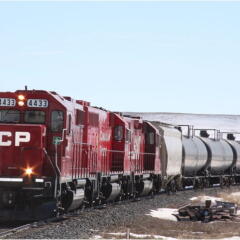
The future pace of crude-by-rail growth in North America may depend on rulings expected by the end of 2014 from the US Department of Transport (DOT) concerning rail tank car designs mandated to carry crude oil safely. The costs of replacing or retrofitting the existing tank car fleet to meet such new standards - designed to reduce the risks associated with recent high profile accidents - will pass to rail car lessors and crude shippers who will end up paying higher lease rates. Today in the first of a two part series we look at how the rail industry can comply with new tank car standards.
We have previously discussed the rail industry tank car safety debate following a series of tragic accidents involving crude carrying trains including the fatal derailment of a train at Lac-Mégentic in Quebec a year ago in July 2013 (see Could New Tank Car Rules Derail the Bakken Crude Boom?). There are a number of rail safety regulatory bodies. In the US, the DOT Pipeline and Hazardous Materials Safety Administration (PHMSA) establishes safety regulations relating to crude-by-rail transportation. In Canada, Transport Canada performs a similar function. In addition, the Association of American Railroads (AAR) Tank Car Committee (TCC) is a key participant in the setting of industry standards regarding the design and construction of tank cars.
The rail industry had already moved toward more stringent requirements for rail tank car design before the recent accidents. In 2011, the TCC asked PHMSA to adopt upgraded design requirements for new tank cars carrying hazardous materials such as crude oil (PHMSA Petition – 1577). These upgrades, known by the design standard CPC-1232, include thicker, more puncture resistant tanks, thicker walls at both ends of the tanks, and more protection for the fittings and valves on top of the rail cars. The new requirements would replace the majority of existing rail tank cars used to transport light sweet crude - built to a design known as DOT 111A. Rail tank cars constructed with insulation and heated coils and designed to carry heavy crude are already compliant with the new standards and not expected to be subject to new design requirements. (That means shippers of heavy Canadian oil sands bitumen crude blended for rail transport with reduced diluent – known as railbit or purebit – should not be impacted – see The Road to Market for Canadian Bitumen Crude). On January 11, 2014 the Canadian Government published rules that will go into effect in July, setting a new Canadian rail tank car standard called TP14877, based on the US PHMSA Petition – P1577. On May 7, 2014 PHMSA issued Safety Advisory 2014-01 strongly urging the phase-out of the older DOT-111 tank cars—but it did not require this by any certain date. On April 23, 2014 Canada ordered that older tank cars be phased out or retrofitted by May 2017 and that the least crash-resistant DOT-111 tank cars be removed from dangerous goods service within 30 days. The US DOT is expected to make a firm ruling on new tank car standards by the end of 2014 that could also require the retirement or retrofitting of DOT-111 tank cars within a limited timeframe. The AAR tank car committee has suggested that the DOT could decide on a safer design than the CPC-1232 by requiring thicker steel walls on all new tank cars.

About the song
“The Times They Are a-Changin’” was written by Bob Dylan and appears as the first song on side one on Bob Dylan’s third studio album of the same name. Dylan wrote the song to be an anthem for change. It became a rallying cry for the civil rights and anti-war movement in the U.S. in the 1960s and remains a timeless classic song of strength for troubled times. It was released as a single in the U.K. in 1965, where it went to #9 in the U.K. Singles chart. Surprisingly, it was not released as a single in the U.S. The song has been covered by many artists, including Peter, Paul and Mary; Joan Baez, The Byrds, Bruce Springsteen, and Brandi Carlile. In December 2010, Dylan’s hand-written lyrics of the song sold at auction at Sotheby's in New York City for $422,500. Personnel on the record were: Bob Dylan (lead vocal, acoustic guitar, harmonica).
The album, The Times They Are a-Changin', was recorded between August and October 1963 at the Columbia 7th Ave. studio in New York City and produced by Tom Wilson. Released in February 1964 (days after The Beatles appeared on Ed Sullivan), it went to #20 on the Billboard 200 Albums chart and has been certified Gold by the Recording Industry Association of America. No singles were released from the LP in the U.S.
Bob Dylan is an American singer and songwriter. He has been an iconic international figure in popular culture for over six decades and has released 40 studio albums, 16 live albums, 31 compilation albums, seven soundtrack albums, 24 EPs, and 102 singles. He is a member of the Rock and Roll Hall of Fame and the Songwriters Hall of Fame and is a recipient of Kennedy Center Honors, a Presidential Medal of Freedom, a Polar Music Prize, France’s Legion d’Honneur, and a Nobel Prize in Literature. Dylan is also known for his paintings, drawings and books. His most recent book, “The Philosophy of Modern Song,” contains essays on 66 songs by artists who have influenced him. Dylan still records and tours and is appearing with Willie Nelson, Robert Plant and Alison Krauss at the Outlaw Music Festival Tour in the U.S., which began in late June 2024 and continues through September 2024. Dylan’s archives are housed at the Bob Dylan Center in Tulsa, which opened in May 2022.





Comments
Sandy, as always a great overview of the issue. The California Energy Commission recently conducted a workhop on crude-by-rail (CBR) on June 25. Bill Finn of the Railway Supply Institute made a presentation that provided a good break-down of the rail tank car fleet (crude and ethanol), as well as projections for 2015. A link to that presentation is as follows:
http://www.energy.ca.gov/2014_energypolicy/documents/2014-06-25_workshop/presentations/Finn_PPT_Updated.pdf
A link to all the presentations is:
http://www.energy.ca.gov/2014_energypolicy/documents/2014-06-25_workshop/presentations/
Regards,
Gordon Schremp
Senior Fuels Specialist
California Energy Commission