


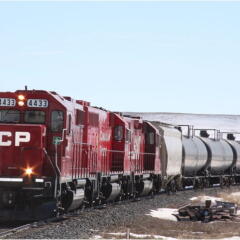
If as appears likely, US regulators impose new rail tank car safety standards by the end of 2014 including the phasing out of older designs, the cost for a new car could be as much as $150,000. Retrofitting older designs to meet new standards could range between $20,000 and $60,000 per car. The resulting higher lease costs, concerns about safety and lingering logistics issues from this past winter are leading to producers looking more favorably at pipeline projects. The latest data this week from North Dakota indicates crude-by-rail traffic out of that State fell by 11.5 % from 693 Mb/d in November 2013 to 614 Mb/d in May 2014. Today we look at the impact of these changes on future crude-by-rail traffic.
In Part 1 of this series we discussed new regulations from the US Department of Transport (DOT) Pipeline Hazardous Materials Safety Administration (PHMSA), expected by the end of 2014 that could impose new safety standards for rail tank cars that carry crude by rail. In April 2014 Canada ordered that older tank cars be phased out or retrofitted before May 2017 and that the least crash-resistant DOT-111 tank cars be removed from dangerous goods service within 30 days. These moves to increase safety standards follow a series of tragic accidents involving crude-carrying trains including the fatal derailment of a train at Lac-Mégentic in Quebec a year ago in July 2013. If as expected, new DOT regulations require the replacement of older DOT-111 design rail tank cars within a specific timeframe then the immediate impact will primarily be on the owners of tank cars – most of whom - 79 % - are lease companies with the rest being shippers. These owners will be required to pay for replacement or retrofitting – with added costs likely trickling down to shippers via increased lease fees.
We also looked at the size of the existing fleet of cars used for crude-by-rail shipments. After that post an RBN member sent us this link to a presentation by Bill Finn of the Railway Supply Institute Tank Car Committee at a recent California Energy Commission workshop on crude-by-rail. That presentation provides detailed breakdowns of the existing crude rail tank car fleet at the end of 2013 – 43,750 tank cars – 29,400 legacy DOT-111 design and 14,350 of the newer CPC-1232 design. There is also a 50,400 tank car backlog of factory orders (as of March 31, 2014) that will not be completed until the end of 2015. At that point production capacity of 28,000 new tank cars per year would be available to replace the existing fleet – a process that would take less than two years i.e. by 2017 without a rash of tank car orders in the meantime. In this episode we look at the cost of retrofitting older rail tank cars and the overall impact of the expected new safety regulations on crude-by-rail traffic.
Estimates of the cost of retrofitting DOT-111 rail tank cars to meet the CPC-1232 or higher standards that the DOT seems likely to impose by the end of 2014, fall in a wide range. That is because different existing designs require more or less work to update. The cost ranges we have seen quoted are between $20,000 and $60,000 to retrofit each tank car. New tank cars cost somewhere between $130,000 and $150,000 each and have a life expectancy of 35 years. Retrofit costs to bring existing DOT-111 tank cars up to spec would therefore be less expensive for newer tank cars than replacement cost. Older tank cars would likely be retired and replaced with new builds. We have seen various estimates of the cost per Bbl that retrofit or new tank cars would add to existing lease fees - ranging from 30 cnt/Bbl to a $1/Bbl extra - depending on the extent of retrofit and over what period of time the cost is spread (usually 10 years). In the short term, if the regulations require replacement or retrofit in a tight time frame, the cost of leasing would increase because there would be a shortage of compliant tank cars. Some industry pressure already exists to adopt the newer CPC-1232 standard. Railroads such as Canadian National are providing freight rate incentives to shippers that use tank cars built to the CPC-1232 standard. Midstream company Global Partners LP decreed that beginning June 1, 2014, it requires all oil shipments arriving at its facility in Albany, NY be transported in CPC-1232 tank cars.
Given that the cost of retrofit is lower than replacement, the ability of the rail tank car industry to adapt quickly to new regulations will somewhat depend on the available maintenance facilities that can perform upgrades. We posted a blog about a year ago describing the rail tank car maintenance business and how it is adapting to increased demand from crude-by-rail traffic (see Bad Orders in the Crude by Rail Market). Most maintenance involves field repairs to tank cars and federally mandated tank car certification every ten years. All the larger manufacturers and lease companies have maintenance facilities – only some of which could be used for retrofitting. Two industry stalwarts, Greenbrier and WATCO recently (June 4, 2014) announced a railcar repair joint venture in part in the expectation that new regulations will create a boom in retrofits. That joint venture, expected finalized in 3Q 2014, will comprise a railcar repair network of 38 locations across North America, including 14 certified tank car shops. Greenbrier also proposed its own safer “Tank Car of the Future” design (see Figure #1).

About the song
“The Times They Are a-Changin’” was written by Bob Dylan and appears as the first song on side one on Bob Dylan’s third studio album of the same name. Dylan wrote the song to be an anthem for change. It became a rallying cry for the civil rights and anti-war movement in the U.S. in the 1960s and remains a timeless classic song of strength for troubled times. It was released as a single in the U.K. in 1965, where it went to #9 in the U.K. Singles chart. Surprisingly, it was not released as a single in the U.S. The song has been covered by many artists, including Peter, Paul and Mary; Joan Baez, The Byrds, Bruce Springsteen, and Brandi Carlile. In December 2010, Dylan’s hand-written lyrics of the song sold at auction at Sotheby's in New York City for $422,500. Personnel on the record were: Bob Dylan (lead vocal, acoustic guitar, harmonica).
The album, The Times They Are a-Changin', was recorded between August and October 1963 at the Columbia 7th Ave. studio in New York City and produced by Tom Wilson. Released in February 1964 (days after The Beatles appeared on Ed Sullivan), it went to #20 on the Billboard 200 Albums chart and has been certified Gold by the Recording Industry Association of America. No singles were released from the LP in the U.S.
Bob Dylan is an American singer and songwriter. He has been an iconic international figure in popular culture for over six decades and has released 40 studio albums, 16 live albums, 31 compilation albums, seven soundtrack albums, 24 EPs, and 102 singles. He is a member of the Rock and Roll Hall of Fame and the Songwriters Hall of Fame and is a recipient of Kennedy Center Honors, a Presidential Medal of Freedom, a Polar Music Prize, France’s Legion d’Honneur, and a Nobel Prize in Literature. Dylan is also known for his paintings, drawings and books. His most recent book, “The Philosophy of Modern Song,” contains essays on 66 songs by artists who have influenced him. Dylan still records and tours and is appearing with Willie Nelson, Robert Plant and Alison Krauss at the Outlaw Music Festival Tour in the U.S., which began in late June 2024 and continues through September 2024. Dylan’s archives are housed at the Bob Dylan Center in Tulsa, which opened in May 2022.






Comments
If the regulators were sensitive at all to risk factors as well as to politics the regulators would allow far more permissive rules for the rail transport of bitumin and ban the rail transport of unstabilized Bakken crude.