Considerable time and effort has been spent tracking the federal government’s plan to spend billions of dollars to create a number of regional hydrogen hubs. News about the Department of Energy’s (DOE) hub-selection process has been hard to come by, especially since the potential applicants weren’t publicly disclosed at the time of the agency’s informal cutdown in late 2022 and many potential developers, for competitive reasons, have elected to play their cards very close to the vest. In today’s RBN blog, we’ll publish the DOE’s full list of 33 encouraged proposals for the first time, examine some of the plans that were combined in an effort to produce a stronger joint application, and share a little about the concept papers that didn’t make the DOE’s informal cut.
The U.S. has made clean hydrogen a priority, with the federal government’s Regional Clean Hydrogen Hubs (H2Hubs) initiative intended to accelerate the process. As we noted in Part 1 of this series, the DOE opened up $7 billion in funding in September 2022 for the development of several hubs. For the first stage of the hub-selection process, the DOE’s Office of Clean Energy Demonstration (OCED), which will administer the hydrogen-hub funding, required interested parties to submit concept papers about their planned projects. Of the 79 papers that were submitted, 33 were encouraged at the end of 2022 to submit a full application by the April 7 deadline. (Also note that projects that were encouraged to submit a full application were not required to do so, and projects on the discouraged list were still eligible to submit a full application.)
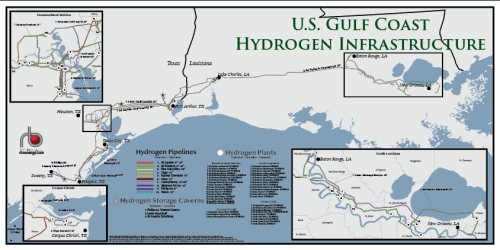
RBN’s U.S. Gulf Coast Hydrogen Infrastructure Map lays out the pipelines and merchant hydrogen plants that make up the gulf coast market, providing an unprecedented snapshot of the region’s hydrogen infrastructure network.
Clean hydrogen can be produced in a few different ways. It can be made by running water through nuclear- or renewables-powered electrolyzers, yielding hydrogen and oxygen. Separately, low-carbon hydrogen can be produced by running natural gas through SMRs or ATRs — steam methane reformers and auto-thermal reformers, respectively — and capturing and sequestering most of the carbon dioxide (CO2) emissions, resulting in low net lifetime greenhouse gas (GHG) emissions. A clean hydrogen hub, then, is “a network of clean hydrogen producers, potential clean hydrogen consumers, and connective infrastructure located in close proximity.” In our initial blog we were able to identify more than half of the projects that were encouraged by the DOE to submit a full application.
About the song
“The Contenders” was written by Ray Davies and appears as the first song on side one of The Kinks’ eighth studio album, Lola Versus Powerman and the Moneygoround, Part One. The song features a memorable slide guitar hook from Dave Davies and great blues harp from Ray Davies. Personnel on the record were: Ray Davies (lead vocals, rhythm guitar, resonator guitar), Dave Davies (lead guitar, slide guitar, banjo, backing vocals), John Dalton (bass, backing vocals), Mick Avery (drums, percussion), and John Gosling (piano).
Lola Versus Powerman and the Moneygoround, Part One, was recorded between April and September 1970 at Morgan Studio in London with Ray Davies producing. Released in November 1970, the album went to #35 on the Billboard 200 Albums chart. The concept album offered a satirical look at the music industry. Hunter Thompson once said that “the music industry is a cruel and shallow money trench, a long plastic hallway where thieves and pimps run free and good men die like dogs. There’s also a negative side.” That pretty much sums up Ray Davies’s take on managers, song publishers, unions, the press, and life on the road reflected in the songs on the LP. Two singles, including the Top 10 hit, “Lola,” were released from the album.
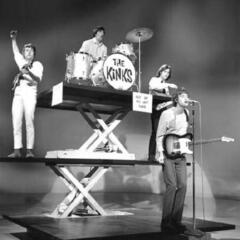
The Kinks were an English rock band formed in London by brothers Ray and Dave Davies. Twelve members have passed through the band, with Ray and Dave Davies being the only original members in the band during the Kinks’ entire 33-year run. They released 24 studio albums, six live albums, 32 compilation albums, 10 EPs and 78 singles. They are members of the Rock and Roll Hall of Fame, and the UK Music Hall of Fame. The band gave its last public performance in 1996 and officially broke up in 1997 due to creative tensions between Ray and Dave Davies. Both brothers have gone on to successful solo careers recording and touring.