The Corpus Christi crude oil market is pulling as much volume as it can from the Permian Basin via pipelines that are running nearly at capacity. That explains why two midstream companies are responding with plans to boost the capacities of their respective pipelines from the Permian to refineries and export terminals in the Corpus area. But the situation is complicated by the very real possibility that one or more deepwater export facilities capable of fully loading a Very Large Crude Carrier (VLCC) may be built off the Texas coast. In today’s RBN blog, we’ll examine current and proposed pipeline takeaway capacity out of the Permian and the potential for proposed offshore export facilities to impact pipeline flows from West Texas to the coast.
Before we get into this topic, let’s recap the highlights in Part 1 of this series. In that piece, we emphasized that producers must have sufficient takeaway capacity to handle their rising volumes of crude oil and associated gas. Gas takeaway constraints are already here, and the industry is eagerly anticipating the ramp up of a new pipeline: the 2.5-Bcf/d Matterhorn Express (see Life in the Fast Lane), which will come online later this year. However, still more gas takeaway capacity will be needed to keep up with the Permian’s growth trajectory (see our Around the Bend series) and several projects are in the running to provide that (see Come Dancing).

The Natural Gas Master Class is a one-day online event focusing on understanding flow analysis, interpreting pipeline data and forecasting future flows. This course is designed to equip you with the knowledge and skills to effectively analyze the complexities of natural gas markets, flow analysis, and pipeline modeling. Join us online
October 21 | Online
For crude oil, at first glance, Permian’s drillers would seem to have enough pipe capacity to send barrels out of the shale patch. After all, production now stands at about 6.3 MMb/d and total pipeline capacity out of the play totals 7.8 MMb/d (including about 1.2 MMb/d to Cushing, OK), leaving the basin with nearly 2 MMb/d of unused takeaway space once you account for about 400 Mb/d of in-region refinery demand. The catch — and there’s always a catch, right? — is that some destination markets are more attractive than others. Also, while Permian crude oil production growth has been relatively anemic for a while now (compared to its historic growth), it’s forecast to rise to near 7.8 MMb/d by 2035, a gain of 1.5 MMb/d.
Takeaway capacity from the Permian to Corpus Christi-area refineries and its export-oriented terminals is already constrained, largely because of shipper interest in moving barrels to the two facilities in Ingleside — across the bay from Corpus proper — that can partially load VLCCs, the preferred means for transporting crude to Asia. Enbridge Ingleside Energy Center (EIEC) and Gibson Energy’s South Texas Gateway (STG) are the nation’s #1 and #3 crude export terminals by volume this year, averaging 876 Mb/d and 576 Mb/d, respectively, through the week ended May 3 (Enterprise Houston was #2 at 755 Mb/d) according to RBN’s Crude Voyager report. Each facility can fill a 2-MMbbl VLCC to about two-thirds of its capacity before sending it out to the deeper waters of the Gulf of Mexico where smaller tankers top them off with reverse lightering.

Figure 1. Corpus Christi Crude Exports by Terminal. Source: RBN’s Crude Voyager
About the song
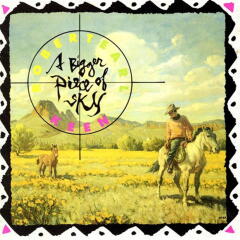
“Corpus Christi Bay” was written by Robert Earl Keen and appears as the ninth song of Robert Earl Keen’s fourth studio album, A Bigger Piece of the Sky. The song tells the story of two brothers working the oil rigs of Corpus Christi Bay and the adventures they encounter. The line from the song: “That life is contagious, and it gets down in your blood,” presents a credo of the oil rig worker. Personnel on the record were: Robert Earl Keen (lead vocal, acoustic guitar), George Marinelli (electric guitar), Tommy Spurlock (acoustic guitar, gut string guitar, steel guitar, lap steel), Gerry Tallent (bass), and Dave Durocher (drums, percussion, backing vocals).
A Bigger Piece of the Sky was recorded at The Board Room in Nashville during July 1992. Produced by Garry Velletri, it was released on Sugar Hill Records in October 1993. Many consider it Keen’s best album, bringing together a variety of Americana alternative country styles rooted in Texas music. The album was re-released on Koch Records in August 2004.
Robert Earl Keen is an American singer, songwriter and guitarist from Houston. He spent his teenage years following his sister Kathy around downtown Houston bars as she participated in foosball tournaments. As Kathy would hustle the locals and win championships, Keen would have the opportunity to check out the local live music talent in Houston bars. He soon started playing guitar while going to school at Texas A&M in College Station, TX. It was at Texas A&M that he met fellow student and musician Lyle Lovett, and the die was cast for Keen’s pursuit of a career in music after graduation. After relocating to Austin, he started honing his chops and paying his dues in the bars around the area. Keen spent $4,500 of his own money financing his first album, No Kinda Dancer, released in 1984. Writing songs in the storytelling tradition of fellow Texas songwriters Townes Van Zandt, Guy Clark and Joe Ely, his career started taking off with the 1989 release of West Textures, which contained his now-popular song, “The Road Goes on Forever.” He has released 12 studio albums, seven live albums, one compilation album, and 17 singles. His songs have been covered by such artists as George Strait, Lyle Lovett, Nancy Griffith, and the Dixie Chicks. He continues to tour and has three Texas dates scheduled for May. Keen hosts the Americana Podcast.