Western Canada’s Montney-sourced natural gas production has been on a remarkable upward trajectory in the past decade. Most of this growth has been focused in one province: British Columbia. However, that progress has not come without difficulty. A key challenge during BC’s gas boom has been providing sufficient pipeline takeaway capacity — the hurdles include the BC Montney’s remoteness, various regulatory impediments, and the unique geologic nature of the play. For this amazing gas supply growth story to continue well into the future, more pipeline capacity needs to be constructed. In our concluding blog on the Montney, we discuss recent pipeline developments and the challenges still ahead.

You might say that natural gas-producing formations with immense reserves are only as good as the pipelines that ship the gas to end-use markets. Through the mid-2010s, Marcellus/Utica production suffered growing pains as midstream companies struggled to keep up with sharply rising pipeline takeaway needs, a topic we first discussed in our 50 Ways to Leave the Marcellus Drill Down Report seven years ago and continued to revisit countless times since. Producers and midstreamers in Western Canada’s prolific Montney formation have faced a similar dilemma, and with the Montney’s pivotal role in the region’s overall gas supply growth, the push is on to develop more takeaway capacity sooner than later.
We provided a short primer on the Montney in Part 1 of this blog series. Spanning parts of Alberta and British Columbia (BC) and covering about 50,000 square miles (Figure 1), the Montney is roughly two-thirds the size of the Permian Basin in Texas and New Mexico, and lies sandwiched between the Duvernay and Deep Basin. Its reserves as of 2019 were pegged at 576 Tcf, and its gas production has risen from zero in 2005 to more than 7 Bcf/d as of February 2021, or about 45% of all the gas produced in Western Canada.
About the song
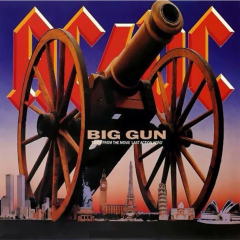
“Big Gun” was written by Malcolm Young, Angus Young, and Brian Johnson. Performed by AC/DC, it appears as the first track on the Last Action Hero: Music from the Original Motion Picture soundtrack album, released in June 1993. “Big Gun” was the first single from the LP, released in May 1993 to coincide with the movie’s release. The film starred Arnold Schwarzenegger, who is also in the video for the song, which features AC/DC performing the tune at a mock concert setting. (Interestingly, the band has never performed the song live in a concert setting since.) The Rick Rubin-produced single went to #1 on the Billboard Mainstream Rock chart and #65 on the Billboard Hot 100 Singles chart. Personnel on the record were: Brian Johnson (lead vocals), Angus Young (lead guitar), Malcolm Young (rhythm guitar, backing vocals), Cliff Williams (bass, backing vocals), and Chris Slade (drums). "Big Gun" would later appear in the AC/DC boxset, Backtracks.
AC/DC is an Australian rock and roll band formed in Sydney in 1973 by brothers Angus and Malcolm Young. The band has released 17 studio albums, three live albums, two soundtrack albums, one EP, and 47 singles and has sold over 200 million records worldwide. They have won one Grammy Award. Twenty-one members have passed through the ranks of AC/DC since its formation. Bon Scott died in 1980 and Malcolm Young in 2017. The band continues to record and tour.