Despite many challenges, natural gas production in Western Canada has been hitting record highs this year, powered by what seems to be the inexhaustible energy of the unconventional Montney formation. This immense resource remains the primary focus of most Canadian gas producers, and those that operate in the British Columbia portion of the Montney know they have their work cut out for them in the next few years if they are to meet the growing need for gas, especially when the LNG Canada export terminal comes online mid-decade. In today’s RBN blog, we update the Montney’s production and productivity trends in British Columbia and evaluate whether enough progress is being made.

Canadian crude output is rising, requiring new export routes. As traditional pathways face constraints, the U.S. Rockies—especially the Guernsey, WY hub—are emerging as key corridors for moving Canadian heavy crude to downstream markets, including the Gulf Coast.
Even if you only read the occasional headline — or RBN blog — about North American natural gas, it’s hard not to see mention of Western Canada’s Montney. This enormous source of gas has steadily risen over the years to dominate Canadian production growth and continues to forge ahead as producers respond to higher natural gas prices. From next-to-no production in 2005, the Montney now accounts for just over 50% of all the natural gas produced in Western Canada as of September 2022, a share that is expected to continue to rise in the years ahead given its gargantuan reserves and prolific wellhead productivity.
We did a full monty on the Montney (sorry!) in our four-part Big Gun series last year. There, we provided an overview in Part 1, being careful to describe its rock as a mix of mostly siltstone and sandstone, with some shale on its easternmost extent — effectively qualifying the Montney as a tight gas formation. The Montney’s geographic extent (yellow-bordered area in Figure 1 below) spans parts of Alberta and British Columbia (BC), covering more than 50,000 square miles (~130,000 square kilometers), or roughly two-thirds the size of the Permian Basin in Texas and New Mexico. With the recoverable resource from the Montney estimated at 565 Tcf by the Canada Energy Regulator (CER) in its “2021 Energy Future” update, the formation’s potential for future production remains almost boundless.
About the song
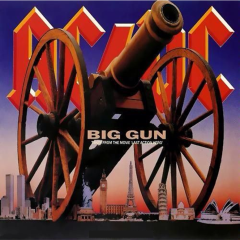
“Big Gun” was written by Malcolm Young, Angus Young, and Brian Johnson. Performed by AC/DC, it appears as the first track on the Last Action Hero: Music from the Original Motion Picture soundtrack album, released in June 1993. “Big Gun” was the first single from the LP, released in May 1993 to coincide with the movie’s release. The film starred Arnold Schwarzenegger, who is also in the video for the song, which features AC/DC performing the tune at a mock concert setting. (Interestingly, the band has never performed the song live in a concert setting since.) The Rick Rubin-produced single went to #1 on the Billboard Mainstream Rock chart and #65 on the Billboard Hot 100 Singles chart. Personnel on the record were: Brian Johnson (lead vocals), Angus Young (lead guitar), Malcolm Young (rhythm guitar, backing vocals), Cliff Williams (bass, backing vocals), and Chris Slade (drums). "Big Gun" would later appear in the AC/DC boxset, Backtracks.
AC/DC is an Australian rock and roll band formed in Sydney in 1973 by brothers Angus and Malcolm Young. The band has released 17 studio albums, three live albums, two soundtrack albums, one EP, and 47 singles and has sold over 200 million records worldwide. They have won one Grammy Award. Twenty-one members have passed through the ranks of AC/DC since its formation. Bon Scott died in 1980 and Malcolm Young in 2017. The band continues to record and tour.