


Carbon-neutral hydrocarbons may sound like an oxymoron, but an increasing number of international shippers have been assembling and sending out cargoes of LNG whose expected lifecycle carbon-dioxide (CO2) emissions have been fully offset by carbon credits. What’s next? No-calorie cherry pie? No-loss gambling on DraftKings? A winning season for the Houston Texans? (Probably not.) As you’d expect, carbon-neutral cargoes of LNG — and crude oil and LPG — are designed to help hydrocarbon sellers and buyers alike meet their goals for reducing their greenhouse gas emissions (GHGs). The concept is still relatively new, though, and many of the participants in these deals are still in learning mode, seeking to gain experience with something they expect to see a lot more of soon. In today’s blog, we discuss the relatively short history of this type of shipment and the first signs that carbon-neutral hydrocarbons are about to go mainstream.
As we said in Part 1, there’s a big push by the government, industry, and the broader public to reduce GHG emissions and to offset those that do occur. Toward that end, a number of LNG-market players have been seeking to differentiate their LNG from that supplied by their competitors. They’re doing that by offering buyers the option of contracting for carbon-neutral LNG (a.k.a. net-zero LNG), where every metric ton (MT) of CO2 emitted during natural gas production, liquefaction, shipping, and end-use consumption is matched one-for-one with an MT of independently verified, “nature-based” carbon offsets.

Canadian crude output is rising, requiring new export routes. As traditional pathways face constraints, the U.S. Rockies—especially the Guernsey, WY hub—are emerging as key corridors for moving Canadian heavy crude to downstream markets, including the Gulf Coast.
We also noted that the world’s first two shipments of carbon-neutral LNG were made by Shell in July 2019, to buyers in Japan (Tokyo Gas) and South Korea (GS Energy). For each of these deals, Shell used what UK regulators have established as a standard for the lifecycle — or Scope 1, Scope 2, and Scope 3 — GHG emissions from the 70,000 metric tons (MT) of LNG carried in an average cargo. Under that standard, the LNG’s lifecycle emissions would total about 240,000 MT of CO2 equivalent (CO2e) and, with each carbon offset credit equaling 1 MT of CO2e, Shell used or “retired” about 240,000 credits to offset each cargo. For Shell and other LNG suppliers exploring this carbon-neutral space, the CO2 offsets typically come from global portfolios of projects that are designed to either avoid the generation of CO2 or remove CO2 from the atmosphere. These projects fall into a few major categories, including conservation (sustainable management of forests), afforestation (planting trees where they had never been), and reforestation (planting trees in areas that have been deforested).
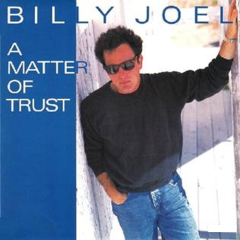
About the song
“A Matter of Trust” was written by Billy Joel and appears as the third song on side one of his 10th studio album, The Bridge. Released as the second single from the album in July 1986, "A Matter of Trust" went to #10 on the Billboard Hot 100 Singles chart. Personnel on the record were: Billy Joel (lead, backing vocals, guitar, acoustic piano, synthesizer); David Brown and Russell Javors (guitar); Doug Stegmeyer (bass), Liberty DeVito (drums), and Jeff Bova (synthesizer).
The Bridge was recorded in 1985-86 at The Power Station, Chelsea Sound, and RCA Studios in New York City and Evergreen Studios in Burbank, CA. Produced by Phil Ramone, the album was released in July 1986. It went to #7 on the Billboard Top 200 Albums chart, and has been certified 2X Platinum by the Recording Industry Association of America. Four singles were released from the LP.
Billy Joel is an American singer, songwriter, and musician from New York who has sold over 150 million records worldwide. He started his career as a member of The Hassles, who made two albums for United Artists in 1967 and 1969. Joel then formed the keyboard and drum duo, Attila, who released one album for Epic in 1970. Stephen Thomas Erlewine of All Music wrote: "Attila undoubtedly is the worst album released in the history of rock and roll." Joel himself has called the album "psychedelic B.S." He started his solo career in 1971, with the release of his debut album, Cold Spring Harbor. Billy Joel has released 13 studio albums, six live albums, 16 compilation albums, and 61 singles. He has won five Grammy Awards, is a member of the Rock and Roll Hall of Fame, and has been awarded a Gershwin Prize for Popular Song from the Library of Congress and a Kennedy Center Honor. He continues to write music and occasionally perform live.




Comments
The article says carbon credits cost 2 to 3 dollars per MT? Maybe you mean per Mscf. See Carbon Price Viewer - Ember (ember-climate.org). So it's more like $3-4/MMBtu. Am I missing something?