Finding a home for growing condensate range material being produced in the Ohio Utica shale play involves local refinery deliveries as well as new transport routes to markets outside the region as far away as Canada. Midstream companies are busy developing infrastructure plans to gather both wellhead condensate and output from natural gas processing plants in the region. Today we detail MPLX and its sponsor Marathon Petroleum Corporation’s (MPC) recently announced Utica shale plans.
We last looked at oil and condensate production in the Utica in May (2013). Our analysis showed that although the Utica was originally touted as the next big oil play, successful drilling has been concentrated in the Point Pleasant condensates and wet gas sectors of the play in Northeast Ohio (see drilling activity map below) resulting in more condensate and natural gas liquids (NGLs) production than oil (see Utica Oil or Bust?). We also pointed out that low production volumes so far were caused by producers sitting on completed wells and waiting for infrastructure to be built in the region. The latest data from the Ohio Department of Natural Resources indicates that of 963 wells permitted, only 174 are so far producing. However, a surge in Utica liquids production is expected by the end of this year as new capacity comes online to process wet natural gas (see The Big Surge Comes to Whoville). The latest Bentek estimates are for oil and condensate production of 21 Mb/d increasing to 156 Mb/d by the end of 2018 (for Ohio, November 2013).
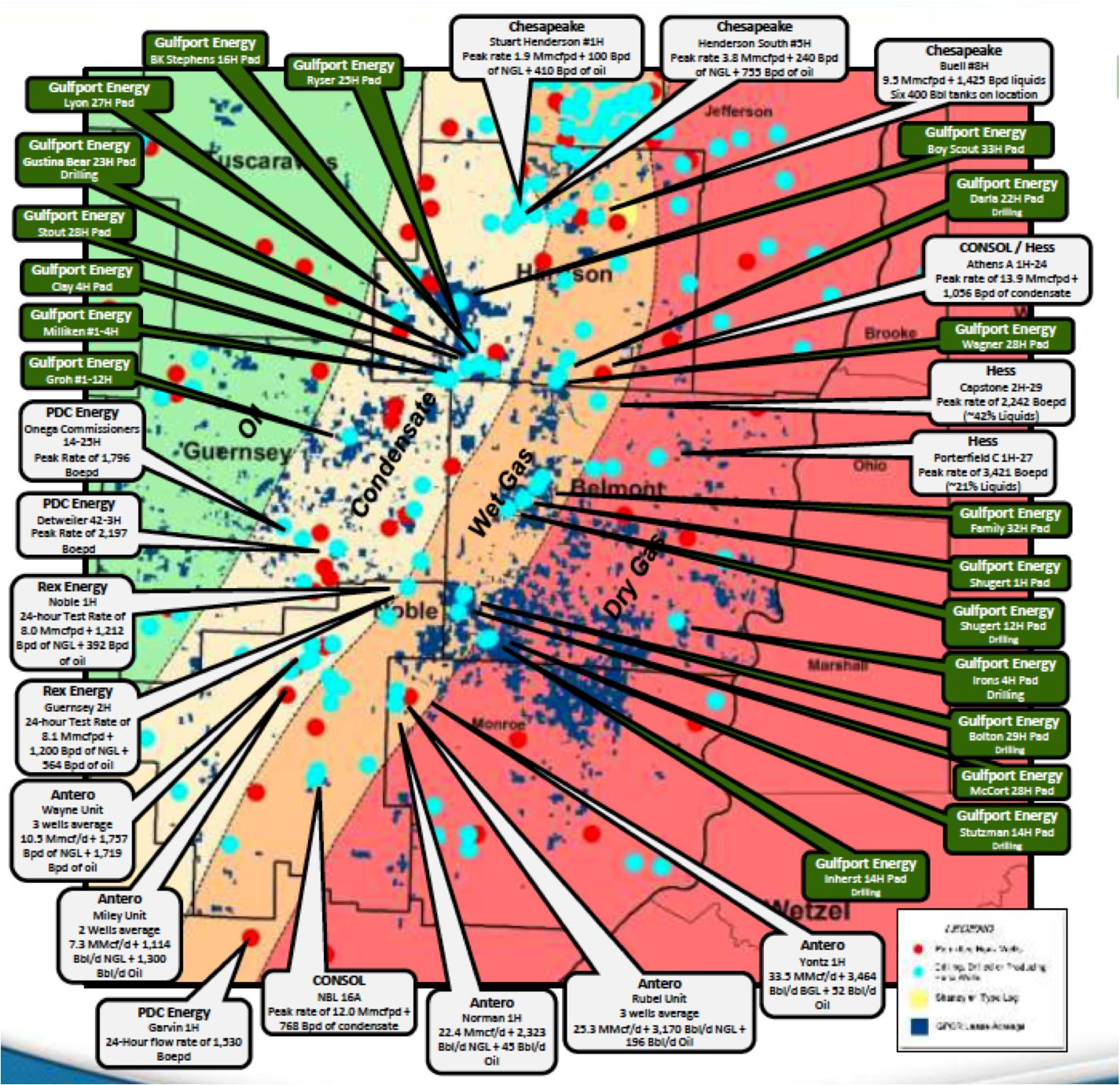
Source: Gulfport Energy Investor Presentation
With growing NGL output from the play, midstream companies have been rapidly developing and planning processing and fractionation infrastructure. Between now and 2015 nearly 4.7 Bcf/d of additional cryogenic natural gas processing capacity is due to come online along with 500 Mb/d of fractionation capacity and 500 Mb/d of NGL pipeline takeaway capacity to support growing Utica and wet Marcellus production (see Whoville, the Big New NGL Hub in Marcellus/Utica). Midstream companies are also making plans to handle significant condensate output in the Utica. As we have discussed many times in RBN blogs, condensates are naphtha range materials with API gravity between 50 and 70 degrees (see Fifty Shades of Condensate Which One Did You Mean?). Lease condensate is produced at the wellhead and plant condensates are produced at various stages of gas processing – as part of the raw liquids stream separated from dry gas at cryogenic plants or as natural gasoline (aka C5 or pentanes plus) output from the fractionation of raw NGLs (see Like A Box of Chocolates – The Condensate Dilemma). For midstream companies the challenge lies in figuring out markets where there is demand for these naphtha range materials and then developing a strategy to deliver condensates to market.
In this blog series we look at midstream plans to capture and deliver condensate range materials to market from Utica shale production. In the first two episodes we describe condensate and crude supply infrastructure plans recently outlined by MPLX at the Hart Energy DUG East Conference (November 15, 2013). MPLX is a Master Limited Partnership (MLP - see Masters of the Midstream for more on MLP structures) created in October 2012 to operate pipeline and transportation assets on behalf of sponsor company MPC.
Already this year MPC – the largest refiner in the Utica region - announced plans to spend $300 MM to build two condensate splitters - one with 25 Mb/d capacity at their Canton, OH refinery (expected online by the end of 2014) and the other with 35 Mb/d at their Catlettsburg, KY refinery located on the Ohio River (expected online by mid 2015). The two splitters will operate as separate units – meaning that their throughput is additional to refinery crude distillation capacity - and they will process raw condensate into a mix of gasoline and distillate products. To meet that need MPLX and MPC announced plans at their 3Q 2013 earnings call to build and operate a pipeline system to transport crude, condensate and natural gasoline in southeastern Ohio and deliver it to MPC’s Canton refinery and to a barge loading facility on the Ohio River at Wellsville that will feed Catlettsburg. Before the pipeline is built MPC is currently delivering condensate to Canton via a 12 Mb/d truck rack unloading facility and to Wellsville via a 6 Mb/d truck to barge unloading facility.

About the song
"Whole Lotta Shakin' Goin' On" was written by Dave Williams and Roy Hall, a Nashville club owner and promoter who used the pseudonym of "Sunny David" for the song's copyright. It became a regional hit for blues shouter Big Maybelle on the Okeh label in 1955. Maybelle's version, which features the raunchier original lyrics, was produced by a very young Quincy Jones. Jerry Lee Lewis, already riding high on “Crazy Arms,” his first single for Memphis's Sun Records, went in and cut "Whole Lotta Shakin' Goin' On" with Roland Janes on guitar and J.M. Van Eaton on drums. The Jack Clement-produced single was released in April 1957 and went to #3 on the U.S. singles charts. It was the record that really shot Lewis to worldwide fame. His live performance of “Whole Lotta Shakin’ Goin’ On” on the Steve Allen Show in 1957 –– with Jerry Lee, his hair wildly askew, pounding the piano keys like a man possessed and kicking his piano chair across the stage (to have it jokingly thrown back by Steve Allen) –– certainly made an impression on the millions of TV viewers observing it in the comfort of their living rooms. There was a revolution happening in the music of America's youth, and it was called rock and roll.
Jerry Lee Lewis helped invent rock and roll piano, with his driving left-hand bass figures and the pounding chords and flourishes his right hand provided. He took the boogie woogie to a whole new realm. Couple that with his wild antics of playing standing up (sometimes on top of the piano), pounding the lid open and closed for effect, kicking piano benches and microphone stands across stages, and generally looking like a madman ... there was nothing like a Jerry Lee Lewis concert in the 1950s. Lewis was one of the first inductees to the Rock and Roll Hall of Fame in 1986. Now 82 years old, he is the last man standing of the rock and roll pioneers of Memphis's Sun Records.