It’s expected to be a big year for U.S. LNG. The U.S. was the top monthly exporter of LNG for the first time in December 2021 and is expected to hold onto that crown as new capacity at Sabine Pass and a new terminal, Calcasieu Pass, begin service this year. The chaos of European gas markets has made U.S. exports particularly attractive, especially after a year or more of high global demand, sky-high global gas prices, and an undersupplied market that has left offtakers clamoring for more. Last year saw those offtakers come back to the negotiating table for long-term sales and purchase agreements (SPAs) from new U.S. LNG capacity and several projects now have a realistic path to a positive final investment decision (FID) in 2022. In today’s RBN blog we begin a series taking a closer look at some of the projects most likely to reach FID this year, starting with arguably the most likely next contender, Venture Global’s Plaquemines LNG.
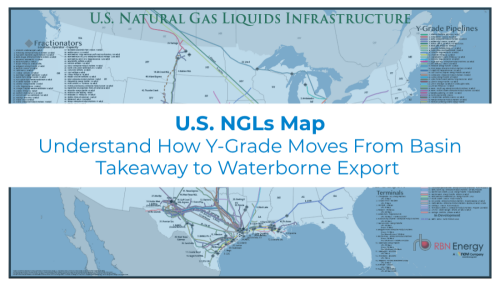
Visualize the infrastructure behind U.S. NGL movement.
The U.S. NGLs Map provides a comprehensive view of the transport, processing, and export networks moving NGLs across the U.S.
Feedgas demand for U.S. LNG exports is at an all-time high, driven mostly by commissioning activity at Sabine Pass Train 6 (see Hear My Train a Comin’), but also from many of the existing U.S. terminals operating at peak capacity for extended periods to produce additional LNG cargoes above long-term contract levels (see Higher and Higher). And although winter is winding down, feedgas demand is still elevated, indicating that spot-market production is ongoing. With such a profitable year for existing LNG terminals, it’s no wonder that LNG operators and developers are excited at the prospect of building more LNG capacity. And after a long, COVID-induced hiatus, offtakers — both big global portfolio players and end users, like utilities — seem ready to commit to more medium- and long-term capacity. Since May, five new LNG projects or terminal expansions have been able to sign more than 23 million metric tons per annum (MMtpa) of binding offtake capacity (see The Race is On), pushing a number of LNG projects closer to FID than they’ve ever been before. Multiple projects are racing to capitalize on the momentum that the extended run of high global gas prices has brought. Just how many projects will be able to achieve FID is unclear, but it is likely to be more than one in the U.S. Gulf Coast, and once that decision is made, it’s unlikely to be walked back, reshaping the global LNG landscape and the U.S. gas market for years to come. But that’s a topic for another day. For now, let’s take a closer look at the project closest to FID, Plaquemines LNG.
Plaquemines LNG is a greenfield LNG terminal planned in Plaquemines Parish, LA, about 20 miles south of New Orleans. The terminal plans to use the same modular technology as Venture Global’s currently commissioning terminal, Calcasieu Pass. Eventually, Plaquemines LNG (pronounced PLACK-a-min) could be as large as 20 MMtpa (2.65 Bcf/d), consisting of 36 electrically powered, mid-size modular liquefaction trains configured into 18 blocks. But only the first half of the project (Phase 1) — nine blocks (with two mini-trains each) for a total of 11.3 MMtpa (1.5 Bcf/d) of nameplate capacity — is under consideration for FID in 2022. The liquefaction process will be powered by on-site, behind-the-fence, combined-cycle gas turbines (CCGT) supplied by feedgas and boil-off gas from the liquefaction process. Phase 1 will also consist of three pre-treatment trains, each of which can process feedgas for half of the terminal’s capacity, providing redundancy to minimize outage and maintenance downtime, as well as two 200,000-cubic-meter storage tanks. The terminal site also has space for up to three ship berths, but most likely only one or two will be included in Phase 1.
About the song
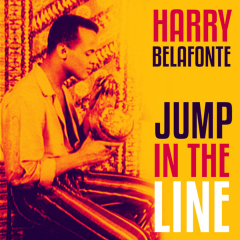
“Jump in the Line (Shake Senora)” was written by Lord Kitchener (“Kitch” was known as the “grand master of calypso” and later was a pioneer in the Soca music movement). The song appears as the seventh tune on Harry Belafonte’s 11th studio album, Jump Up Calypso, and was released as a single in November 1961. It has been covered by many artists over the years, with Belafonte’s version being featured during the end of Tim Burton’s 1988 hit comedy/horror film, Beetlejuice. Personnel on the record were: Harry Belafonte (vocals), The Trinidad Steel Band (instrumentation), Ernie Calabria, Millard Thomas (guitar), and Norman Keenan (bass).
Jump Up Calypso was recorded in 1960 and produced by Bob Bollard. Released in November 1961, the album went to #3 on the Billboard 200 Albums chart.
Harry Belafonte (Harold George Bellanfanti Jr.) is an American singer, songwriter, activist, and actor. He was born in Harlem to Jamaican parents. In the late 1940s Belafonte took acting lessons at the Dramatic Workshop of the New School in New York City alongside Marlon Brando, Sidney Portier and Tony Curtis. He received a Tony Award for his acting in the Broadway revue John Murray Anderson’s Almanac in 1954. He started his career as a singer in New York to help pay for his acting lessons. The first time he sang in front of an audience he was backed up by the Charlie Parker band. His breakthrough album in 1956, Calypso, became the first LP to sell a million copies within a year. It contained his most famous song, “The Banana Boat Song,” with its call and response lyric: “Day-O.” Belafonte has released 30 studio albums, eight live albums, three compilation albums and 20 singles. He has appeared in 35 films and documentaries, and 25 television shows. He has been a longtime humanitarian and political activist, and has won three Grammy Awards, one Emmy Award and one Tony Award. He has received a Kennedy Center Honor, a National Medal of Arts and a Grammy Lifetime Achievement Award, and has a star on the Hollywood Walk of Fame. At the age of 95, he is still active in film, music, and political activism.