


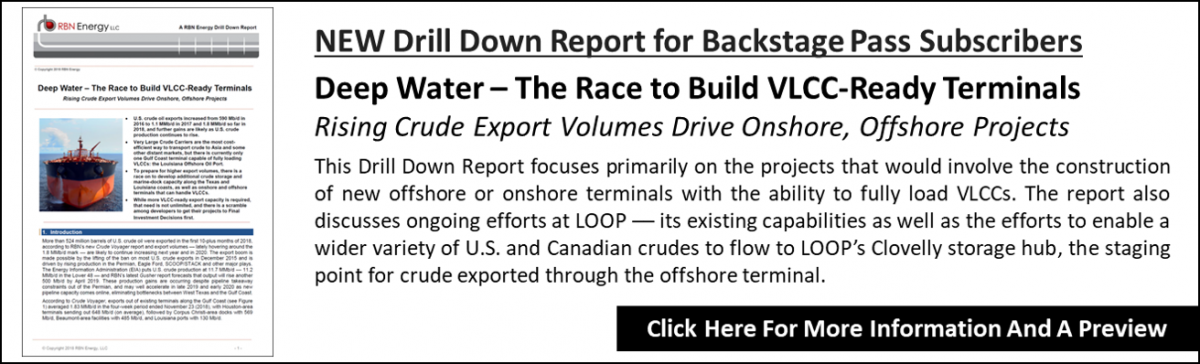
This summer and fall, more than a half dozen companies and midstream joint ventures have announced plans for new deepwater export terminals along the Gulf Coast that — if all built — would have the capacity to load and send out more than 10 MMb/d, which is notable because the U.S. Lower 48 currently produces 11.2 MMb/d. Most of these projects won’t get built, of course — export volumes may well continue rising, and the economics of fully loading VLCCs at deepwater ports are compelling, but even the most optimistic forecasts suggest that only one or two of these new terminals will be needed through the early 2020s. So, there’s a fierce competition on among developers to advance their VLCC-ready export projects to Final Investment Decisions (FIDs) first. Today, we discuss highlights from our new Drill Down Report on deepwater crude export terminals as well as the export growth and tanker-loading economics that are driving the project-development frenzy.
So far in 2018, the U.S. has exported more than 524 million barrels of crude oil and export volumes — lately hovering around the 1.8 MMb/d mark — are likely to continue increasing next year and in 2020. The export boom is made possible by the lifting of the ban on most U.S. crude exports in December 2015 and is driven by rising production in the Permian, Eagle Ford, SCOOP/STACK and other major plays. U.S. crude production has reached 11.7 MMb/d — all but 500 Mb/d of it in the Lower 48 — and RBN’s latest Gusher report forecasts that output will rise another 500 Mb/d by April 2019. These production gains are occurring despite pipeline takeaway constraints out of the Permian, and may well accelerate in late 2019 and early 2020 as new pipeline capacity comes online, eliminating bottlenecks between West Texas and the Gulf Coast.
According to our latest Crude Voyager, exports out of the Gulf Coast averaged 1.83 MMb/d in the four-week period ended November 23 (2018), with Houston-area terminals sending out 648 Mb/d (on average), followed by Corpus Christi-area docks with 569 Mb/d, Beaumont-area facilities with 485 Mb/d, and Louisiana ports with 130 Mb/d.
Generally speaking, the bigger the tanker you’re using to haul crude long distances, the more cost-efficient the journey. With Asia accounting for nearly half of total U.S. export volumes in the first 10-plus months of 2018, the VLCC, with a storage capacity of about 2 MMbbl, has become the (super)tanker of choice. The catch is, there’s only one Gulf Coast terminal currently capable of fully loading a VLCC without reverse lightering. That would be the Louisiana Offshore Oil Port (LOOP), which is located in 110-foot-deep waters 18 miles off Port Fourchon, LA — and which was originally designed (back in the late 1970s and early ‘80s) as an import-only facility. Elsewhere along the coast, outgoing VLCCs need to be either fully loaded or topped off in offshore deep water by reverse lightering — a time-consuming and costly process that typically involves shuttling crude out in Aframaxes or other smaller tankers to a VLCC in a trans-shipment area (TSA) and transferring the crude onto the larger ship.
About the song
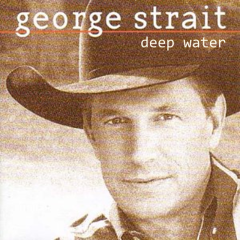
“Deep Water” is a track off country singer George Strait’s 1986 album, 7. "Deep Water" was written by Fred Rose and was first recorded and released by Bob Wills and his Texas Playboys in 1948. George Strait’s 7 LP — his seventh album — reached #1 on the Billboard Top Country Albums chart and #27 on the Billboard Top 200 Albums chart. It produced two #1 hit singles, “Nobody in His Right Mind Would’ve Left Her” and “It Ain’t Cool to Be Crazy About You.” Personnel on the LP were: George Strait (lead vocals and acoustic guitar), Curtis Young (background vocals), Eddie Bayers (drums), David Hungate (bass), Billy Joe Walker (guitar), Reggie Young (guitar), Richard Bennett (guitar), John Jarvis (piano), Johnny Gimble (fiddle and mandolin) and Paul Franklin (steel guitar).
George Strait is an American country music singer, songwriter, actor, and record producer. Many consider Strait the “King of Country Music.” He has sold more than 120 million records worldwide and has 13 multi-Platinum, 33 Platinum, and 38 Gold albums. He started his musical journey playing in a rock-and-roll cover band during his high school years in Pearsall, TX. He started singing country music in an Army-sponsored country band while stationed in Hawaii. After his stint in the Army, Strait enrolled as a student at Texas State University in San Marcos, where he formed the Ace in the Hole Band. After releasing some music on an independent Texas label, he signed his first record deal with MCA Records in Nashville in 1981. He has released 29 studio albums, three live albums, 12 compilation albums, one soundtrack album, and 102 singles. He has appeared in three motion pictures and one television show. He holds the record for most ACM and CMA Awards and is third only to Elvis Presley and The Beatles for the most Gold and Platinum albums. He was inducted into the Country Music Hall of Fame in 2006. Strait has retired from touring, giving the final concert on his The Cowboy Rides Away Tour in Arlington, TX, in June 2014. He still occasionally records and is scheduled to appear at nine stadium shows with Chris Stapleton in 2024, with the first set for May 4 in Indianapolis.






Comments
Downloading