The initial start-up of Cheniere Energy’s Midship Pipeline two weeks ago occurred in a radically different market environment than when the project was conceived. As the first greenfield, large-diameter natural gas pipeline project out of the SCOOP/STACK in years, it was meant to provide relief for the once takeaway-constrained producers in the Central Oklahoma production region and connect what was until the past year a rapidly growing supply region to emerging LNG export demand along the Gulf Coast, including at Cheniere’s own Corpus Christi, TX, terminal. Instead, SCOOP/STACK production hit the skids last fall, and rig counts since then have plunged to the lowest levels in well over a decade. On the delivery end of the pipe, U.S. LNG export demand is being challenged by a global gas glut and disappearing margins to international markets. Still, the Midship project’s initial capacity of 1.1 Bcf/d is more than 80% subscribed by firm shippers, and the new pipeline is slated to provide some of the most economic routes out of the SCOOP/STACK. Today, we provide an update on the project’s start-up and the changed market environment it’s facing.
When Cheniere filed its Section 7c application with the Federal Energy Regulatory Commission (FERC) in May 2017 to build its 1.44-Bcf/d Midship Pipeline project, associated gas production from the crude oil, liquids and condensate-focused SCOOP and STACK plays in the Woodford Shale’s Cana region (a.k.a. the Cana-Woodford) — a part of the greater Anadarko Basin — was on a resounding upswing. Producers were flocking to the play and ramping up activity, even as oil prices were still recovering from the 2014-15 collapse and barely approaching $50/bbl. All signs at the time pointed to robust economics. The value-add of multiple product streams — crude oil and the associated gas and NGLs emerging from the wells, combined with the well performance and drilling efficiencies achieved in the region — signaled some of the most attractive economics in the country for producers. These included healthy double-digit internal rates of return (IRRs) — even at sub-$50/bbl crude oil prices. In fact, for a while there, SCOOP and STACK were two of the fastest-growing shale producing regions in the U.S., and it appeared at the time that the only thing that would slow things down would be the emergence of midstream constraints as midstreamers were struggling to keep up with the rapid production gains.
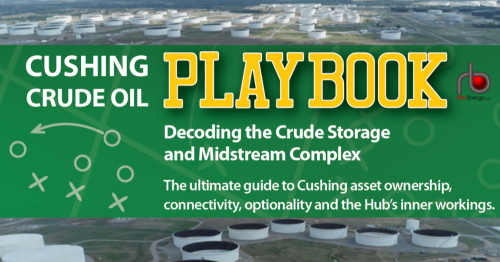
To truly understand Cushing — what it does and how it works — you need to know the hub’s assets and how they fit together. RBN’s Cushing Crude Oil Playbook provides the first one-stop, comprehensive guide to the hub’s assets.
It’s worth noting too, that at the same time that SCOOP/STACK production was taking off, Cheniere was ramping up LNG export capacity along the Gulf Coast, with the addition of five successive liquefaction trains at its Sabine Pass LNG export project in Louisiana that came online between early 2016 and early 2019, and another two trains at its Corpus Christi LNG facility in South Texas. Given its free-on-board (FOB) LNG sales model, Cheniere is responsible for securing feedgas for LNG production and its offtakers don’t take title of the gas until after it’s been liquefied. So, the combination of the need for more SCOOP/STACK takeaway capacity and Cheniere’s need for securing additional supply for its LNG export projects provided a sound rationale for Midship. The large-diameter greenfield pipeline was designed to move as much as 1.44 Bcf/d from the heart of the SCOOP/STACK plays south to the Oklahoma-Texas border for further delivery via multiple interconnecting interstate pipelines to Southeast and Gulf Coast markets, including LNG export facilities.
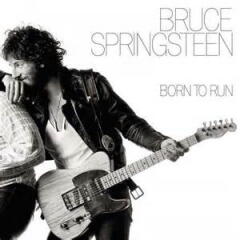
About the song
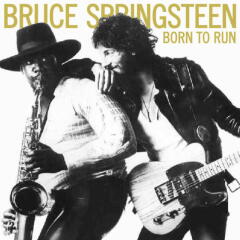
"Born to Run" was written by Bruce Springsteen, and appears as the first song on side two of Springsteen's third studio album of the same name. The song was recorded between January and August 1974 at 914 Sound Studios in Blauvelt, NY, with Springsteen and Mike Appel producing. Copies of the song were intentionally leaked to key East Coast deejays, where it quickly became a popular requested song. With the pump primed, the song was officially released as a single in August 1975, and went to #23 on the Billboard Hot 100 Singles chart. "Born to Run" would go on to be covered by many artists, including Allan Clarke (who was the first one to record the tune), Suzi Quatro, Frankie Goes To Hollywood, and Roger Daltrey. Personnel on the record were: Bruce Springsteen (vocals, guitar), Garry Tallent (bass), Ernest "Boom" Carter (drums), David Sancious (keyboards), Danny Federici (organ, glockenspiel), and Clarence Clemons (tenor sax).
The album, Born to Run, was recorded between May 1974 and August 1975, with Springsteen, Mike Appel, and Jon Landau producing. Released in August 1975, the album went to #3 on the Billboard Top 200 Albums chart, and has been certified 6x Platinum by the Recording Industry Association of America.
Bruce Springsteen is an American singer, songwriter, and musician. Nicknamed "The Boss" by his fans, he has sold more than 135 million records worldwide as a member of the E Street Band and as a solo artist. He has made 19 studio albums, 23 live albums, one soundtrack album, eight compilation albums, seven EPs, and 70 singles. Springsteen has won 20 Grammy Awards, two Golden Globe Awards, one Academy Award, and one Tony Award. He is a member of the Songwriters Hall of Fame and the Rock and Roll Hall of Fame. He has been awarded Kennedy Center Honors and the Presidential Medal of Freedom, and was named the MusiCares person of the year. Springsteen continues to record and tour, and was recently involved in the Jersey 4 Jersey Show to raise money for COVID-19 relief funds.