We often tend to focus on the U.S. refining picture, but, just like crude oil, refined products trade globally, and international closures ultimately have the same effect as domestic ones on the worldwide products market. Recent international closures have been distributed throughout the world — concentrated in developed countries, including several in Europe, as well as Japan, Singapore, Australia and New Zealand, but also in some developing economies like South Africa and Sri Lanka. Most of these capacity reductions were driven by the same forces as in the U.S., namely, poor economics as a result of the pandemic-lockdown-driven demand plunge in 2020 and 2021, as well as expectations that margins would take a long time to recover post-COVID. Of course, worries that the energy transition and policies to that end would suppress demand in the long-term also played a key role, as did some fundamental competitiveness issues at individual facilities. In today’s RBN blog, we take a closer look at the more than 2 MMb/d of international capacity closures since 2019.

The Future of Fuels bi-annual report by RBN's Refined Fuels Analytics provides an in-depth analysis of the U.S. and global refinery industries, focusing on crude oil and fuel market dynamics, supply and demand, alternative fuels, refinery capacities, and price forecasts to help stakeholders navigate the evolving energy landscape.
The first blog in this series reviewed the roughly 1.3 MMb/d of North American refinery capacity reductions that have occurred since 2019, and the additional 400 Mb/d planned to be taken offline over the next two years. But unlike in the U.S., where the refining industry had been adding capacity prior to 2019, Europe has experienced a long-term decline in refining capacity due to sluggish demand and decreased competitiveness. Since 1980, the continent’s refinery capacity (excluding Turkey and the former USSR) has fallen by almost 8 MMb/d (a decline of more than a third; stacked bars in Figure 1). Most recently, Europe lost about 3 MMb/d of refinery capacity from 2006 through 2017 (dashed red box), before a brief “European Spring,” inspired by lower crude costs and a bump in demand, led to a few years of better margins. The good times came to an abrupt end with the COVID-related lockdowns, and since the beginning of 2020, Europe has lost an additional 800 Mb/d of refining capacity through complete and partial closures.
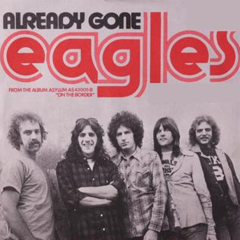
About the song
“Already Gone” was written by Jack Tempchin and Robb Strandlund. It appears as the first song on the Eagles’ third studio album, On the Border. It was released as the first single from the album in April 1974 and went to #32 on the Billboard Hot 100 Singles chart. Personnel on the record were: Glenn Frey (lead vocals, guitar solo), Don Henley (drums, backing vocals), Bernie Leadon (guitar, backing vocals), Randy Meisner (bass, backing vocals), and Don Felder (guitar solos).
On the Border was initially being produced by Glyn Johns, who had the band recording at Olympic Studios in London. After disagreements between the band and Johns, the band relocated to The Record Plant in Los Angeles and hired producer Bill Szymczyk, who had recently produced Joe Walsh who was managed by the Eagles’ manager, Irving Azoff. The band wanted to go in a more rock direction with the album. Johns produced two songs on the album, Szymczyk produced the rest. Bernie Leadon’s friend Don Felder so impressed the band with his guitar skills on “Already Gone” and “Good Day in Hell” that they asked him to join the Eagles. Released in March 1974, On the Border went to #17 on the Billboard 200 Albums chart and has been certified 2x Platinum by the Recording Industry Association of America. It was the first album of the Eagles to be released in quadraphonic sound in addition to stereo. Three singles were released from the LP.
The Eagles are an American rock band formed in Los Angeles in 1971. They are one of the most successful rock bands in history, with records sales of over 200 million worldwide. They have released seven studio albums, two live albums, 10 compilation albums and 30 singles. They have won six Grammy Awards and have been inducted into the Rock and Roll Hall of Fame and the Vocal Group Hall of Fame. The band received Kennedy Center honors in 2016. Nine members have passed through the band since its inception. Glenn Frey died in January 2016 at the age of 67. The band continues to record and tour and is scheduled to perform at the Sphere in Las Vegas in April and September.