No doubt about it. The global effort to reduce emissions of carbon dioxide — the most prevalent of the greenhouse gases — is really heating up. Yes folks, CO2 is in the spotlight, and everyone from environmental activists and legislators to investors and lenders want to slash how much of it is released into the atmosphere. There are two ways to do that. First, produce less of it. That’s what the development of no- or low-carbon sources of power and the electrification of the transportation sector are intended to accomplish. The second way is to capture more of the CO2 that’s being emitted and make it go away, and the most cost-effective means to that end is sequestration — permanently storing CO2 deep underground, either in rock formations or in oil and gas reservoirs through a process called enhanced oil recovery, or EOR. Sure, there’s an irony in using and sequestering CO2 to produce more hydrocarbons, but the volumes of CO2 that could be squirreled away for eternity through EOR are enormous, and the crude produced might credibly be labeled “carbon-negative oil.” In today’s blog, we continue our look at the rapidly evolving CO2 market and the huge opportunities that may await those who pursue them.

Canadian crude output is rising, requiring new export routes. As traditional pathways face constraints, the U.S. Rockies—especially the Guernsey, WY hub—are emerging as key corridors for moving Canadian heavy crude to downstream markets, including the Gulf Coast.
As we said in Part 1 of this blog series, CO2 EOR technologies have been around for almost 50 years. During most of that time, however, EOR has been a footnote in the financial statements of all but a handful of companies. But now, ESG and the momentum to address the climate-change challenge sooner rather than later has thrust CO2 EOR to center stage. Whether they are involved in CO2 capture or not, oil and gas companies are fond of EOR. Unlike solutions that rely on technologies like solar photovoltaics and lithium-battery storage (outside the sweet spot of most oil companies), CO2 EOR uses processes and techniques that are quite familiar to hydrocarbon producers, as well as being proven and used in several major basins. So we know they work, and can be scaled up to handle far greater volumes of CO2 than they do today. We’ll get back to just how much CO2 is sequestered using EOR a little later, but first let’s consider the big picture. For starters, how big is this CO2 problem in the first place?
The answer? Really big. In fact, it’s hard to wrap your head around the sheer magnitude of the GHGs being emitted into the atmosphere. As shown in Figure 1, more than 50 gigatons (billion metric tons) of GHGs are released each year across the globe, here calibrated to CO2-equivalent volumes. CO2 alone (lavender bar segments) accounts for about four-fifths of the total, followed by methane (light green bar segments) and nitrous oxide (yellow bar segments). The blue line represents the U.S. portion of the worldwide CO2 annual total: about 5 gigatons. If you squint looking at Figure 1, you’ll see that U.S. CO2 emissions have been gradually declining since 2005, when they reached almost 6 gigatons. Much of that decline is tied to shifts in the U.S. power generation sector from coal to natural gas and renewables. In contrast, GHG emissions by the rest of the world increased by almost 10 gigatons of CO2 equivalent over the same period, mostly due to economic growth in China, India, and other emerging markets, with some reduction in 2020 due to the COVID pandemic.
About the song
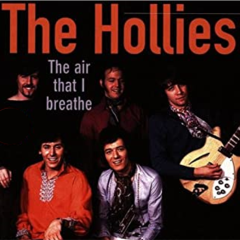
"The Air That I Breathe" was written by Albert Hammond and Mike Hazlewood. It originally appeared as the 10th cut on Albert Hammond's 1972 debut album, It Never Rains in Southern California. The album went to #77 on the Billboard Top 200 Albums chart. Three singles were released from the LP.
The Hollies recorded the song in 1973, and it appears as the fifth song on side one of The Hollies' 14th studio album, Hollies. Recorded at EMI Studio in London in 1973, it was released as a single in the U.S. in March 1974 and went to #6 on the Billboard Hot 100 Singles chart. Personnel on the record were: Allan Clarke (lead vocals), Tony Hicks (lead guitar, backing vocals), Terry Sylvester (rhythm guitar, backing vocals), Bobby Elliott (drums), Bernie Calvert (bass, keyboards), and Chris Gunning (orchestral arrangements). In 1992, Radiohead had a hit with "Creep," a song with a similar chord progression and melodic content as "The Air That I Breathe." The publisher of the older song sued Radiohead and a settlement was reached under which songwriters Hammond and Hazlewood were given co-writing credits and a portion of the royalties. Many artists have covered "The Air That I Breathe" over the years, including Simply Red, K.D. Lang, Olivia Newton-John, and The Mavericks.
The LP Hollies was produced by The Hollies and Ron Richards. Released in March 1974, it went to #28 on the Billboard Top 200 Albums chart.
The Hollies are a British rock band formed in 1962 in Manchester, England, by Allan Clarke and Graham Nash. They, along with The Rolling Stones, are among the few UK rock groups from the early '60s that have never disbanded. The Hollies have released 21 studio albums, 22 compilation albums, seven EPs, and 67 singles. The band was inducted into the Rock and Roll Hall of Fame in 2010. Nineteen members have passed through the band's ranks since its formation. Original member Tony Hicks and longtime member Bobby Elliott lead a touring version of The Hollies today.