In our view, there are two or three clear leaders in the competition for billions of dollars in U.S. support for clean-hydrogen hubs — for example, it would be hard to imagine the Department of Energy (DOE) passing over hub proposals in Texas, Louisiana or the Marcellus/Utica. At the same time, there’s a lot to be said for plans to develop hydrogen hubs in California, North Dakota and, we might add, the Rockies, a region with extensive energy-related infrastructure and a long list of prospective clean-hydrogen end-users, not to mention at least two projects to convert coal-fired power plants to hydrogen. In today’s RBN blog, we discuss a multistate push to make the Rockies a hotbed of hydrogen-related activity.
As we said in our first blog on hydrogen hubs, a provision in last year’s $1-trillion-plus Infrastructure Investment & Jobs Act provides up to $8 billion in federal funding over five years to support the development of at least four such hubs around the U.S. The DOE announced in September that concept papers from hub proponents were due November 7 and full applications by April 7, 2023; winners would be notified in the fall of 2023; and award negotiations with them completed in the winter of 2023-24. We’ve already discussed hydrogen-hub proposals in the Houston area, Corpus Christi, Southern California and Louisiana, Oklahoma and Arkansas, as well as plans for a hub centered in Senator Joe Manchin’s West Virginia and maybe a couple of hubs in the Midwest and Great Plains.
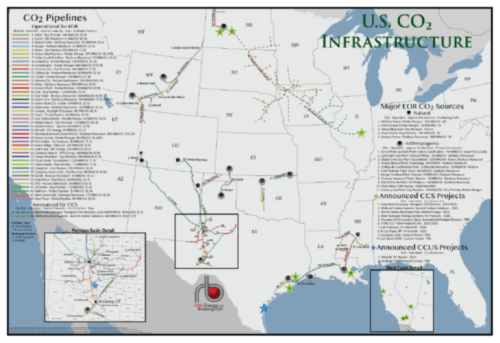
RBN Energy’s US CO₂ Infrastructure map brings together legacy Enhanced Oil Recovery (EOR) assets, as well as announced large-scale Carbon Capture and Sequestration (CCS) and Carbon Capture, Utilization and Sequestration (CCUS) projects, all in our signature concise, accurate, and intelligible style.
Today, we turn our attention to the Rocky Mountains. Many of us think of the Rockies as God’s country: amazing scenery, fresh air, great skiing and fly-fishing, and mountain-biking and hiking ... well, you get the idea. But the region also has a more practical side, and more than its share of energy production: coal, crude oil, natural gas, refining and, more recently, wind and solar power. It has a surprising number of other industries as well — mining, cement and manufacturing of all sorts. So, it really should come as no surprise that the half-dozen states along the Continental Divide have the critical mass to develop a strong response to the DOE’s ongoing solicitation for clean-hydrogen-hub proposals.

About the song
“Rocky Mountain Way” was written by Joe Walsh, Joe Vitale, Rocke Grace and Kenny Passarelli. It appears as the first song on side one of Joe Walsh’s second studio album, The Smoker You Drink, The Player You Get. Released as a single in June 1973, the song went to #23 on the Billboard Hot 100 Singles chart. Walsh said the lyrics came to him as he was mowing the lawn at his Colorado home. “I looked up and there’s the Front Range of the Rocky Mountains and it knocked me back because it was just so beautiful.” The song features Walsh using one of the original talk boxes designed and manufactured by Bob Heil. Walsh gave songwriting credits to all four members of his band Barnstorm, since they helped transform what began as a blues jam in the studio to a fully realized song. The Colorado Rockies Major League Baseball team plays “Rocky Mountain Way” after every home win at Coors Field. The Denver Broncos National Football League team plays Godsmack’s version of the song at home games at Empower Field at Mile High Stadium. Personnel on the Joe Walsh record were: Joe Walsh (lead vocal, guitar, keyboards), Kenny Passarelli (bass, backing vocals), Joe Vitale (drums, percussion, backing vocals), Rocke Grace (keyboards, backing vocals), and Joe Lala (percussion).
The Smoker You Drink, The Player You Get was recorded between late 1972 and early 1973 at Caribou Ranch in Nederland, CO, and the Record Plant in Los Angeles. Produced by Joe Walsh and Bill Szymczyk, it was released in June 1973. The album went to #6 on the Billboard 200 Albums chart and has been certified Gold by the Recording Industry Association of America. The cover art for the album features a British Sopwith Snipe fighter plane with French colors that appears to be flying upside down as the blue sky is at the bottom and the brown ground is at the top of the illustration. One single was released from the LP.
Joe Walsh is an American guitarist, singer, songwriter and record producer. He started his professional career as the lead singer and guitarist of the James Gang, a rock and roll trio formed in Cleveland, OH, in 1966. He left the band in 1972 to pursue a solo career. In 1975, Walsh joined The Eagles. He released four studio albums with the James Gang and has released five albums with The Eagles so far. As a solo artist, he has released 20 studio albums, one live album, six compilation albums, and eight singles. He has appeared on more than 40 albums by other artists. Walsh continues to record and tour, with six upcoming shows with the James Gang booked in November.