One of the most prevalent stories in the U.S. natural gas market over the past decade has been soaring associated gas production in the Permian Basin and the question of what to do with it. Numerous pipelines have been built over the years connecting Permian gas to demand regions, and more are in the works. The largest source of incremental demand is LNG exports, mostly from the Sabine River area at the Texas/Louisiana border. The catch is, getting Permian gas past Houston to the banks of the Sabine presents significant challenges. In today’s RBN blog, we’ll discuss Kinder Morgan’s proposed Trident Pipeline — an attempt to overcome those challenges — and explain why this new outlet would alter gas pricing and flow dynamics in the broader Gulf Coast region.
We at RBN have written about existing and planned gas pipelines out of the Permian many times in the past, recently cataloguing a number of proposed lines in Come Dancing. While that piece primarily covered projects that originate in West Texas, we also snuck in WhiteWater Midstream’s Blackfin Pipeline, which was to be constructed entirely in the eastern half of Texas, bringing gas from Colorado County (near one terminus of the four-year-old Permian Highway Pipeline) north around Houston, ending in the area just north of Beaumont, where other lines would bring gas to LNG terminals in the Sabine River area. Also on the list from that blog was Energy Transfer’s proposed Warrior Pipeline, which would bring gas from the Permian to the area just south of Dallas-Fort Worth. Gas could then move toward the Sabine River through existing intrastate systems (and potentially new ones).

The Natural Gas Master Class is a one-day online event focusing on understanding flow analysis, interpreting pipeline data and forecasting future flows. This course is designed to equip you with the knowledge and skills to effectively analyze the complexities of natural gas markets, flow analysis, and pipeline modeling. Join us online
October 21 | Online
A few months later, Oceanfront Property told the story of the proposed DeLa Pipeline, which would bring “wet” gas all the way from the Permian Basin to gas processing plants in Louisiana. These proposals all identified the need to bridge the gap between the Sabine River region and new gas coming out of the Permian. That need has become more acute than ever now that Matterhorn Express Pipeline started reporting flows on October 1. Matterhorn will ultimately transport 2.5 Bcf/d from the Permian to the area just west of Houston. Now, a new proposal by pipeline giant Kinder Morgan (KM) may be the solution for moving excess Permian gas to the Sabine.
On October 14, KM announced an open season for its Trident Pipeline project: a 48- and 42-inch pipeline that would run from Katy, TX, just west of Houston to the Sabine River, terminating at the Golden Pass LNG export facility in Port Arthur. The next day, Golden Pass Chief Commercial Officer Jeff Hammad announced at the Gulf Coast Energy Forum that Golden Pass had committed to be an anchor shipper on Trident. Golden Pass, a 70/30 joint venture of QatarEnergy (Qatar’s national oil and gas company) and ExxonMobil, is what we would call a very creditworthy counterparty. KM indicated in its open season announcement that it was negotiating with more than one anchor shipper.
The difficulty of getting gas from locations like Katy to the Sabine is that most routes are highly challenging. The most direct path would plow straight through the Houston area, and while the nation’s fourth-most-populous city may be more amenable than most to the pipeline business, negotiating right-of-way agreements across more than a hundred miles of suburban and urban properties would be a Herculean task. (KM does hold significant right of way in Houston for its Texas and Tejas systems.) Instead, the choice has been for Trident to move north around the heavily populated areas before heading over to Port Arthur. This approach has its own challenges, the first being that it’s a long way north to actually avoid those populated areas. Then, the Sam Houston National Forest comes into play. It would make sense that KM would want to avoid having to get federal permits to cross the forest, especially after the ordeal Mountain Valley Pipeline (MVP) went through regarding the Jefferson National Forest in Virginia. The huge advantage enjoyed by the Texas intrastate market is the avoidance of extended delays, so staying away from federal permitting seems immensely wise.
Details about the pipeline route are rough at this point, although KM did sketch out (in the open-season announcement) the counties in which it would have delivery points. Based upon that information and RBN’s own judgment, we have developed a potential pipeline route, as shown in Figure 1 below. (An official KM map has not been released.) As you can see, this route allows the pipeline to avoid a lot of the impediments to cross-regional construction. It could also allow the line to pick up production on intrastate pipelines from the Texas portion of the Haynesville play, where KM has a significant presence. That could be a big advantage as LNG terminals look to secure feedgas with low nitrogen levels to blend with higher-nitrogen Permian gas (see It’s a Gas Gas Gas). As noted earlier, the Trident Pipeline is planned to be 48 or 42 inches in diameter, depending on the location, and able to flow up to 2.8 Bcf/d.
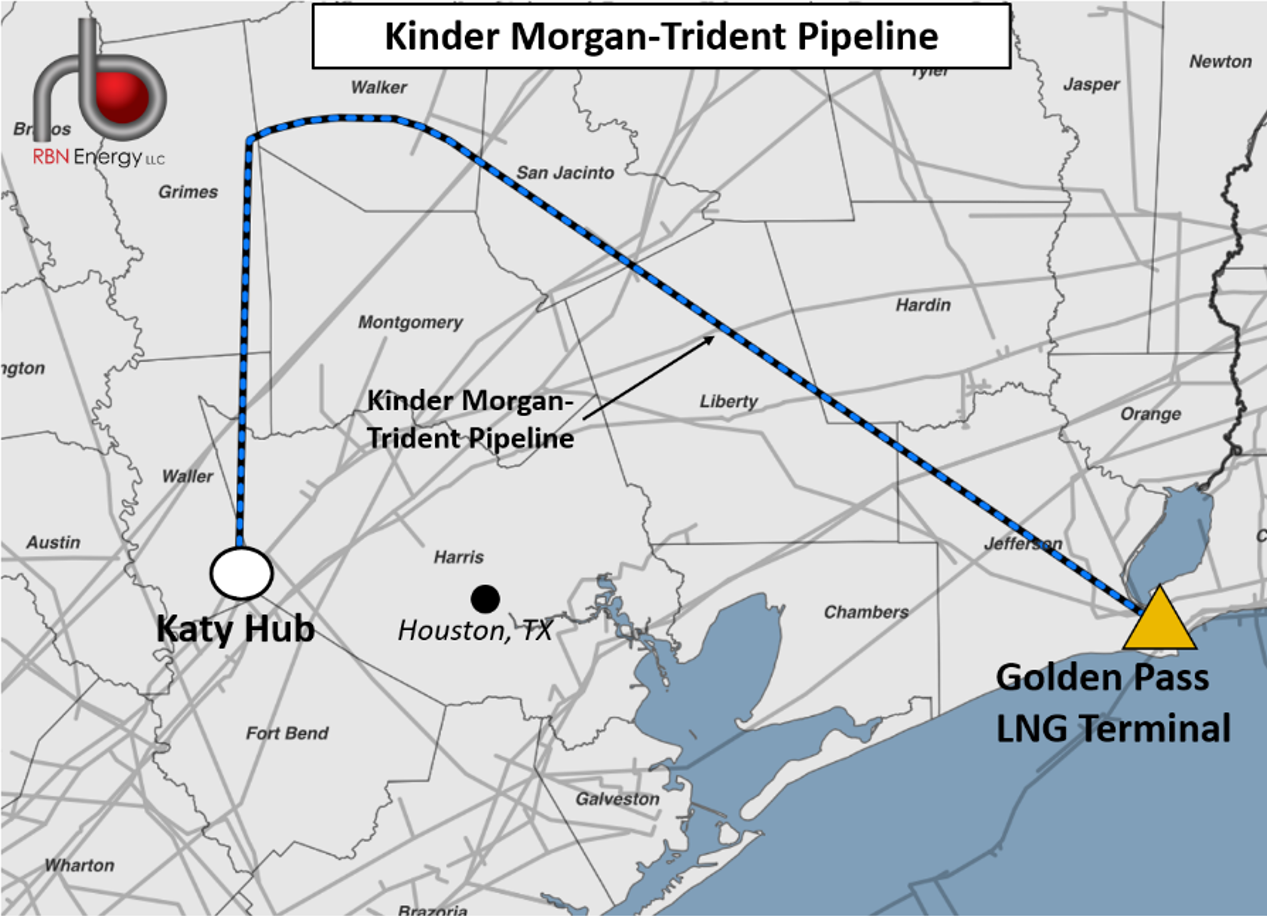
Figure 1. Potential Route for Kinder Morgan’s Proposed Trident Pipeline. Source: RBN

About the song
“Over the Hump” was written by Bunny Sigler and appears as the fifth song on Curtis Mayfield’s 15th studio album, Heartbeat. The song is about escaping the daily grind and getting over the hump to enjoy your life. It features Mayfield’s cool falsetto vocals over his signature single-coil Fender guitar stylings. Mayfield incorporated a unique open F-sharp tuning on his guitar, enabling him to utilize minimum finger movement to achieve his chording. He would use a capo to change keys. Personnel on the record were: Curtis Mayfield (vocals, guitar), Raymond Earl (bass), Ken Miller (guitar), Scotty Miller (drums) Bunny Sigler (orchestrations and arrangements), and uncredited session vocalists (backing vocals).
Heartbeat was recorded in early 1979 at Sigma Sound Studios in Philadelphia, Curtom Studios in Chicago, Kendum Recorders in Burbank, and Blank Tapes in New York City. Produced by Norman Harris, Bunny Sigler, Ronald Tyson and Curtis Mayfield, the album was released in August 1979. It went to #42 on the Billboard 200 Albums chart.
Curtis Mayfield was an American R&B singer, songwriter, guitarist and record producer. Known for his socially conscious lyrics, he started his professional career as a singer in the Chicago-based vocal group The Impressions when he was a teenager. After making several hit records with The Impressions, he went solo in 1970 until his death in December 1999 at the age of 57. With The Impressions, he released 12 studio albums and 50 singles. As a solo artist, he released 24 studio albums, a soundtrack album, a live album, nine compilation albums, and 34 singles. He was inducted into the Rock and Roll Hall of Fame as a member of The Impressions and as a solo artist. He is also a member of the Songwriters Hall of Fame and Vocal Group Hall of Fame. He won two Grammy Awards and has a Grammy Legend and a Grammy Lifetime Achievement Award.