Since the long-standing ban on most exports of U.S. crude oil was lifted more than five years ago, major ports and marine terminals along the Gulf Coast have been competing fiercely for the business of crude shippers. The primary weapons in this battle for barrels have been the abilities to provide easy pipeline access to the Permian and other key production basins, ample storage near the water for blending and staging, and top-notch dock facilities for quickly, efficiently loading crude onto tankers, the bigger the better. On that last point, for many shippers the vessel of choice is a 2-MMbbl VLCC, which typically offers the lowest per-barrel cost for long-distance oil delivery. Crude-laden VLCCs are “low riders” that need deep water, though, and so far only the Louisiana Offshore Oil Port can fully load one. Within a year, though, thanks to a long-awaited Corpus Christi Ship Channel dredging project now under way, marine terminals in Ingleside, TX, will be able to do the next-best thing: loading up to 1.6 MMbbl onto VLCCs, and thereby reducing the need for offshore reverse lightering. Today, we discuss the project to deepen the channel to 54 feet and its impact on crude exports.

The race among Gulf Coast ports for supremacy in crude oil exports doesn’t really have a finish line. Still, it’s fair to say that, after a slow start, Corpus Christi sprinted into the lead in late 2019, with export volumes surging past the Houston region’s ~1 MMb/d, and has been increasing that advantage ever since. As we said last spring in our How Much More Can She Stand blog series on export terminals, the Port of Corpus Christi’s growth in oil export volumes has been driven primarily by two things: (1) the three big new pipelines that now move crude from the Permian to the Corpus/Ingleside area (Cactus II, EPIC Crude, and Gray Oak) and (2) the extensive storage and marine-dock infrastructure already in place and the new, export-oriented pipeline connections, tankage, and docks being added. In three episodes in that same blog series, we looked at the veteran and newbie marine terminals along Corpus Christi’s Inner Harbor, and at the three terminals located across Corpus Christi Bay in Ingleside: the Moda Ingleside Energy Center, Flint Hills Resources Ingleside, and the new South Texas Gateway, which loaded its first tanker last July.
All nine of the Corpus/Ingleside terminals capable of exporting crude oil are sited along the broader Corpus Christi Ship Channel system (blue line in Figure 1) — six of them along the Inner Harbor end of the 29-mile-long main ship channel (gray terminal icons) and the three Ingleside terminals near the ship channel’s La Quinta Junction (dashed purple oval). The ship channel system has been developed, expanded, and deepened over the past 101 years, beginning in 1920 when Congress authorized a U.S. Army Corps of Engineers study on the feasibility of making Corpus Christi a deepwater port. Dredging for an initial 25-foot-deep channel from the Gulf of Mexico via an inlet near Port Aransas to Corpus’s shoreline started in 1925 and was completed the following year at a cost of $1.8 million. The Inner Harbor was dredged and deepened through a number of projects in the 1930s through the 1970s; the six-mile La Quinta Ship Channel spur from La Quinta Junction was added to the system in the 1950s. For more than 30 years, the entire system has been maintained at a depth 47 feet below what is now officially called “Mean Lower Low Water” (MLLW). For our purposes, MLLW is best described as the average minimal tidal depth likely to be encountered by maritime operators.
About the song
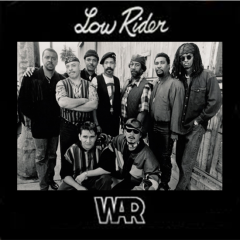
“Low Rider” was written by Jerry Goldstein, Lonnie Jordan, and Howard Scott. It is the seventh song on War's seventh studio album, Why Can't We Be Friends. Released as a single in June 1975, “Low Rider” rose to #1 on the Billboard R&B chart and #7 on the Billboard Hot 100 Singles chart. The song has been covered and sampled by many artists, including Willy DeVille, Beastie Boys, Carlos Santana, and George Clinton. It has also appeared in many television shows and films. Personnel on the record were: Howard Scott (guitar, vocals), B.B. Dickerson (bass, vocals), Lonnie Jordan (keyboards, vocals), Harold Brown (drums, vocals), Papa Dee Allen (congas, bongos, percussion, vocals), Charles Miller (horns, vocals), and Lee Oskar (harmonica, vocals).
Why Can't We Be Friends was recorded in 1974 at Sound City Studios in Van Nuys, CA, with Jerry Goldstein, Lonnie Jordan, and Howard Scott producing. Released in June 1975, the album went to #1 on the Billboard R&B chart, and #8 on the Billboard Top 200 Albums chart. Four singles were released from the LP, which has been certified Gold by the Recording Industry Association of America.
War is an American funk/rock/soul band formed in Long Beach, CA, in 1969. Jerry Goldstein and Eric Burdon saw the band playing at a club called the Rag Doll in North Hollywood in 1970, and enlisted the band to back Burdon. Their debut album together, Eric Burdon Declares "War," spawned the hit single "Spill the Wine" in 1970. Burdon would leave the band in 1971 after two albums. War has released 17 studio albums, three live albums, eight compilation albums, and 60 singles. Twenty-seven members have passed through the band since its formation. Three original band members have passed away: Charles Miller in 1980, Papa Dee Allen in 1988, and B.B. Dickerson in 2021. The band, under the direction of original member Lonnie Jordan, still records and tours.