For almost a year now, Corpus Christi-area marine terminals have been exporting more crude oil than their competitors in Houston, Beaumont, and Louisiana, largely thanks to the recent startup of new, large-diameter oil pipelines from the Permian to Corpus. Beginning today, with the expected arrival of the first tanker at the spanking-new South Texas Gateway Terminal in Ingleside, the Corpus area will have the potential to widen its lead in export volumes. In addition to its connections to the EPIC Crude and Gray Oak pipelines from West Texas — and the new Harvest Pipeline and the older Flint Hills Resources system — the South Texas Gateway facility can partially load 2-MMbbl Very Large Crude Carriers. Today, we discuss the Gulf Coast’s newest marine terminal and the important economic edge it gains from handling VLCCs.

Canadian crude output is rising, requiring new export routes. As traditional pathways face constraints, the U.S. Rockies—especially the Guernsey, WY hub—are emerging as key corridors for moving Canadian heavy crude to downstream markets, including the Gulf Coast.
According to RBN’s weekly Crude Voyager report, marine terminals in Corpus Christi and nearby Ingleside exported 249 MMbbl in the first six months of 2020, or about 1.54 MMb/d. That’s more exported crude than Houston (159 MMbbl) and Beaumont (73 MMbbl) combined, and more than three times what Louisiana sent abroad in the same period (80 MMbbl). Most impressive, perhaps, is how quickly Corpus has risen to the top. Terminals there exported only 160 MMbbl in 2018 as a whole, the equivalent of only 440 Mb/d. As we said, a big factor in Corpus’s growth has been the start-up of the Cactus II, EPIC Crude, and Gray Oak pipelines, which together provide some 2.1 MMb/d of Permian-to-Corpus pipeline capacity. But growth in export volumes would not have been possible without expansions at the port city’s five older crude-handling marine terminals and development of the four new export-focused terminals that have come online in the past 10 months: Eagle Ford Terminals (first loading in September 2019), EPIC Marine Terminal (December 2019), Pin Oak Corpus Christi (April 2020), and now South Texas Gateway.
We discussed the six terminals in Corpus Christi’s Inner Harbor area in Part 6 and Part 7 of our recent “How Much More Can She Stand” blog series. Then, in Part 8, we looked at the terminals in Ingleside, which is located across Corpus Christi Bay from Corpus proper, and which is served by a spur off the main Corpus Christi Ship Channel. At Ingleside, Moda Midstream’s Moda Industrial Energy Center (MIEC; blue terminal icon in Figure 1), has 11.6 MMbbl of storage capacity and three berths, while Flint Hills Ingleside Terminal (yellow terminal icon) — owned by Koch Industries’ Flint Hills Resources (FHR) unit — has 3.5 MMbbl of storage and two berths.
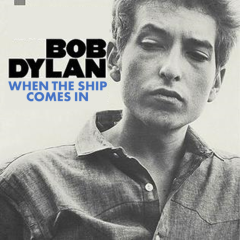
About the song
"When the Ship Comes In" was written by Bob Dylan and appears as the third song on side two of Dylan's third studio album, The Times They Are a-Changin'. Dylan wrote the song in August 1963, and first performed it with Joan Baez at the March on Washington the same month. The song is rumored to have been written about an incident in which a hotel clerk refused Dylan entrance into his hotel due to his "unkempt appearance." Others have speculated that the lyrical theme was influenced by the Brecht/Weill song, "Jenny's Song," from their Threepenny Opera.
“When the Ship Comes In” was recorded in New York City in October 1963. The Times They Are a-Changin' LP was recorded between August and October of that year at Columbia Studio A in New York City, with Tom Wilson producing. The album was released in January 1964, and went to #20 on the Billboard 200 Albums chart. It has been certified Gold by the Recording Industry Association of America. The LP’s title-track single went to #9 on the UK Billboard Singles chart, but it was not released as a single in the U.S.
Bob Dylan is an American singer-songwriter, author, and visual artist who has been an icon of popular culture for over 50 years. He has released 39 studio albums, 12 live albums, 19 compilation albums, 26 EPs, seven soundtrack albums, and 94 singles. Dylan has sold more than 100 million records worldwide. He has won the Nobel Prize in Literature, one Academy Award, one Golden Globe Award, and 10 Grammy Awards. Dylan is a member of the Rock and Roll Hall of Fame, the Songwriters Hall of Fame, and the Nashville Songwriters Hall of Fame. He has received the Presidential Medal of Freedom, and the French Legion of Honor, and has been named the MusiCares Person of the Year. Dylan's archives reside in the Gilcrease Museum and Woody Guthrie Center in Tulsa, OK. The Bob Dylan Center in the Arts District of Tulsa is scheduled for opening in late 2021. He still records and tours to this date. His latest album, Rough and Rowdy Ways, was released in June 2020. Touring is on hold for now due to COVID.