


The Marcellus/Utica is a natural-gas-and-NGLs play, right? Almost entirely, yes. But a handful of dogged, innovative E&Ps have been producing fast-rising volumes of superlight crude — better described as condensate — in the Utica Shale’s “volatile oil window” in eastern Ohio. In today’s RBN blog, we discuss recently ramped-up drilling-and-completion activity in that swath of the Buckeye State, the potential for more growth through the second half of the 2020s, and the impact of increasing output on Midwest midstreamers and refiners.

Canadian crude output is rising, requiring new export routes. As traditional pathways face constraints, the U.S. Rockies—especially the Guernsey, WY hub—are emerging as key corridors for moving Canadian heavy crude to downstream markets, including the Gulf Coast.
Few would have guessed it a quarter-century ago, but the Marcellus/Utica region in Pennsylvania, Ohio and West Virginia is now one of the world’s most prolific and vital natural gas production areas, with output currently topping 32 Bcf/d and decades of reserves yet to be tapped. The overlapping shale plays generate hundreds of thousands of barrels of NGLs per day that are consumed in the Northeast and Midwest, piped or railed away to other U.S. and Canadian markets — or piped to the Marcus Hook export terminal near Philadelphia and shipped overseas.
What’s less well-known is that parts of the Utica play — mostly in a few counties in eastern Ohio — also produce relatively modest amounts of crude oil, almost all of it condensate with an API value (or viscosity) of 55 to 59 degrees. More recently, at least a couple of E&Ps in the Utica have been producing small volumes of “heavy condensate” with an API value of 49 to 52-degrees — still far lighter than West Texas Intermediate (WTI), which has an API of about 40 degrees. (Despite the wide variation in the viscosity of condensate being produced in the Utica today, all condensate barrels in the play are currently fungible — though that may change, as we’ll discuss later.)
In the Pre-Shale 2000s, crude oil/condensate production in the three Marcellus/Utica states — the last gasp of output from conventional oil and gas wells drilled years earlier — was flat-lining at de minimis levels. But a sharp rise in drilling-and-completion activity pushed Ohio production alone to a peak of 80 Mb/d in the fall of 2015 and a pre-COVID peak of 87 Mb/d in the summer of 2019 (from only 14 Mb/d in 2012; see Figure 1 below). And, as we’ll get to later, production has been on a tear since the winter of 2021-22, more than doubling from a post-pandemic low of 48 Mb/d to 108 Mb/d in September, the latest EIA data available.
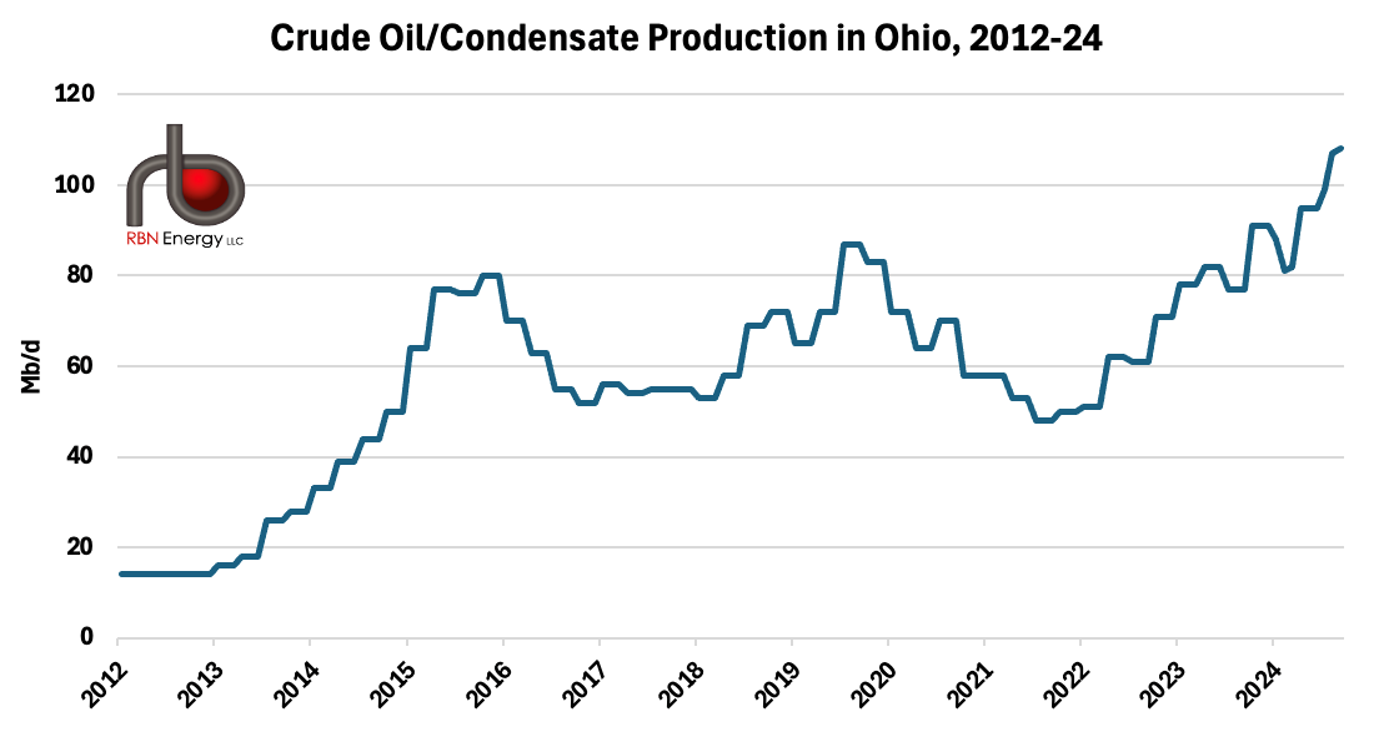
Figure 1. Crude Oil/Condensate Production in Ohio, 2012-24. Source: EIA
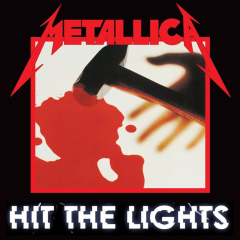
About the song
“Hit the Lights” was written by James Hetfield and Lars Ulrich and first appeared as the 10th song on the June 1982 Metal Blade compilation release, Metal Massacre. The album was produced by Metal Blade founder and owner Brian Slagel. It also featured cuts by Los Angeles metal bands Steeler, Ratt, and Malice. Metallica‘s name was misspelled as “Mettallica” on the label. Personnel on this version were: James Hetfield (vocals, guitar), Lloyd Green (guitar), Ron McGovney (bass), and Lars Ulrich (drums).
A second version of “Hit the Lights” appears as the first song on side one of Metallica’s debut studio album, Kill ’Em All. Lead guitarist Dave Mustaine was replaced by Kirk Hammet as recording for Kill ’Em All commenced, but it is rumored he played lead guitar on this song. Credited personnel on the album were: James Hetfield (vocals, rhythm guitar), Kirk Hammett (lead guitar), Cliff Burton (bass), and Lars Ulrich (drums). Kill ’Em All was recorded in May 1983 at Music America in Rochester, NY, and produced by Paul Curcio for Megaforce Records. Originally released in July 1983, the LP was re-released in 1988, when the band had four albums under its belt and a huge following. That time, the album went to #120 on the Billboard 200 Albums chart and has been certified 3X Platinum by the Recording Industry Association of America. Two singles were released from the LP.
Metallica is an American heavy metal band formed in Los Angeles in 1981 by James Hetfield and Lars Ulrich but based in the San Francisco Bay area for most of its career. They are considered one of the pioneering groups of thrash metal along with Slayer, Anthrax, and Megadeth. They have released 11 studio albums, eight live albums, one soundtrack album, three EPs and 49 singles and have sold more than 125 million records worldwide. Metallica has won two American Music Awards, five Billboard Awards, nine Grammy Awards and two MTV Video Music Awards. They were inducted into the Rock and Roll Hall of Fame in 2009. Eight members have passed through the band since its formation. Band founders Hetfield and Ulrich, along with lead guitarist Kirk Hammett and bassist Robert Trujillo, continue to record and tour.




Comments
It's a big problem for any refinery making asphalt or petcoke. Also, while you would think that such light "crudes" would flow easily through pipelines there is a high pour point issue due to paraffin wax content.