


Once consigned to a flat or declining profile, natural gas production in Western Canada has been increasing steadily since 2012, to the extent that it has now begun to stretch the ability of the existing pipeline network to the breaking point. Most striking is that this expansion in production has been taking place in an era of declining natural gas prices and weakening basis for Western Canada’s primary natural price marker, AECO, and rising and relentless competition from U.S. gas supplies in several of Canada’s key domestic and export markets. If the pricing, pipe egress and export situation has become so dire, why are producers still drilling for and pumping out even more natural gas? Today, we address this question in the second part of our series investigating Western Canada’s natural gas supply and demand balance.
Growing natural gas supplies from Western Canada have been depressing the AECO gas price and widening AECO’s discounts versus the U.S. benchmark Henry Hub (i.e. basis). Although the decline in the absolute AECO price has been part of a broader downturn in natural gas prices across North America, driven by rapidly rising U.S. gas supplies, it is the weakening of AECO basis (the local price relative to the U.S. benchmark Henry Hub) that suggests that the Western Canada gas market is facing additional challenges in the form of being oversupplied and/or under-piped. In the series opener (Part 1), we considered that big-picture trend — rising production in Western Canada and what has become a situation of insufficient export capacity in getting all that gas to market. We’ve also explored some of these issues previously in our Don’t Do Me Like That series, where we discussed additional operational issues on TC Energy’s Alberta pipeline system that may be contributing to weaker pricing and the widening basis outcomes for AECO. We’ll update our analysis on infrastructure constraints as well as local demand trends later in this series. First, today, we dive deeper into the production trends that have led the market to this point and their effects on prices.
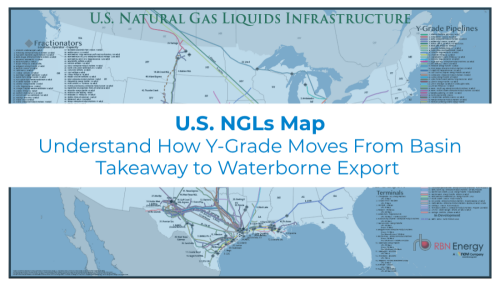
Visualize the infrastructure behind U.S. NGL movement.
The U.S. NGLs Map provides a comprehensive view of the transport, processing, and export networks moving NGLs across the U.S.
Figure 1 below provides a historical perspective on the relationship between AECO prices and natural gas production volumes from Alberta and British Columbia (BC) — where 98% of Western Canada’s gas is produced and where all of the transportation constraints have developed. AECO — shown with the left axis in U.S. dollars per MMBtu (US$/MMBtu; blue line) and Canadian dollars per gigajoule (C$/GJ; red line) — has experienced some very wild pricing episodes over the past two decades, but has been more or less on a downward track since 2014. By then, the Shale Revolution was well under way, and the U.S. Northeast was emerging as a net exporter of Appalachian supply to neighboring regions, including the U.S. Midwest and Ontario — markets previously served to a large extent by Western Canadian supply.

About the song
“Get Me Out of Here,” written by Stephan Jenkins, is the eighth track on the fifth studio album, Dopamine, by alternative rock band Third Eye Blind. The song and album were released in summer 2015 and reached #1 on the Billboard Independent Albums chart shortly after release. The song, along with many others on the Dopamine album written by Jenkins, took more than six years to finally reach completion, due to Jenkins’s frequent bouts with writer’s block and the band’s heavy touring schedule.
Third Eye Blind is an American alternative rock band formed in San Francisco in 1993. Originally consisting of the songwriting duo Stephan Jenkins and Kevin Cadogan, the band has also included Arion Salazar and Brad Hargreaves; the group released its first studio album in 1997. After the release of the band’s second album in 1999, Cadogan left the band, and numerous additional personnel changes have taken place over the years. Jenkins remains responsible for most of the band’s songwriting efforts, but frequently invites collaborations with other songwriters and other members of the band. Third Eye Blind remains active to this day, touring and releasing occasional extended singles.


