
From space the light thrown off by Bakken gas flaring makes sparsely populated western North Dakota look like Minneapolis-St. Paul. But the gathering pipelines, the processing plants and the interstate pipelines needed to transport Bakken gas to market are finally being built, and within a few years the glow of gas flaring in the region is expected to dim. Today we continue our review of gas flaring in the Bakken with a focus on increased efforts to move Bakken gas to processing plants and consumers.
In Part 1 of this series we described how lags in development of the infrastructure to gather, process and transport gas have kept the Bakken flaring issue on the front burner, so to speak. About 300 MMcf/d of gas produced in the oil-rich region is currently being flared or burned off, either because gas gathering capacity has not been built to serve newer wells, or because the gathering capacity that has been put in place requires more compression and/or “looping”,(building parallel lines). There is a big push on to build gas processing capacity. ONEOK, for example, started up 300 MMcf/d of processing capacity between December 2011 and April 2013, and plans to add another 400 MMcf/d (half of that at Garden Creek and half at Lonesome Creek) by the end of 2015. And Hess in April (2014) started up its newly expanded Tioga, ND processing facility, more than doubling its capacity to 250 MMcf/d. The region’s overall gas processing capacity now tops 1 Bcf/d and is expected to exceed 1.6 Bcf/d by the end of next year. Those totals respectively match current and expected gas production levels, but because of continuing shortfalls in gas gathering infrastructure too much stranded Bakken gas will still be flared.
To help reduce the share of gas flared in the region to less than 10% by 2020, the North Dakota Industrial Commission (NDIC) in March (2014) approved a rule that will require oil producers to provide gas capture plans for new drill sites starting on June 1, 2014 and will phase in the requirement for existing sites over the following few months. (Environmental groups want these to be expanded to require the plans to include onsite use of gas that for whatever reason cannot be piped out. We will explore onsite approaches to reduce flaring in our next episode.) NDIC also is considering a rule that would require oil producers to curtail production from wells until they are connected to gathering pipelines sufficient to collect all of the associated gas produced. The commission would exempt a producer from the requirement if it can be proven it would be economically infeasible to connect a well to a gas gathering pipeline. The North Dakota Petroleum Council, which supports the NDIC’s rule changes to date (and actually proposed most of them), also wants the state legislature to approve changes that would allow energy companies to acquire pipeline rights of way through eminent domain, if necessary, so needed gathering pipelines can be built much more quickly and the need for any flaring can be minimized.
Meanwhile, midstream companies are responding to the increasing volumes of Bakken gas being gathered and processed. North Dakota has two primary interstate (and cross-border) natural gas pipelines: the 2.4 Bcf/d Northern Border Pipeline (aqua line in the map in Figure #1) and the 1.6 Bcf/d Alliance Pipeline (green line), each of which was designed to deliver Western Canadian gas to the US’s industrial heartland.
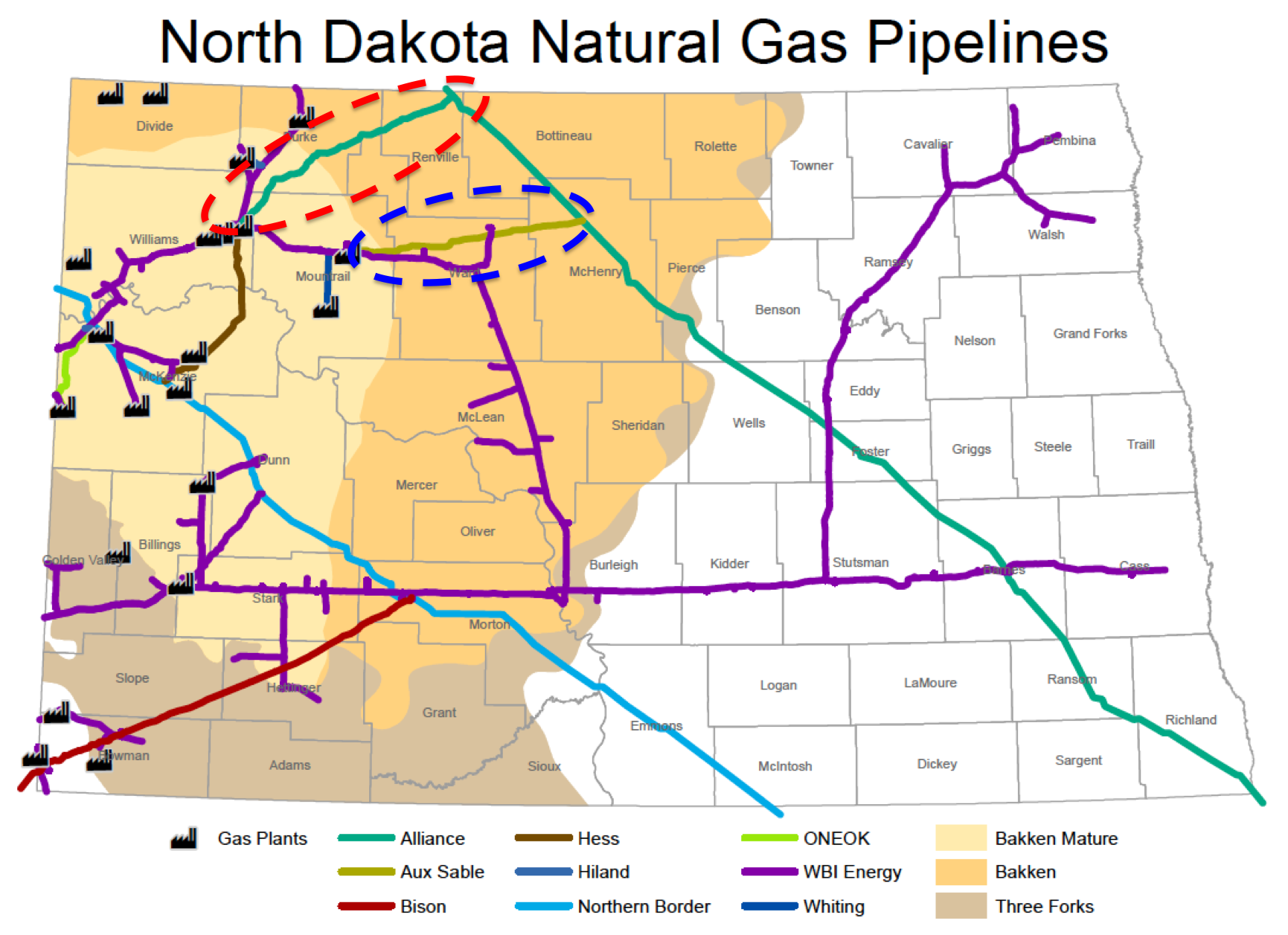
Figure #1

About the song
“We Didn’t Start the Fire,” a single from Billy Joel’s 1989 album Storm Front, was a Number 1 hit in the U.S. and a Top 10 hit in several other countries.