For the first time ever, U.S. natural gas-fired power plants are routinely generating more electricity than their coal-fired counterparts, at least during the spring, summer and fall. Prior to 2015 coal held a clear lead over natural gas in power generation but last year they were neck and neck at 33% of fuel consumed for power generation according to the latest Energy Information Administration (EIA) statistics released Friday (February 26, 2016). This is partly due to tightening federal environmental rules, but another major driver is very low natural gas prices, which have been averaging below $2/MMBtu. Coal prices have been falling too as coal markets respond to stronger-than-ever competition from gas, but not enough to prevent a lot of coal-to-gas switching in the power sector. Today, we update last fall’s analysis of the death-match battle between coal and natural gas with a look at how persistently low gas prices may keep gas on top.
In April 2015, U.S. power plants fired by natural gas produced more electricity than coal-fired plants—that had never happened before. Coal retook the lead in May and June, but since then gas has remained on top, and in some months gas’s edge over coal has been significant. In October, for example, gas-fired units generated 35% of the nation’s power, compared with 31% for coal, and in December--the latest month for which EIA statistics are available—the score was gas 34%, coal 28%. What a difference a year makes. In October 2014, coal-fired generation held a huge 38%-to-27% edge over gas, and the following month coal’s margin over gas was a still-significant 35% to 31%. As we discussed back in September 2015 – the last time we looked at the contest (see Torn Between Two Fossil Fuels) - as recently as 2008 coal-fired units were producing more than twice the electricity that gas units did. Since then, U.S. production of natural gas has continued growing, natural gas prices (which spiked to more than $13/MMBtu in 2006) have fallen (and become less volatile), and federal rules on power plant emissions have been tightened considerably, with possible implementation of the Environmental Protection Agency’s (EPA) Clean Power Plan (CPP)—a potential game-changer for coal and gas—looming.
Last September we also discussed the final version of the CPP (whose implementation the U.S. Supreme Court blocked on February 9, 2016 with a “stay” until legal challenges to the CPP play out), which calls for reducing the power sector’s carbon dioxide (CO2) emissions by 32% from their 2005 levels by 2030, mostly through the expanded use of wind and solar power. If the CPP is implemented, EPA expects coal’s share of total generation to decline to 27% in 2030 (from an average of 33% in the 12 months ended December 2015) and gas’s share to inch up to 33% (from 32% in the December 2014-November 2015 period).
Our focus this time shifts to the nearer term, and specifically to the outlook for 2016 and 2017 natural gas consumption by the U.S. power sector. Once safety and reliability are assured, regional electric grid operators and individual utilities base their hour-by-hour decisions on which generation units to run (or keep idle) primarily on the fuel cost of producing power at each unit—and, of course, on just how much power is needed at any given moment to keep pace with electricity demand. Typically, power sources with low fuel costs (such as wind turbines, solar photovoltaic facilities and “run-of-the-river” hydroelectric units) are always called upon to feed whatever energy they are generating into the grid. Larger “baseload” units such as nuclear plants and (newer, bigger and cleaner) coal-fired units are also dispatched most of the time because their fuel costs per megawatt hour (MWh) are very low and they take a long time to start and stop. As electricity demand rises, the next units to be “dispatched” (or called into service) are generally the next tier of (slightly less efficient) coal units and/or highly efficient gas-fired combined-cycle gas turbine (CCGT) units (which use both gas turbines and waste-heat-driven steam turbines to produce up to 50% more power than simple-cycle combustion turbines, or CTs, see Strange Magic). If electricity demand is high enough to warrant still more power generation (say, on a cold winter morning or a hot summer afternoon), grid operators and utilities turn to higher-cost generators that are typically older and less efficient or burn expensive feed stock like fuel oil. Material differences in the balance between coal and natural gas used for power generation result from an increase in the use of newer CCGT plants in place of coal to meet baseload demand. All available gas and coal units are used to meet demand during on-peak periods.
About the song
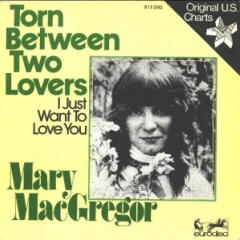
“Torn Between Two Lovers” was written by Peter Yarrow (of Peter, Paul & Mary fame) and Phillip Jarrell. It appears as the fifth song on side two of the 1976 debut album of the same name by Mary MacGregor. The song about a love triangle was recorded at Muscle Shoals Studio in Alabama and released as a single in November 1976. It went to #1 on the Billboard Hot 100 Singles chart and has been certified Gold by the Recording Industry Association of America. Personnel on the record were: Mary MacGregor (lead vocals), Berry Beckett, Tim Henson (keyboards), David Hood (bass), Roger Hawkins (drums), Ken Bell (acoustic guitar), David Campbell (string arrangements, conducting), and Ginger Holladay, Lisa Silver, Sheri Kramer (backing vocals).
The album Torn Between Two Lovers was recorded in 1976 at Muscle Shoals Studio in Sheffield, AL, and produced by Peter Yarrow and Barry Beckett. Released in November 1976, it went to #3 on the Billboard Country Albums chart and #17 on the Billboard 200 Albums chart. Three singles were released from the LP.
Mary MacGregor is an American pop singer. She started her professional career in 1975 as a backing vocalist for Peter Yarrow on tour and appeared on Yarrow’s Love Songs LP. Yarrow helped to secure a record deal on Ariola Records for the singer and a production deal for Yarrow and Muscle Shoals musician Barry Beckett to produce her debut album. She released four studio albums and 10 singles. In 1980, she won Best Song at the World Popular Song Festival in Tokyo. MacGregor retired from the music business in 2000 and lives with her husband and children on a ranch in central California.