


For the next few years, New Englanders will remain heavily dependent on natural-gas-fired generation — and keep their fingers crossed regarding the availability of piped-in gas for power during periods of frigid winter weather. But the power sector in the enviro-conscious six-state region has ambitious plans to gradually ratchet down its reliance on gas and other fossil fuels and increase the role of wind, solar, and battery storage. Over time, that could help to alleviate the gas-supply risk associated with New England’s seasonally insufficient gas pipeline capacity. However, front-and-center roles for highly variable renewable energy sources could pose reliability challenges of their own. In today’s RBN blog, we discuss the evolution of the region’s electric grid and what it may mean for natural gas producers and midstreamers.

The Natural Gas Master Class is a one-day online event focusing on understanding flow analysis, interpreting pipeline data and forecasting future flows. This course is designed to equip you with the knowledge and skills to effectively analyze the complexities of natural gas markets, flow analysis, and pipeline modeling. Join us online
October 21 | Online
For two decades, fans of the New England Patriots depended on Tom Brady — and their GOAT (greatest of all time) hardly ever disappointed, taking the Pats to 17 division titles, 13 AFC championship games, and nine Super Bowls (winning six of them). That’s an enviable combination of reliability and excellence. But 20 years is an eternity for an NFL quarterback, and Brady, in March 2020, decided to part ways with cold and snowy Gillette Stadium in Foxborough, MA, and take his extraordinary talents to the Tampa Bay Buccaneers, who offered him more money, a stronger offense (and defense), and a much warmer place to practice, play, and live. The 2020-21 season was a tipping point for the Pats, who struggled under a new QB, Cam Newton, and didn’t make it to the playoffs for the first time in a dozen years. This season, though, the Patriots are back — Newton is out and, under the team’s rookie QB, Mac Jones, New England leads the AFC East and has the inside track to a playoff spot. In other words, there may be a future for the Pats without Brady after all.
New England’s power generation sector may soon approach a tipping point too, and its success in pulling off a smooth transition from the old paradigm to the new hangs in the balance. For half a century, the northeastern corner of the Lower 48 has relied on a traditional mix of coal-, oil-, and natural-gas-fired plants — plus a handful of nuclear plants and some imported hydroelectric power from Quebec — to keep the lights on. By the 2010s, however, there was a big push to shut down emission-intense coal and oil plants and, especially in Vermont and Massachusetts, to close older nuke units too, replacing most of their generating capacity with new gas-fired combined-cycle plants and peaking units. In the 2018-20 period alone, about 2,500 MW of new gas capacity came online (white power plant icons in Figure 1), including an 805-MW Competitive Power Ventures facility in Oxford, CT; a 674-MW Footprint Power plant in Salem, MA; a 485-MW PSEG Power plant in Bridgeport, CT; a 333-MW Stonepeak Infrastructure Partners peaking unit in Sandwich, MA; and a 200-MW Exelon plant in Medway, MA.
About the song
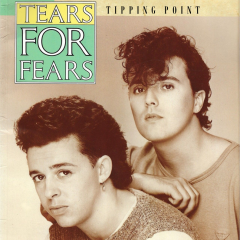
“The Tipping Point” was written by Roland Orzabal and Charlton Pettus. It will appear as the second cut on the album of the same name by Tears for Fears, due to be released in February 2022. Released as a single in October 2021, “The Tipping Point” went to #20 on the Billboard Adult Alternative Songs Singles chart. It was Tears for Fears’ first new original song released in four years. Personnel on the record included: Roland Orzabal (vocals, guitar, keyboards), and Curt Smith (vocals, bass, keyboards).
The Tipping Point album is the seventh studio album by Tears for Fears. It will be the first studio LP they have released since Everybody Loves a Happy Ending, released 18 years ago. Produced by Florian Reutter, Sacha Skarbek, and Tears for Fears, the album will be released in February 2022. Two singles have been released from the LP to date.
Tears for Fears are an English pop rock band formed in Bath, England, in 1981 by Roland Orzabal and Curt Smith. They have released six (soon to be seven) studio albums, three live albums, three compilation albums, one EP, and 35 singles. They have two Gold and seven Platinum albums, as certified by the Recording Industry Association of America. The band still records and occasionally tours, with a summer tour of the U.S. and UK scheduled to commence in May 2022.





Comments
The article would have been more informative if it had included an estmate of the cost impact on consumers in New England of the transition from natural gas-fired generation to the new "green" electric generation resources.