Infrastructure constraints in the energy sector come in all shapes and sizes, and don’t think for a second that they only involve pipelines. For many producers of crude oil, refined products and other liquids, the Mississippi River is a critically important conduit for barging commodities to market. Lately though, water levels on sections of the river have been near historic lows, reducing both the volume of liquids that each barge can carry and the number of barges the Mississippi can handle. Among other things, the low water situation has been putting a squeeze on condensate producers in the “wet” Marcellus/Utica, who depend on barges to transport a significant portion of their superlight crude oil down the Ohio and Mississippi rivers to refineries and for blending into Light Louisiana Sweet (LLS). In today’s RBN blog, we discuss the situation.
The rapid run-up in U.S. crude oil, natural gas and NGL production through the 2010s put enormous pressure on the nation’s energy-related infrastructure. In what seemed like a flash, the Bakken in western North Dakota became a leading crude oil play, spurring the development of crude-by-rail terminals and takeaway pipelines. In the Marcellus/Utica, production growth made the Northeast self-sufficient in natural gas and resulted in a slew of pipeline reversals, expansions and greenfield projects to enable gas to flow west and south. And over the past five years or so, we’ve chronicled a phenomenal build-out of infrastructure within and out of the Permian, most of it designed to gather and process hydrocarbons in West Texas and southeastern New Mexico, and transport them to end-users and export markets along the Gulf Coast.
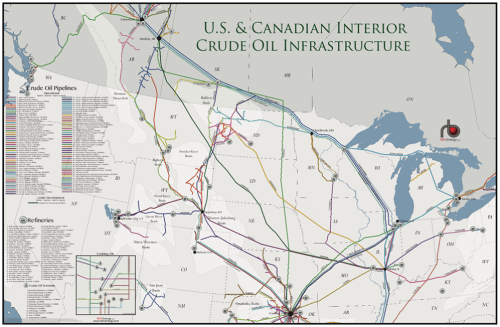
RBN's US & Canadian Interior Crude Oil Infrastructure Map features pipelines, refineries, and terminals that are new, existing, and under development from Canada to the Bakken Shale to Cushing.
One of the most impressive — and comprehensive — infrastructure projects of the Shale Era was MPLX’s development of a condensate and NGL “purity product” pipeline-and-storage network in the Midwest. RBN estimates that the network now transports more than 30% of the condensate produced in the liquids-rich Marcellus/Utica play; the pipes also move much of the natural gasoline produced there and, more recently, a portion of the play’s isobutane as well. As important as this network is, however, Marcellus/Utica producers also depend on other means of transport to get these liquids to market, especially barges moving condensate down the Ohio and the Mississippi.

About the song
“A Country Boy Can Survive” was written by Hank Williams Jr. and appears as the first song on side one of Williams’s 33rd studio album, The Pressure is On. Released as a single in January 1982, it went to #2 on the Billboard Hot Country Singles chart and has been certified Gold by the Recording Industry Association of America (RIAA). It is considered one of Williams’s signature songs and has been referred to as “the rednecks’ national anthem.” It paints a positive picture of survival in rural America, even if “the preacher man says it’s the end of time and the Mississippi River, she’s a-goin’ dry.” After 9/11, Williams re-wrote the song as “America Will Survive” and the re-written single went to #45 on the country charts, as did the re-release of the original song on its 25th anniversary in 2007. Personnel on the record were: Hank Williams Jr. (vocals, acoustic, electric guitars, dobro); Kenny Bell, Bobby Thompson and Paul Worley (acoustic guitar); Reggie Young and Billy Joe Walker Jr. (electric guitar); Joe Osborn and Bob Wray (bass); James Stroud (drums); Larry Knechtel and Pig Robbins (piano); Mike Lawler (organ); Eddie Long and Sonny Garrish (steel guitar); Mike Auldridge (dobro); Lisa Silver and Vernon Derrick (fiddle); Reggie Young (electric sitar); and Terry McMillan (harmonica).
The Pressure is On was recorded at Sounds Stage Studios in Nashville during the summer of 1981, with Jimmy Bowen producing. Released in August 1981, it went to #5 on the Billboard Top Country Albums chart and #76 on the Billboard 200 Albums chart. Two hit singles were released from the LP.
Hank Williams Jr. (Randall Hank Williams Jr.), also known as Bocephus, is an American singer, songwriter, and musician. He is the son of legendary country music artist Hank Williams and the father of Hank Williams III. Williams first stepped on a stage at the age of eight, singing his father’s songs. By the age of 15, he was performing on the 1964 television shows Shindig and The Jimmy Dean Show. The same year found Williams adding the vocals to the film Your Cheatin’ Heart and releasing his debut album, Long Gone Lonesome Blues. By the mid-1970s Williams had reinvented himself with the release of his Hank Williams Jr. and Friends LP, featuring a more Southern rock approach. In December 1975, just before the album’s release, Williams was severely injured in a mountain-climbing accident that took him two years to recover from. As his music leaned more toward Southern rock, Williams’s record sales began to climb. Between 1979 and 1992, the prolific artist released 21 albums that were all certified at least Gold by the RIAA. He has released 36 studio albums, 25 compilation albums and 109 singles. He has won 24 ACM Awards, 11 CMA Awards, four Emmy Awards and eight Grammy Awards and is a member of the Country Music Hall of Fame and the Nashville Songwriters Hall of Fame. Williams continues to record and tour.