Crude oil is demonstrating yet again its penchant for what markets hate most: surprise. Last month, the Organization of the Petroleum Exporting Countries (OPEC) and collaborating governments were carefully easing the production cuts with which they steered the market through an oil-demand crisis caused by the COVID-19 pandemic. Demand was recovering as economies reopened after being locked down during most of 2020 and early 2021. And the near-month futures price for light, sweet crude on the New York Mercantile Exchange (NYMEX) — having closed below zero for the first time ever on April 20, 2020 — rose above $70/bbl for the first time since October 2018. Until mid-June, the market’s main concern was the potential for a supply surge if Iran escaped sanctions by agreeing with the U.S. to again suspend nuclear development. Surprise! Only days after his election as Iranian president on June 18, Ebrahim Raisi announced new limits on what his government would negotiate regarding nuclear work and said he would not meet with U.S. President Joe Biden. Suddenly, new oil supply from Iran looked less imminent than it did before Raisi’s election. Then July arrived. Surprise! OPEC members and nonmembers, collectively known as OPEC+, which had been voluntarily limiting production ended an important meeting without agreeing, as had been expected, to extend their phasedown of supply restraint. Suddenly, the market had to wonder whether the result would be too little supply or a price-crushing production spree if OPEC+ discipline collapsed. In today’s blog, we examine how these developments relate to each other in the twin contexts of a rebalancing oil market and of past oil-supply management.

After last year’s craziness, it can be hard to remember that the OPEC+ agreement predated the COVID pandemic by several years. Officially known as the Declaration of Cooperation (DOC), the deal came together in late 2016 in response to a price collapse that began in mid-2014 (see Is This the Real Life? Is This Just Fantasy?). As agreements to limit production go, this one has had impressive staying power. It has survived competition (especially from oil produced from U.S. shale), membership changes, and — most dramatically — the March 2020 rift between production leaders Saudi Arabia and Russia, which we blogged about in Wipe Out. In fact, as we noted in Heal Me, the OPEC+ group refashioned the DOC in April 2020 to move forward from that brouhaha, importantly assigning the two disputants equivalent quotas of 11 MMb/d each and agreeing to cut OPEC+’s production by a total of 9.7 MMb/d for two months and by diminishing amounts later. The collective production cut now is down to 5.8 MMb/d. It was at a July 1 meeting of OPEC+ representatives that a new, market-rattling dispute emerged, this one between Saudi Arabia and the United Arab Emirates (UAE; see What a Fool Believes).
We’ll cover the Saudi-Emirati flare-up in a minute. First, we need to look at the fading prospects for new Iranian supply anytime soon to illustrate the market conditions under which all this plays out and then to show how these surprises are linked.
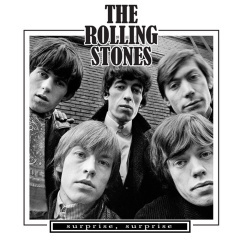
About the song
“Surprise, Surprise” was written by Mick Jagger and Keith Richards. It appears as the sixth song on side two of The Rolling Stones’ third U.S. album, The Rolling Stones Now! Personnel on the record were: Mick Jagger (lead vocals, tambourine, percussion), Keith Richards (guitar, backing vocals), Brian Jones (guitar, backing vocals), Bill Wyman (bass, backing vocals), and Charlie Watts (drums, percussion).
The Rolling Stones Now! album was recorded between June 1964 and January 1965 at Chess Records in Chicago, RCA Records in Hollywood, and Regent Sound Studios in London. Produced by Andrew Loog Oldham, the LP was released in the U.S. in February 1965. It went to #5 on the Billboard Top 200 Albums chart, and has been certified Gold by the Recording Industry Association of America. Two singles were released from the album. “Heart of Stone” went to #19 on the Billboard Hot 100 Singles chart.
The Rolling Stones are an English rock band formed in London in 1962. Eight members have passed through the band since its formation. Founding members Mick Jagger and Keith Richards are still in the band. Longtime member Ronnie Wood joined them in 1974 after the departure of Mick Taylor. Brian Jones died in 1969, Bill Wyman officially retired from the band in 1995, and Charlie Watts died in 2021. Darryl Jones has been the touring bassist for The Stones since 1993. The Rolling Stones have released 31 studio albums — their latest, Hackney Diamonds, dropped last week — as well as 33 live albums, 29 compilation albums, three EPs, and 121 singles. They have won one Billboard Music Award, 11 Grammy Awards, three MTV Video Music Awards, and two World Music Awards. The Rolling Stones were inducted into the Rock and Roll Hall of Fame in 1989 and the UK Music Hall of Fame in 2004. The band continues to record and tour.