
Refinery distillation units separate crude oil into light, medium and heavy fractions. After that, refiners start performing chemical reactions using catalysts — materials that accelerate chemical reactions — to change the oil’s natural molecules into the forms needed in modern fuels. In recent years, refiners have stepped up their efforts to recycle those catalysts to improve their profitability and environmental performance. In today’s RBN blog, we explain how catalysts, which were formerly disposed of as hazardous waste, are increasingly being recycled and reused in refineries.

The Natural Gas Master Class is a one-day online event focusing on understanding flow analysis, interpreting pipeline data and forecasting future flows. This course is designed to equip you with the knowledge and skills to effectively analyze the complexities of natural gas markets, flow analysis, and pipeline modeling. Join us online
October 21 | Online
To produce the fuels they need, refineries employ catalytic cracking, which cracks heavier molecules into lighter gasoline molecules, increasing the volume of gasoline produced from a barrel of crude, and catalytic hydrogenation, which removes sulfur atoms embedded in the molecules, thereby reducing pollution when fuel is combusted. These reactions do not occur at measurable rates except in the presence of a catalyst.
To understand the importance of a catalyst, let’s start with a look at a sulfur compound commonly found in gasoline before it is desulfurized, known as 2,4-diethylthiophene. It consists of a carbon-ring structure containing a single sulfur atom with two attached hydrocarbon side chains containing two carbon atoms each (see Figure 1 below). The sulfur atom (S) is a problem because when this molecule is burned in engines, the sulfur atom ends up as part of sulfur oxide, which impairs the performance of a vehicle’s catalytic converter and contributes to air pollution.
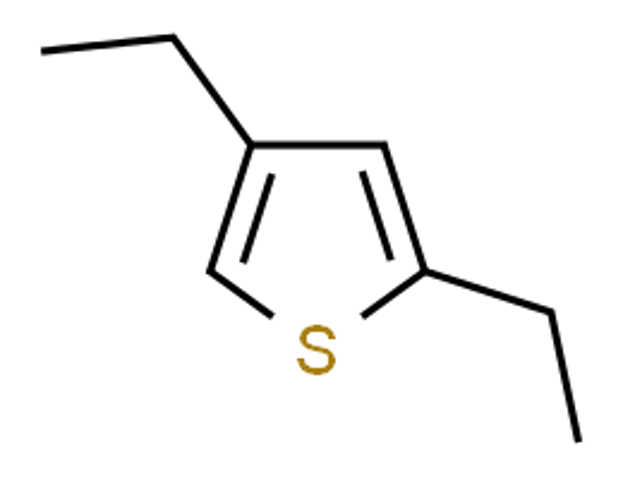
Figure 1. Structural Image of 2,4-diethylthiophene. Source: ChemSpider
Tighter regulations forced the virtually complete removal of sulfur from 21st century gasoline. Today, this molecule is desulfurized at the refinery in a hydrogenation reactor, where it reacts with hydrogen to form a sulfur-free gasoline molecule that goes into the gasoline pool. The sulfur atom instead ends up in the byproduct hydrogen sulfide (H2S), which goes to another unit at the refinery where it is converted into elemental sulfur. That desulfurization reaction, and ones like it, are occurring continuously in hydrogenation reactors in every modern refinery today and are the single biggest reason modern fuels cause less pollution.

About the song
“Save It For Later” was originally written by Dave Wakeling as a teenager before he formed his group, which was called The English Beat in the U.S. and The Beat in the UK. The song appears as the first song on side two of The English Beat’s third studio album, Special Beat Service. It was released as a single in April 1982 and went to #58 on the Billboard Dance/Disco chart. The Who's Pete Townshend claims the song is one of his favorites and has covered it on several occasions. The song has also appeared in a few movies and television shows. Personnel on the record were: Dave Wakeling (vocals, guitar), Ranking Roger (toasting, vocals, percussion), David Steele (bass), Andy Cox (guitar), Everett Morton (drums) and Saxa (saxophone).
Special Beat Service was the third and final studio album of the original version of The English Beat. Produced by Bob Sargeant in England in spring of 1982, the album went to #39 on the Billboard Top 200 Albums chart.
The English Beat were formed in Birmingham, England, in 1978. The original band recorded three studio albums and released 13 singles. Ranking Roger would later front a version of the English Beat in the UK, while Dave Wakeling would do the same in the U.S., where he now lives in the Los Angeles area. The English Beat featuring Ranking Roger released two studio albums and three live albums, and The English Beat featuring Dave Wakeling released one studio album. Dave Wakeling and Ranking Roger left the band in 1983 and formed the group General Public. Beat members Andy Cox and David Steele formed the band Fine Young Cannibals. Ranking Roger died in March 2019 at the age of 56.