


It seems logical to maintain stockpiles of critically important commodities like crude oil, heating oil and gasoline. After all, supply can be cut off suddenly by acts of God or man, causing price spikes, cold houses and empty gas tanks. Worries about supply interruption led to the creation of a federal Strategic Petroleum Reserve (SPR) and Northeast Home Heating Oil Reserve (NEHHOR) and, more recently, both federal and state reserves for motor fuels, again in the Northeast. But does the SPR as currently configured still make sense, given how much has changed in crude production and flows? Should we set up heating oil or motor fuel reserves in regions beyond the Northeast? And what about a strategic reserve for propane—an important fuel for millions of American homes and businesses? Today, we continue our look at the challenges of stockpiling hydrocarbons in a changing, unpredictable energy world.
It may surprise many readers to know that the U.S. is actually in worse shape today as far as our reliance on crude supplies from overseas (imports) are concerned than it was during the Arab oil embargoes of the 1970s—in spite of the recent shale boom driven increase in domestic production. In May of 1973 Energy Information Administration (EIA) data shows that U.S. crude production was 9.3 MMb/d while imports were 3.2 MMb/d. In November of 2014 production was 9 MMb/d but imports were 7.3 MMb/d – more than double what they were in the 70’s. So we remain vulnerable to the disruptive, out-of-the-blue supply cut-offs that can come from events as different as a Category 5 hurricane, an uprising in the Middle East or the current U.S. refinery workers strike As we said in Episode 1 of our series, the federal government responded to the 1973-74 Arab oil embargo by establishing the SPR that now stores 692 MMBbl of crude at four salt-dome sites along the Gulf Coast and reacted to spiking heating oil prices in the winters of 1996-97 and 1999-2000 by setting up NEHHOR, the nation’s first refined products stockpile that now stores a total of 1 MMBbl at sites in Connecticut and Massachusetts. More recently, in the wake of Superstorm Sandy in October 2012, both the feds and the state of New York started strategic reserves for gasoline and diesel. The feds are storing a total of 1 MMBbl of motor fuel, 700 MBbl of it at sites in New Jersey and 300 MBbl at sites in Massachusetts and Maine; New York is storing a total of 131 MBbl, 71 MBbl of it on Long Island and 60 MBbl upstate.
The value of the SPR has been tested, but only on a relatively small scale. In no instance has a hurricane, international crisis or other event required the release of more than 30 MMBbl (less than 5% of SPR’s total reserves). (That high mark of SPR sales came in 2011, because of supply disruptions in Libya and other countries.) There are a lot of questions about the value of having an SPR. Many ask whether it is too big (or too small), whether the types of crude it stockpiles match the imported supplies that might be interrupted, and whether the SPR sites’ location along the Gulf Coast still makes sense, given the major changes in U.S. oil production and flows in the past few years. Some also wonder why the federal government takes such an outsized role in meeting the total U.S. requirement (under our long-standing agreement with the International Energy Agency, or IEA) to maintain stockpiles of crude or refined products equivalent to at least 90 days of imported supply. Most other IEA members either impose stockpiling requirements on or share the obligation with, their oil industry, in order to meet the IEA mandate.

Figure #1
About the song
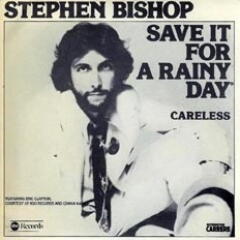
"Save It for a Rainy Day" was written by Stephen Bishop, and appears as the 10th song on Bishop's debut studio album, Careless. The song was released in December 1976 and went to #6 on the Billboard Adult Contemporary chart and #22 on the Billboard Hot 100 Singles chart. Personnel on the recording were: Stephen Bishop (lead vocals, acoustic guitar), Eric Clapton (lead electric guitar), Jeff Staton Jones (bass, rhythm electric guitar), Russ Kunkel (drums), Barlow Jarvis (acoustic piano, electric piano), Chaka Khan (backing vocals, lead vocal at end of song), and Ian Freebairn-Smith (horn arrangements). Country artist Kenny Chesney had a #1 hit on the country charts with a different song of the same title. Americana band, The Jayhawks, had a different song with the same title on their album, Rainy Day Music.
Bishop’s Careless LP was recorded at ABC Studios and A&M studios in Hollywood, CA, with Henry Lewy and Stephen Bishop producing. Released in December 1976, the album went to #32 on the Billboard Top 200 Albums chart. Two singles were released from the album, the other being “On and On,” which peaked at #11 on the Billboard Hot 100.
Stephen Bishop is an American singer-songwriter, musician, and actor. He is also known as playing the folk singer on the stairway in the movie National Lampoon's Animal House, where John Belushi grabs his guitar and smashes it to pieces. Bishop has contributed many songs to motion pictures, and a long list of recording artists have covered his songs over the years. Bishop has released 19 albums and 16 singles. He continues to record and tour to this date, with all touring plans on hold until 2021 due to COVID.






Comments
Crude oil imports are 7.3 MMbpd, but some of that is refined and exported. The SPR volume would not have to account for that volume if the objective is to keep US consumers supplied.