


The EIA report on propane inventories that came out yesterday was a shocker. This time of year, stocks are supposed to be building toward the levels needed to get U.S. propane markets through the winter season. But the numbers released on Wednesday showed an inventory decline, resulting in inventory balances now below the five-year minimum. The culprit, of course, is exports, with 1.4 MMb/d of them reported last week, a 17% gain over the year-to-date average. And these cargoes to overseas markets are happening even with propane prices in the stratosphere: more than double where they stood this time last year. Propane marketers were hoping that higher prices would slow down exports, but so far that is not happening. In today’s blog, we examine U.S. exports of LPG — propane plus butane — and discuss what may be ahead for these markets.
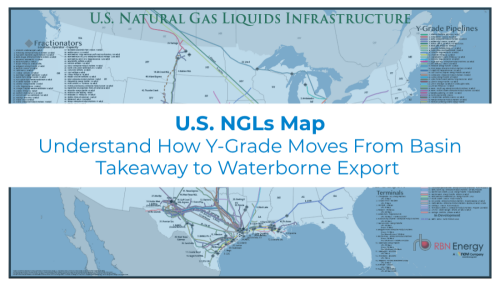
Visualize the infrastructure behind U.S. NGL movement.
The U.S. NGLs Map provides a comprehensive view of the transport, processing, and export networks moving NGLs across the U.S.
This situation just keeps on getting more convoluted. We’ve done half a dozen blogs over the past few months (most recently, Skyrockets in Flight and Higher), wringing our hands over the trajectory of propane inventories — or lack thereof. As shown in Figure 1 below, EIA’s propane/propylene stocks number declined during the week ending August 6, dropping by 640 Mbbl (red line within dashed purple oval) to 65.3 MMbbl. There has not been an inventory decline in the first week in August for at least a decade. Last week’s drop puts inventories a whopping 24 MMbbl below their year-ago level (blue line) and 1.1 MMbbl below the five-year minimum (bottom edge of gray-shaded area). The numbers for the Gulf Coast (PADD 3) are even more worrisome, with inventories down by 951 Mbbl to 33 MMbbl — 1 MMbbl below the five-year minimum. Sure, it does not get as cold along the Gulf Coast as it does in the Midwest, but a lot of propane moves south from PADD 2 to PADD 3 in the form of y-grade (mixed NGLs produced in PADD 2 but fractionated in Mont Belvieu). In effect, the Midwest is competing with export markets and so far, the export markets are winning. But the heavy propane demand months are just around the corner, with crop drying and then cold weather coming on in just a few weeks.
About the song
“Running on Empty” was written by Jackson Browne and appears as the first song on his fifth album of the same name. Released as a single in February 1978, the song went to #11 on the Billboard Hot 100 Singles chart. It was recorded live at the Merriweather Post Pavilion in Columbia, MD, in August 1977. Personnel on the record were: Jackson Browne (lead vocals, guitar), Danny Kortchmar (guitar), David Lindley (lap steel guitar), Craig Doerge (piano), Leland Sklar (bass), Russ Kunkel (drums), and Rosemary Butler and Doug Haywood (backing vocals).
Running on Empty was a unique album in that all the song’s themes focused on life on the road. The album was recorded at various locations, including concert venues, the tour bus, and hotel rooms. None of the tracks had been released on an album before, and they included Browne’s road band at the time. Recorded in August and September 1977 and produced by Jackson Browne, the album was released in December 1977 and went to #3 on the Billboard Top 200 Albums chart. It has been certified 7X Platinum by the Recording Industry Association of America. Three singles were released from the LP.
Jackson Browne is an American singer, songwriter and musician. He has released 15 studio albums, three live albums, two compilation albums, and 44 singles. He is a member of the Rock and Roll Hall of Fame and Songwriters Hall of Fame, and has received the John Steinbeck Award, the Harry Chapin Humanitarian Award, the Golden Plate Award, and the Gandhi Peace Award. Browne released his latest album, Downhill from Everywhere, in July 2021, and begins his latest tour this month.







Comments
Hi Guys,
EIA also publishes, only during the winter months, a deck that shows days of disposition - essentially the calculation you show as days of supply + exports. So there is a name for that :)
Also, take a look at the Short Term Energy Outlook, where we project inventories through the end of the year (and through the end of 2022). Just a projection, like everyone else's, but I think it would be insightful. And as always, we're happy to provide background on how those projections are generated.
Best regards,
-Warren