Alaska officials, concerned the state’s once-dominant role in U.S. energy production will continue slipping, are taking a fresh look at helping to jump-start a combined natural gas treatment plant, gas pipeline and LNG export project that would free vast volumes of natural gas now stranded at the state’s North Slope. A new study commissioned by the state found that it could make sense for Alaska to take a 20% or higher equity stake in the project, but that there are significant risks the state would need to mitigate. Today we look at whether the 49th state can make a long-stalled plan by producers to move North Slope gas to market a reality by the mid-2020s.
Ask any American about Alaska and one of the first things that will come to mind is oil, and the oil pipeline that was built in the 1970s to move crude south from the North Slope’s Prudhoe Bay. “Alaskan natural gas” doesn’t roll off most tongues. But as we explored a few months ago in “’Some Plans Are Bigger than Others’—Alaska LNG Exports” the North Slope has some of the world’s biggest gas reserves. The Alaska Department of Natural Resources (ADNR) estimates there are 200 Tcf of unproven and 35 Tcf of proven conventional gas reserves onshore and offshore on the North Slope’s Prudhoe Bay and Point Thomson areas and in waters off the north coast of Alaska. Still, despite years of talk about possible gas pipelines, there is still no outlet—no way out--for all that gas. Instead, Prudhoe Bay producers continue to re-inject 8 Bcf/d of gas into oil wells.
Since the 1970s there has been hope of piping North Slope gas south to the Lower 48, but the last of those plans dried up by 2011-12 after the shale revolution led to the development of major new gas resources in the Barnett, Marcellus, Haynesville and other shale plays much closer to U.S. gas users. That shifted the discussion among Alaska energy giants like ExxonMobil, ConocoPhillips and BP—and TransCanada, which has been working with the state under the Alaska Gas line Inducement Act--to the idea of building about 800 miles of south-bound gas pipeline, a gas treatment plant, and an LNG export terminal in south-central Alaska (see Figure 1).
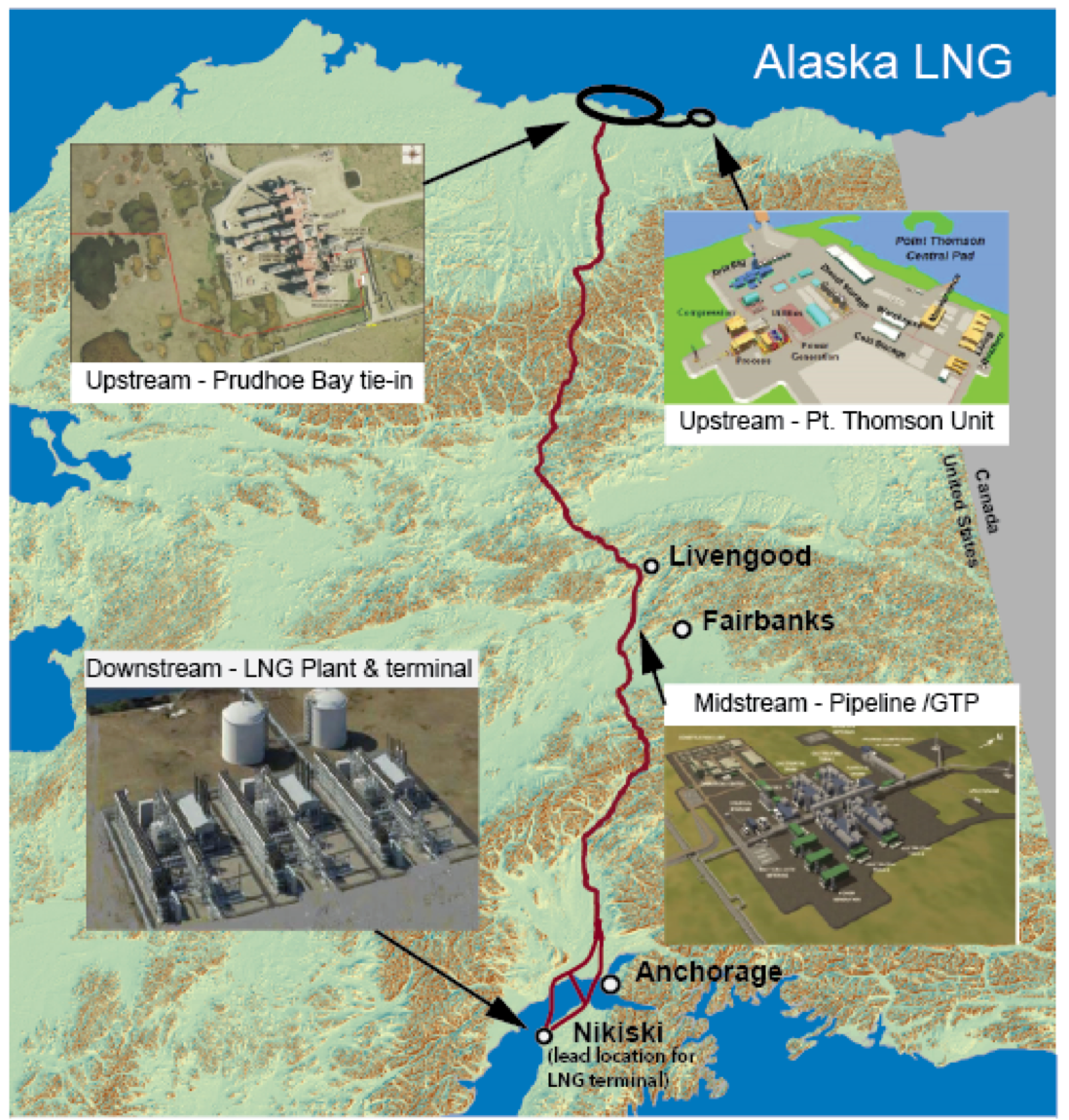
Figure 1
Source: Alaska Gas Pipeline Project Office (http://gasline.alaska.gov/) Click to Enlarge
The primary market for the resulting LNG would be Asia, which buys about 70% of the LNG produced worldwide and whose LNG demand curve has been rising 8%/year the past five years. The catch is, the capital costs associated with all the required infrastructure are high—even by energy industry standards—and gas/LNG producers from Qatar, Australia, western Canada and the Lower 48 already are racing to reach long-term supply deals with Asia’s largest gas consumers. Time’s a-wasting, as they say, and in recent months there has been a new push to assemble the complex financial package needed to make Alaska’s gas export dreams finally happen.
Just last week (week of November 17), a top executive at ExxonMobil laid out the project’s challenges at the Alaska Resource Development Council Conference, and ADNR released a Black & Veatch study it commissioned on how the state might change its gas royalties or taxes—or even take an equity stake in the treat-pipe-and-export project—to help make the project a “go.” Two primary challenges the project faces, ExxonMobil said, are:
- LNG projects with a capacity equivalent to more than 50 Bcf/d are being planned around the world, but less than 40 Bcf/d of additional LNG capacity is likely to be needed by 2030 to keep pace with expected LNG demand growth.
- Big LNG customers prefer to enter into supply deals with LNG exporters whose terminals and other infrastructure can be built quickly, because that reduces the risk of entering into a long-term LNG supply deal based on too-high prices. The Alaska project would likely take five years or more to come online from the time of final investment decision (FID). The target FID for the Alaska project is 2017-18, with a commercial operation date of 2023-24, or several years behind the first group of LNG exports terminals planned for the U.S. Gulf Coast, West Coast and western Canada.
Black & Veatch said in its study that the Prudhoe Bay and Thomson Point areas have the gas reserves to supply the project’s total needs, at least into the early 2040s, and by then those reserves could almost certainly be supplemented with new, “yet-to-find” fields nearby (see Figure 2). It also said the international LNG market is “illiquid” and “opaque,” with few participants and based primarily on long-term, 20-year-plus contracts. And, it said, the Alaska project would be costly: $10 billion for the gas treatment plant; $12 billion for a 42-inch diameter pipeline with eight compressor stations; and $23 billion for a three-train, 17.4 Mtpa liquefaction plant and export facility.

About the song
“Jump” was written by Michael Anthony, David Lee Roth, Eddie Van Halen and Alex Van Halen. It appears as the second song on side one of Van Halen’s sixth studio album, 1984. It was a unique direction for Van Halen in that the song was driven by a keyboard riff rather than a guitar. With its refrain of “Might as well jump!”, the song addresses survival, life and love in just over four minutes. Roth dedicated the song to his full-contact karate instructor, Benny “The Jet” Urquidez. Roth’s karate skills are on full display in the music video for “Jump.” Released as a single in December 1983, it went to #1 on the Billboard Hot 100 Singles chart and has been certified Gold by the Recording Industry Association of America (RIAA). It has been used in countless television shows, motion pictures and at sporting events. It remains the most successful single of Van Halen’s career. Personnel on the record were: David Lee Roth (lead vocals), Eddie Van Halen (lead guitar, synthesizer, backing vocals), Michael Anthony (bass, backing vocals) and Alex Van Halen (drums).
1984 was recorded between June and October 1983 at 5150 Studios in Studio City, CA. Produced by Ted Templeman, it was released in January 1984 and went to #2 on the Billboard 200 Albums chart. It has been certified Diamond (10 million sales) by the RIAA. Four charting singles were released from the LP.
Van Halen was an American rock band formed in Pasadena, CA, in 1973 by Eddie Van Halen, Alex Van Halen, David Lee Roth and Michael Anthony. They released 12 studio albums, two live albums, four compilation albums and 56 singles, and have sold more than 80 million records worldwide. They band won an American Music Award, a Grammy Award, four MTV Video Music Awards, and was inducted into the Rock and Roll Hall of Fame in 2007. Eight members passed through Val Halen during its decades-long run. David Lee Roth initially left the band after its 1984 Tour and was replaced by ex-Montrose singer Sammy Hagar. It could be argued that Montrose’s debut album, overseen by Van Halen producer Ted Templeman, was the blueprint for Van Halen’s debut LP. After Hager left the band in 1996, Extreme vocalist Gary Cherone took over vocal duties for one album and a tour before the band took a hiatus from 1999 to 2003. Hager briefly returned to the band for a tour in 2004. Longtime bassist and founding member Michael Anthony was dismissed from the band and replaced by Eddie Van Halen’s son, Wolfgang, in 2006, and David Lee Roth rejoined the band. Eddie Van Halen’s death in October 2020 in Los Angeles at 65 signaled an end to the band he helped start.