The incredible growth in U.S. LNG export capacity over the past few years has been facilitated by a mostly predictable federal permitting process. It may sometimes be slower than developers like and leave them more open to pushback at the state and local level, but LNG export projects that enter the federal permitting process with both the Department of Energy (DOE) and the Federal Energy Regulatory Commission (FERC) are generally granted their authorizations and export licenses. And once they have them, they’ve been able to hold onto them — until now. Both FERC and the DOE had been granting extensions to these permits as their authorization windows were closing, meaning that projects that were authorized a decade ago and still not online have retained their authorizations and export licenses. But with a DOE rule change announced April 21, the era of repeatedly renewing authorizations appears to be over. The DOE is sending a clear message to LNG developers: Get your project across the finish line in a timely manner or get out of the way and make space for someone who can. In today’s RBN blog, we take a closer look at the DOE rule change and its impact on LNG projects currently under development.

The policy in question here concerns the DOE’s export licenses, which typically get a lot less press, public pushback and notice than the FERC environmental review and authorization process. Nonetheless, every project that plans to export U.S. natural gas as LNG — meaning not only the projects in the U.S. but any project in Mexico or Canada that plans to source feedgas from the U.S. — requires an export license from the DOE. The export licenses come in two varieties, one for Free Trade Agreement (FTA) countries and one for non-Free Trade Agreement (non-FTA) countries. Projects need both licenses to export competitively — they are usually granted in that order (FTA first, then non-FTA) — and both typically come after a project has already received its FERC authorization. All LNG export licenses contain a clause that essentially says the project has seven years to begin exporting or the license expires. The LNG terminal does not need to reach commercial operations in that seven-year window; the condition is satisfied with the first LNG cargo exported, and commissioning cargoes count.
This time frame was established during permitting for the U.S.’s first LNG export facility, Sabine Pass, after some back and forth with Cheniere around a fair and realistic process. (For more on permitting for energy infrastructure, see Don’t Pass Me By.) Every U.S. LNG terminal that is currently operational, including the still-commissioning Calcasieu Pass, has met the conditions of that clause without needing an extension, a fact noted by the DOE when it announced its new rule. That includes Calcasieu Pass, which has been able to achieve LNG exports during its seven-year window despite its construction happening during COVID, a reason frequently cited by projects seeking extension requests. In 2020, the DOE granted extensions to three LNG projects: the under-construction Golden Pass as well as pre-FID projects Lake Charles LNG and the Cameron expansion project. Golden Pass’s original export license would have expired April 25, 2024, and that was pushed back to September 30, 2025; however, Golden Pass is expected to begin commissioning later this year and it might not even need the extra time it was granted. In the policy change, the DOE reaffirmed that seven-year window and said it will no longer consider extensions unless the project is (1) already under construction and (2) can prove extenuating circumstances outside its control. While there are no specifics on what those extenuating circumstances could be, it certainly seems like saying “COVID” or “bad markets” isn’t going to cut it anymore. If a project isn’t eligible for an extension, it has to restart the DOE licensing process and get in line behind all the new projects in the queue.
About the song
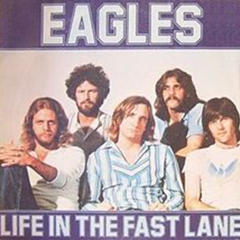
“Life in the Fast Lane” was written by Joe Walsh, Glenn Frey and Don Henley. It appears as the third song on side one of The Eagles’ fifth studio album, Hotel California. The song was based on a guitar riff from Joe Walsh, with the title idea coming from Glenn Frey after a scary high-speed drive with an associate on a freeway in Los Angeles. Frey and Don Henley collaborated on the lyrics. “Life in the Fast Lane” was the third single from Hotel California, released in May 1977. It went to #11 on the Billboard Hot 100 Singles chart. Personnel on the record were: Don Henley (lead vocals, drums), Joe Walsh (lead guitar, rhythm guitar), Glenn Frey (Clavinet, backing vocals), Don Felder (lead guitar, rhythm guitar) and Randy Meisner (bass, backing vocals).
Hotel California was recorded between March and October 1976 at Criteria Studios in Miami and Record Plant Studios in Los Angeles, with Bill Szymczyk producing. Released in December 1976, the album went to #1 on the Billboard Top 200 Albums chart. It has been certified 26x Platinum by the Recording Industry Association of America.
The Eagles are an American rock band formed in Los Angeles in 1971. They have released seven studio albums, two live albums, 10 compilation albums and 32 singles. The band has won five American Music Awards and six Grammy Awards and is a member of the Rock and Roll Hall of Fame and the Vocal Group Hall of Fame. In 2016, The Eagles were recipients of Kennedy Center Honors. Nine members have passed through the ranks of The Eagles since its formation, with Don Henley being the only original member still in the band. Founding member Glenn Frey passed away in 2016. The band still records and tours and recently completed its Hotel California tour.