


Venture Global reached a final investment decision (FID) on Plaquemines LNG Phase 1 in March 2022, making it the first new LNG project to get the green light post-COVID and kicking off a massive expansion period for U.S. LNG. In fact, more than 61 million tons per annum (MMtpa) of new U.S. LNG capacity has been given the go-ahead in the past 17 months, including the full 20-MMtpa Plaquemines LNG project from Venture Global, plus projects from Cheniere, Sempra and, most recently, NextDecade’s Rio Grande LNG. Even if no new LNG projects are sanctioned after this — which seems unlikely, given the progress seen on some pre-FID projects — the U.S. will have the capacity to export 167.5 MMtpa, or more than 22 Bcf/d, by later this decade. This unprecedented level of buildout continues to be dominated by our “Big Three” of U.S. LNG — Cheniere, Sempra and Venture Global — which not only already operate LNG export terminals in the U.S. and have projects currently under construction, but all still have more capacity under development and working toward eventual FIDs. In today’s RBN blog, we wrap up our series with a look at the newest member of the Big Three, Venture Global, its projects under development and the controversy surrounding the commissioning of Calcasieu Pass LNG.
In Part 1, we examined the projects under development by Sempra. Sempra currently operates Cameron LNG in Louisiana and has two sanctioned projects under construction: Port Arthur LNG, the 13.5-MMtpa project in Texas that took FID earlier this year, and ECA LNG (aka Energia Costa Azul LNG), which will be Mexico’s first land-based LNG export terminal. ECA was the last LNG project to take FID pre-COVID and is due online in 2025. Sempra also has planned expansions at Cameron, Port Arthur and ECA under development as well as another terminal in Mexico, Vista Pacifico. The Cameron expansion is the closest of Sempra’s projects to taking FID, with that decision now expected next year, but Sempra has also begun commercializing Port Arthur Phase 2.

The replay of our Fall 2026 School of Energy (September 9 & 10, Houston) is now available online!
Learn from RBN experts, participate in hands-on Excel modeling, connect with industry peers, and gain a stronger understanding of today's interconnected energy markets.
Next, in Part 2, we turned our attention to the undisputed king of U.S. LNG, Cheniere, which is not only the U.S.’s largest LNG exporter, but among the biggest in the world, second only to QatarEnergy. Cheniere currently operates 45 MMtpa (6 Bcf/d) of LNG export capacity at its two terminals, Sabine Pass and Corpus Christi, and has a 10-MMtpa expansion of Corpus Christi under construction as well as further planned expansions at both terminals. With Cheniere’s track record of excellence and reputation, it’s been able to secure long-term offtake commitments for most of the expansions’ capacity very early in the development process. The latest Corpus Christi expansion, Midscale Trains 8 and 9, was sold out before Cheniere had even announced a name for the project, let alone filed with regulators. Both that project and the larger planned expansion at Sabine Pass are in the early stages of the Federal Energy Regulatory Commission (FERC) approval process and will need to complete that before taking FID.
About the song
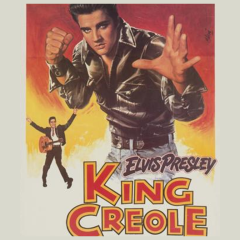
“King Creole” was written by Jerry Lieber and Mike Stoller. It appears as the first song on side one of Elvis Presley’s second soundtrack album, King Creole. The song was released as a single in the U.K. in September 1958 and went to #2 on the U.K. Singles chart. An interesting scene in the movie is where Elvis lip syncs the song. At about 1:20 in the scene Elvis is supposedly playing Scotty Moore’s guitar solo. Moore is in the background, as are other members of Elvis’ band, and Elvis and Moore give each other a funny look during the solo, which features Moore’s hands in the edit, not Elvis’. Elvis’ backup singers, The Jordanaires, are featured as singing horn players in the same scene. Personnel on the record were: Elvis Presley (lead vocals), The Jordanaires (backing vocals), Scotty Moore (electric guitar), Tiny Timbrell (acoustic guitar), Bill Black (electric bass), Neal Matthews (acoustic bass), D.J. Fontana (drums), Bernie Mattinson (percussion), Elmer Schneider and Warren Smith (trombone), Justin Gordon (sax), and Teddy Buckner (trumpet).
The album, King Creole, was recorded in four days in January-February 1958 at Radio Recorders in Hollywood. Felton Jarvis, Walter Schark, and Phil Khagan produced the LP. It features music written specifically for the film starring Presley. Released in September 1958 in conjunction with the movie’s release, it went to #2 on the Billboard 200 Album chart and has been certified Gold by the Recording Industry Association of America (RIAA). Two Eps, Vol. 1 and Vol. 2, were also released from the film. Two singles were released from the LP. “Hard Headed Woman,” released in the U.S. in June 1958, went to #1 on the Billboard Hot 100 Singles chart. It became the first rock and roll single to be certified Gold by the RIAA.
Elvis Presley was an American rock and roll singer and actor. Dubbed “The King of Rock and Roll,” he is one of the most significant figures in popular culture in the 20th century. He released 23 studio albums, 18 soundtrack albums, eight live albums, 13 compilation albums, 29 Eps, and 117 singles, and has sold more than 500 million records worldwide. Presley starred in 31 films and five concert specials. He is a member of the Rock and Roll Hall of Fame, has a Grammy Lifetime Achievement Award, is a recipient of the Presidential Medal of Freedom, and has a star on the Hollywood Walk of Fame. Presley died in Memphis in August 1977 at the age of 42.




Comments
Pretty much every story about LNG exports mentions how easy it's been for them to get offtake agreements. Makes sense, the risk is on the backers of the terminal, not the customers, if feedgas isn't there. The expectation behind these appears to be the inverse of the Aughties - that US gas production will continue to grow, regardless of slowdowns on the oil side, challenges with pipeline permitting, or gas prices. We seem to be racing toward the point where US industry loses its gas cost advantage and ends up in a bidding war with the global market for supply.