No one in North America’s energy sector is likely to forget the second quarter of 2020 anytime soon. In those months — April, May, and June — the demand-destruction effects of the COVID-19 pandemic took root; the price of West Texas Intermediate (WTI) bottomed out, even going negative for a day; and crude oil-focused drillers in particular shut in vast numbers of wells. In late July and August, when exploration and production companies (E&Ps) announced their results for that train wreck of a quarter, it came as no surprise that the write-downs and losses were generally immense and, in many cases, record-shattering. But WTI prices have rebounded somewhat the past couple of months, as has production, suggesting that while E&Ps third-quarter results will be far from stellar, they’ll at least show an improvement and hopefully set the stage for further gains going forward. Today, we break down second-quarter results by producer peer group and discuss the positive trends that portend improved results for the third quarter.
To set the stage, let’s review those horrible second-quarter 2020 results. WTI oil prices fell 40% in the second quarter to an average of $28.17/bbl, from $46.60/bbl in the first quarter of 2020. Even that doesn’t fully reflect the extent of the misery; the 41 major U.S. producers we track realized just $13.89 for every barrel of oil equivalent (boe) they produced in the second quarter, nearly 50% below the previous quarter and the lowest realization in more than a decade. As shown in Figure 1, the E&Ps we follow reported a combined $23.8 billion in pre-tax operating losses in the second quarter (blue bar to far right, measured on the left axis), with $18 billion of that from largely price-related impairments of the value of oil and gas reserves. First-half 2020 losses for the companies totaled $83 billion after a combined $59 billion loss in the first quarter. (As a result of massive reserve write-downs, first-quarter losses dwarfed even those seen in the second quarter. We blogged about it at the time in Spring Breakdown.) Second-quarter cash flow for the group was a scant $5.9 billion (orange bar to far right), down 70% from $19.1 billion in the previous quarter and 79% lower than the $27 billion in the year-ago period.

Crude Oil Permian provides detailed analysis of the fundamental drivers impacting the Permian Basin crude oil market including weekly data, analysis and market intelligence updates of: Permian crude oil supply and demand, pipeline outflows and capacity, prices, and infrastructure updates.
Oil and gas production fell 9% in the second quarter of 2020 to 1.09 billion boe (right end of gray line; right axis) due to a 14% decline in oil output. While NGL production from Oil-Weighted and Diversified E&Ps was down, total NGL production was only 5% lower because those decreases were partially offset by a 3% increase in NGL output from the Gas-Weighted E&Ps. Natural gas production fell 6% to 3 Tcf (500 MMboe). Only seven companies in our universe of 41 E&Ps increased oil and gas output during the second quarter. Three of the companies — Cabot Oil & Gas, Natural Fuel Gas, and HighPoint Resources — were in the black in the quarter. In contrast, a year earlier, the group earned $10.5 billion, with only two companies reporting losses. Two of the E&Ps we track — Chesapeake Energy and Whiting Petroleum — sought bankruptcy protection in the second quarter, while others are in the process of restructuring. Industry-wide E&P Chapter 11 filings soared to 18 from five in the previous quarter. A bleak picture, indeed.
About the song
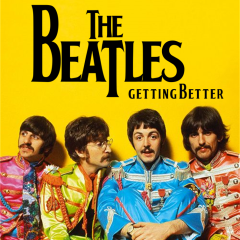
"Getting Better" was written by Paul McCartney and John Lennon, and appears as the fourth track on side one of The Beatles' eighth studio album, Sgt. Pepper's Lonely Hearts Club Band. "It's getting better" was a phrase that Jimmie Nicol used while drumming for The Beatles on a 1964 Australian tour while Ringo Starr was recovering from a tonsillectomy operation. McCartney remembered it, and used the phrase as the foundation for a song he was writing about positivity and moving forward. John Lennon came up with the counter line, "it can't get no worse," and the confessional third verse that he sang with McCartney. The track was recorded at EMI Studios in London during March 1967. The production on "Getting Better," like all of Sgt. Pepper, is a textbook example of how to build tracks to best serve the song. Personnel on the record were: Paul McCartney (lead vocal, bass), John Lennon (backing vocals, rhythm guitar), George Harrison (backing vocals, lead guitar, tambouras), Ringo Starr (drums, congas), and George Martin (piano, pianet).
Sgt. Pepper's Lonely Hearts Club Band was recorded between December 1966 and April 1967 at EMI Studios and Regent Sound in London. Produced by George Martin, the album was released in May 1967. It spent 15 weeks at #1 on the Billboard Top 200 Albums chart, received four Grammy Awards in 1968, and has been certified 11X Platinum by the Recording Industry Association of America. Over 32 million copies of the album have been sold worldwide.
The Beatles were a British rock band formed in Liverpool in 1960. The group, with members John Lennon, Paul McCartney, George Harrison, and Ringo Starr, changed the course of rock music and are regarded as the most influential band of all time. They have sold over 600 million records worldwide, and have released 23 studio albums, five live albums, 53 compilation albums, 21 EPs, and 63 singles. The Beatles have won one Academy Award, one Billboard Music Award, four Brit Awards, nine Grammy Awards, 14 Ivor Novello Awards, one MTV Video Music Award, and three World Music Awards. They are members of the Rock and Roll Hall of Fame, Vocal Group Hall of Fame, UK Music Hall of Fame, and Grammy Hall of Fame, and hold a Grammy Lifetime Achievement Award. Paul McCartney was knighted by the Queen of England in 1997. The Beatles officially broke up in 1970. All four members went on to have successful careers as solo artists. John Lennon died in 1980, and George Harrison in 2001. Paul McCartney and Ringo Starr still record and tour.