The Enbridge Mainline, by far the largest transportation network for growing Western Canadian crude oil supplies to the U.S. Midwest, Gulf Coast and Eastern Canada, recently received regulatory approval for the tolls that it charges shippers for using the massive pipeline system. As we discuss in today’s RBN blog, the Canada Energy Regulator’s (CER) thumbs-up ensures another five years of shipping cost predictability and comes as the Canadian oil pipeline landscape is about to permanently change with the pending startup of the 590-Mb/d Trans Mountain Expansion Project (TMX).

Canadian crude output is rising, requiring new export routes. As traditional pathways face constraints, the U.S. Rockies—especially the Guernsey, WY hub—are emerging as key corridors for moving Canadian heavy crude to downstream markets, including the Gulf Coast.
Much of the headline oil pipeline news out of Canada in recent months has been centered around the Canadian government’s long-delayed and vastly over-budget TMX, which will significantly increase pipeline capacity to Canada’s West Coast. At long last, TMX now looks set to begin receiving crude oil shipments in the form of linefill in a matter of weeks. Equally important, though, was the March 4 news that the CER had placed its stamp of approval on a negotiated settlement between Enbridge and its customers concerning the tolls that will be charged for shipping on the midstream giant’s Mainline through 2028.
Before we review the timeline that brought us to the CER’s recent action, let’s take a quick tour of the Enbridge Mainline System and review its critical role in North American crude oil transportation and refining. The array of pipelines known collectively as the Enbridge Mainline (orange lines in Figure 1 below) handles about 70% of all the crude shipped from Western Canada by pipeline into the U.S. Midwest. The system’s parallel Lines 1, 2, 3, 4 and 67 transport a variety of heavy and light crude oil and NGLs from Edmonton and Hardisty, AB, to Clearbrook, MN, and Superior, WI. From there, other Mainline pipes move crude to the Flanagan hub in north-central Illinois (Line 61), the Chicago area (Lines 6, 14 and 64), Michigan (Lines 5 and 78) and Ontario (Lines 5, 7, 11 and 78). The U.S. side of the Mainline is often referred to as the Lakehead System.
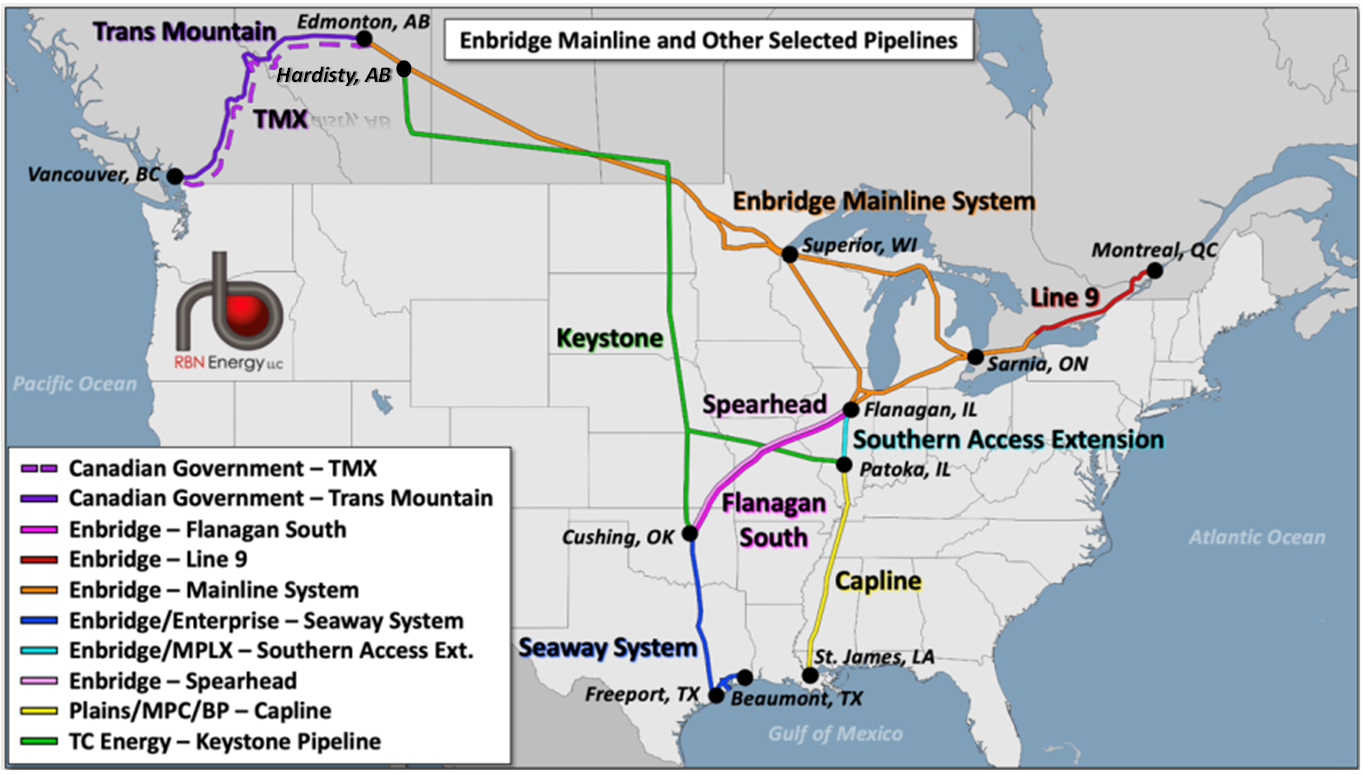
Figure 1. Enbridge Mainline and Other Selected Pipelines. Source: RBN
About the song
“For Whom the Bell Tolls” was written by Cliff Burton, James Hetfield and Lars Ulrich. It appears as the third song on side one of Metallica’s second studio album, Ride the Lightning. The song was inspired by Ernest Hemingway’s novel of the same name. Over the years it has become one of the most popular songs in the band’s catalog and also appears in a few of the band’s live albums and videos. After Elektra Records acquired the band’s catalog in 1985, they released the song as a promotional single with edited and full-length versions. A single of the song was released from the live album with the San Francisco Symphony, entitled S&M2, in August 2020 and went to #18 on the Billboard Hot Rock & Alternative Singles chart. It has been certified Gold by the Recording Industry Association of America (RIAA). Personnel on the original recording were: James Hetfield (vocals, rhythm guitar), Cliff Burton (bass), Kirk Hammett (lead guitar), and Lars Ulrich (drums, anvil). A nearly identical lineup played on the S&M2 recording, with Robert Trujillo on bass in place of Cliff Burton.
Ride the Lightning was recorded in February and March 1984 at Sweet Silence Studios in Copenhagen, Denmark, with Flemming Rasmussen producing. The title of the album was taken from Stephen King’s novel, The Stand, in which the phrase is used to describe execution by an electric chair. Originally released on the Megaforce record label in July 1984 (Elektra Records signed the band in 1985 and acquired their previous catalog), it went to #10 on the Billboard Top Rock Albums chart and #48 on the Billboard 200 Albums chart. It has been certified 6x Platinum by the RIAA. One single was released from the LP.
Metallica is an American heavy metal band formed in Los Angeles in 1981 by Lars Ulrich and James Hetfield. They released their first song on the Metal Massacre I compilation album in June 1982 and released their debut album, Kill 'Em All, in July 1983. The band has released 11 studio albums, eight live albums, one soundtrack album, three EPs, and 44 singles. They have won two American Music Awards, one ASCAP Pop Music Award, five Billboard Music Awards, 10 Grammy Awards, and two MTV Video Music Awards. Metallica was inducted into the Rock and Roll Hall of Fame in 2009. Nine members have passed through the band since its inception, with Ulrich, Hetfield, Hammett, and Trujillo being the longest-serving and current members of the band. Ex-lead guitarist Dave Mustaine is the originator and leader of the band, Megadeth. Metallica’s original bassist, Cliff Burton, died of injuries while on tour with the band in September 1986. Metallica continues to record and tour and will resume its M72 World Tour in May.