For several years now, the biggest hurdle to natural gas production growth in the Marcellus/Utica was takeaway constraints — there simply wasn’t enough capacity on gas pipelines out of Appalachia to support a significant bump-up in regional output. Things have been changing though. The Mountain Valley Pipeline and a slew of expansion projects along Transco are allowing increasing volumes of gas to move to and through Virginia and the Carolinas. The proposed Borealis Pipeline across Ohio would enable up to 2 Bcf/d to move down the Texas Gas Transmission system to the Gulf Coast. And, as we discuss in today’s RBN blog, Kinder Morgan is planning several major projects in the Deep South — including the 2.1-Bcf/d Mississippi Crossing and 1.3-Bcf/d South System Expansion 4 projects — to move more gas into Mississippi, Alabama, Georgia and South Carolina.

The Natural Gas Master Class is a one-day online event focusing on understanding flow analysis, interpreting pipeline data and forecasting future flows. This course is designed to equip you with the knowledge and skills to effectively analyze the complexities of natural gas markets, flow analysis, and pipeline modeling. Join us online
October 21 | Online
As we said in our Don’t Stop Believin’ blog series on the Marcellus/Utica, production in the world-class shale play soared through the 2010s as hundreds of new wells were drilled and completed and many Bcf/d of new takeaway capacity was built. However, the play’s output has been largely rangebound through the first half of the 2020s, hovering between 34 and 36 Bcf/d, largely due to takeaway constraints and the painfully slow pace of capacity additions.
More recently, a number of important projects have advanced to construction and operation — the 2-Bcf/d Mountain Valley Pipeline (MVP) from northern West Virginia to Transco Station 165 in south-central Virginia being a prime example. Just as important, Williams Cos. (Transco’s owner) has been undertaking a long list of projects that allow considerably more gas to flow south on Transco into North Carolina, South Carolina, Georgia and Alabama. Williams and others also have been planning and building pipelines to deliver gas from Transco to points east of the system.
Williams isn’t the only midstream “family” making a series of improvements to its long-haul pipeline systems to facilitate more gas deliveries out of the Marcellus/Utica. Boardwalk Pipeline Partners, owner of the Texas Gas Transmission (TGT) system, is seeking to advance its proposed Borealis Pipeline, a greenfield pipe that would run 180 miles from Clarington, OH, to the northeastern tip of the TGT system in Lebanon, OH. Borealis, along with enhancements to TGT itself, would allow up to 2 Bcf/d to flow south/southwest to the Gulf Coast. Boardwalk is also planning the 1.16-Bcf/d Kosci Junction Pipeline, which will run 110 miles south/southeast from a TGT leg near Kosciusko, MS — Kosci for short — to an interconnect with the company’s Gulf South system south of Meridian, MS.
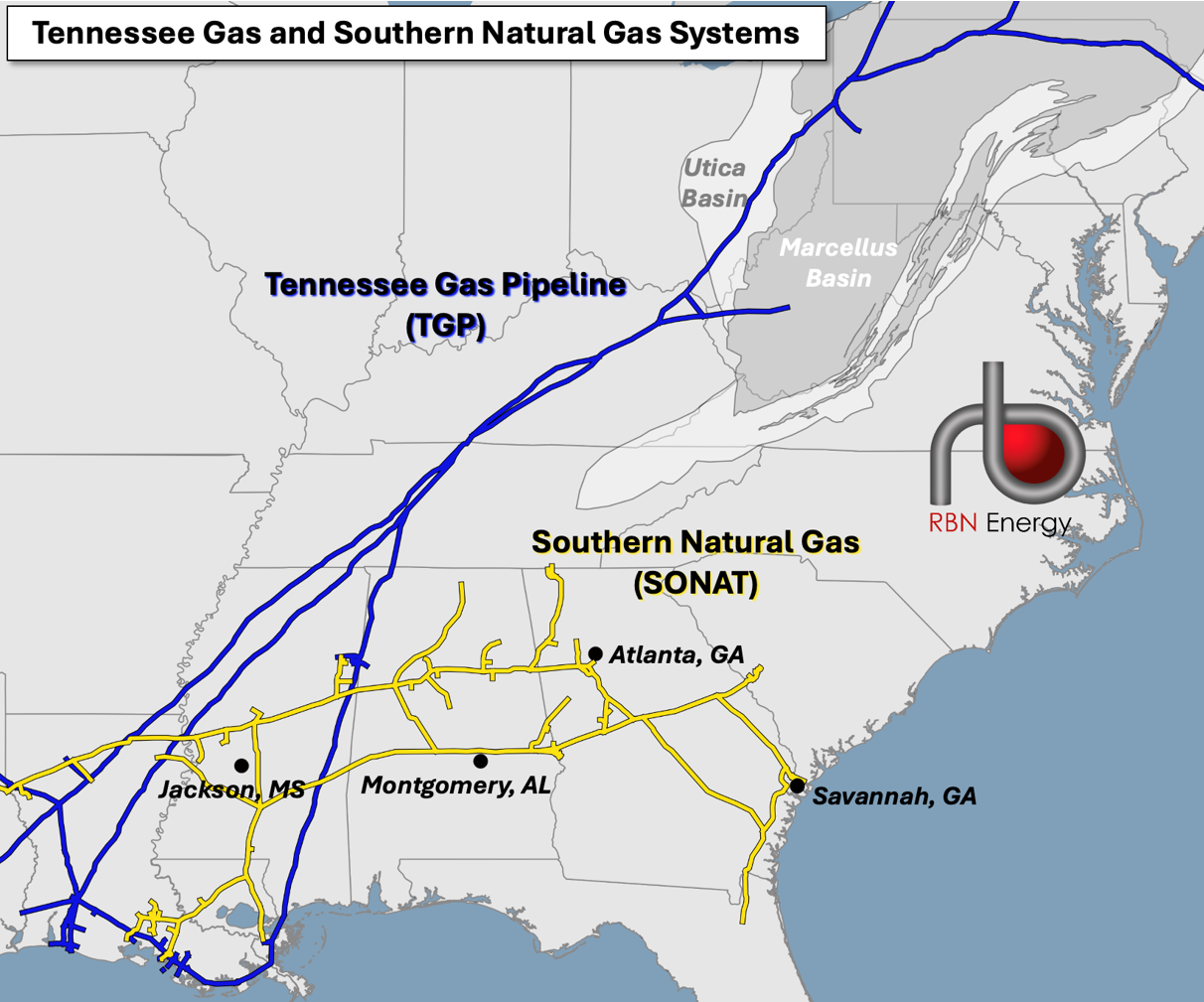
Figure 1. Tennessee Gas and Southern Natural Gas Systems. Source: RBN
About the song
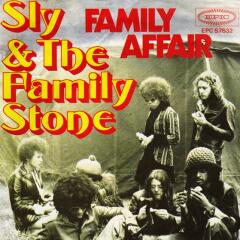
“Family Affair” was written by Sly Stone and appears as the fourth song on side one of Sly and the Family Stone’s fifth studio album, There’s a Riot Goin’ On. The unique production of the song features an early model drum machine. It provides a steady beat that sounds like coconut shells played like claves, establishing the rhythmic foundation the rest of the tracks are layered upon. Sly sings the song softly in his lower register, while his sister Rose provides the answer vocals in the chorus. The single was released in November 1971 and went to #1 on the Billboard Hot 100 Singles chart. It became the third and last #1 single for the group. It has been certified Platinum by the Recording Industry Association of America (RIAA). Personnel on the record were: Sly Stone (vocals, bass, lead guitar, drums, Maestro Rhythm King MRK-2), Rose Stone (vocals), Billy Preston (Hohner Pianet) and Bobby Womack (rhythm guitar).
There’s a Riot Goin’ On was recorded in 1970-71 at The Record Plant in Sausalito, CA, with Sly Stone producing. The album would have a deep effect on funk and hip-hop recordings in the future. Released in November 1971, it went to #1 on the Billboard 200 Albums chart and has been certified Platinum by the RIAA. In 1999, the album was inducted into the Grammy Hall of Fame. Three singles were released from the LP.
Sly and the Family Stone was an American soul/rock band formed in San Francisco in 1966 by lead singer and multi-instrumentalist Sly Stone, along with his brother Freddy Stone on guitar, sister Rose Stone on vocals, Cynthia Robinson on trumpet, Larry Graham on bass, Jerry Martini on saxophone and Greg Errico on drums. The band would heavily influence the sound of American funk, soul, pop and hip-hop music. They released 10 studio albums, three live albums, seven compilation albums and 19 singles and have sold more than 8 million records worldwide. The band officially broke up in January 1975. The group was inducted into the Rock and Roll Hall of Fame in 1993 and a tribute to the group took place at the Grammy Awards in 2006. In February 2025, Questlove released his documentary Sly Lives! (aka The Burden of Black Genius) on Hulu. Sly Stone died in Los Angeles in June 2025 at 82.
We at RBN are saddened by the recent passing of Sly Stone and offer our condolences to his family, friends, fans and associates. His groundbreaking music will live on.