CME’s NYMEX light sweet crude oil contract in Cushing, OK, is not West Texas Intermediate — WTI. Instead, it is Domestic Sweet — commonly referred to as DSW — with quality specifications that are broader and generally inferior to Midland-sourced WTI. In fact, pristine Midland WTI delivered to Cushing sells at a reasonably healthy premium to DSW. That difference in specs, and the fact that the quality of DSW is considerably more variable than straight-as-an-arrow Midland WTI, makes most purchasers of exported U.S. crude (and many domestic refiners too) strongly prefer the more quality-consistent Midland WTI grade. For that reason, when Platts set out to allow U.S. light crude to be delivered as Brent, it said that only Midland WTI will qualify. Consequently, a marketer cannot take delivery of a NYMEX-quality barrel at Cushing, pipe it down to the Gulf Coast, and deliver it to a dock for export if the ultimate destination of that barrel is to be reflected in the Brent price assessment. The implication? There are now effectively two U.S. crude oil benchmark grades, each of which is valued differently, priced differently and used by different markets. Is this a big deal for the valuation mechanisms for U.S. crude oils, or just a minor quirk in oil-market nomenclature? We’ll explore that question in today’s RBN blog.

The Natural Gas Master Class is a one-day online event focusing on understanding flow analysis, interpreting pipeline data and forecasting future flows. This course is designed to equip you with the knowledge and skills to effectively analyze the complexities of natural gas markets, flow analysis, and pipeline modeling. Join us online
October 21 | Online
As a quick refresher on what we covered in We Are The World, Platts announced earlier this year that it will reflect cargoes of Midland WTI crude oil in its Dated Brent crude oil benchmark. Midland WTI crude will be the first grade from outside of the North Sea to be included in Brent. Platts will only reflect Midland WTI cargoes that loaded from a list of specific pipelines and U.S. Gulf Coast crude oil terminals that have demonstrated the ability to consistently deliver Platts’s Midland-spec WTI crude oil. And as we noted in Trading In The USA, what gets generally referenced as WTI is not. The CME Group’s NYMEX light sweet crude oil contract in Cushing — the price the general public usually sees in the news — is often referred to as NYMEX WTI, but that’s confusing because it is not West Texas Intermediate. The NYMEX Rulebook defines deliverable crude streams as Common Domestic Sweet (again, DSW) Streams that meet specific requirements (more on that later). While it is still frequently (and erroneously) referred to as NYMEX WTI, in this blog we’ll call it by its real name: NYMEX DSW.
Platts’s grade requirement for Brent really put the difference between NYMEX DSW and Midland WTI front and center. Before that, the quality of crude from the Permian varied somewhat from pipe to pipe, but it rarely resulted in problems — as long as the crude really was “tightlined” from the Permian. (Tightlining refers to the practice of piping crude oil directly from Point A to Point B — say, Midland to a terminal in the Houston area — without additional inflows of other, different crudes along the way.) In contrast, DSW piped from Cushing to the Gulf Coast may not be acceptable for exports to a lot of refineries, particularly in Europe and Asia, because it is well known to be a BLEND. And that blend may or may not have any “real” WTI in it — all that matters is that it meets NYMEX’s broader spec. The inconsistency in quality that comes along with different blends is the real problem for buyers of exported crudes. And let’s be clear: U.S refiners are not all that crazy about it either … many are just used to it and better set up to deal with it.
About the song
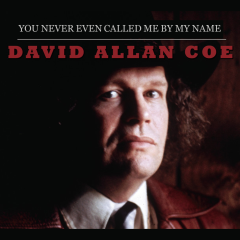
“You Never Even Called Me by My Name” was written by Steve Goodman and John Prine and appears as the 10th song on David Allan Coe’s fourth studio album, Once Upon a Rhyme. The song was originally released on Steve Goodman’s debut album, Steve Goodman, released in 1971. Coe wrote the last verse in his version of the song in response to Goodman’s claim that it was “the perfect country and western song.” Coe stated that it didn’t include anything about Mama, trains, prison, or getting drunk, so he wrote this closing verse:
I was drunk the day my mom got out of prison
And I went to pick her up in the rain
But before I could get to the station in my pickup truck
She got runned over by a damned old train
Released as a single in June 1975, it went to #8 on the Billboard Hot Country Songs Singles chart, making it Coe’s first Top 10 hit. Personnel on the record were: David Allen Coe (lead vocals), The Nashville Edition (backing vocals), Reggie Young (guitar), Pete Drake (pedal steel guitar, dobro), Mike Leech (bass), Larrie London (drums), and Hargus “Pig” Robbins (piano).
Once Upon a Rhyme was recorded at Columbia Studio in Nashville in early 1975 and produced by Ron Bledsoe. Released in June 1975, the album also included Coe’s version of his song, “Will You Lay with Me (In a Field of Stone),” which had been a #1 hit for Tanya Tucker in 1974. One single was released from the LP.
David Allan Coe is an America country music singer and songwriter. His rebellious attitude, wild image, and unconventional lifestyle has won him legions of outlaw country music fans, while alienating the Nashville country music industry establishment. He has released 42 studio albums, four live albums, one soundtrack album, 40 compilation albums and 52 singles. Rebel Meets Rebel, a Coe collaboration with the late Dimebag Darrell and Vinnie Paul, along with Rex Brown of Pantera, was released in May 2006. It went to #38 on the Billboard 200 Albums chart. The record was described as a groundbreaking mix of country music and heavy metal. Coe continues to write and perform live.