For the first time ever, U.S. crude oil exports have hit the 3 MMb/d mark — a once-unthinkable pace equivalent to sending out 10 fully loaded Very Large Crude Carriers a week. VLCCs, with their 2-MMbbl capacity and rock-bottom per-bbl delivery costs, are the most cost-effective way to transport crude to distant markets like China and India. But there’s still only one terminal on the Gulf Coast that can fill a VLCC to the brim — the Louisiana Offshore Oil Port — and pipeline connections from key Texas and Oklahoma plays to LOOP are limited. Elsewhere along the coast, VLCCs need to be loaded in offshore deep water by reverse lightering from smaller vessels — a slower and more costly loading process. Change is a-comin’, though. Companies are testing the docking and partial loading of VLCCs at terminals along the Texas coast, and plans for a number of greenfield facilities capable of partially — or even fully — loading the gargantuan vessels at the dock are being considered. Today, we review the latest efforts to streamline the loading of VLCCs and what they mean for crude-export economics.
As we said in our last look at VLCCs a few months ago (Rock the Boat), the use of the supertankers during the U.S.’s 40-year ban on most crude exports was largely limited to imports to LOOP, occasional shipments out of the Valdez Marine Terminal in Valdez, AK (the southern terminus of the Trans-Alaska Pipeline System) and into Andeavor’s Berth 121 in Long Beach, CA — the two other U.S. facilities designed to handle VLCCs. Since the export ban was lifted in December 2015, though, crude exports — and interest in using VLCCs for exports out of the Gulf Coast — have been on the upswing. Figure 1 shows that in 2015, the last year the ban was in place, exports (almost all of them to Canada) averaged 465 Mb/d, according to the Energy Information Administration (EIA). Exports rose 27% (to just about 590 Mb/d) in 2016, then almost doubled in 2017 (to more than 1.1 MMb/d).
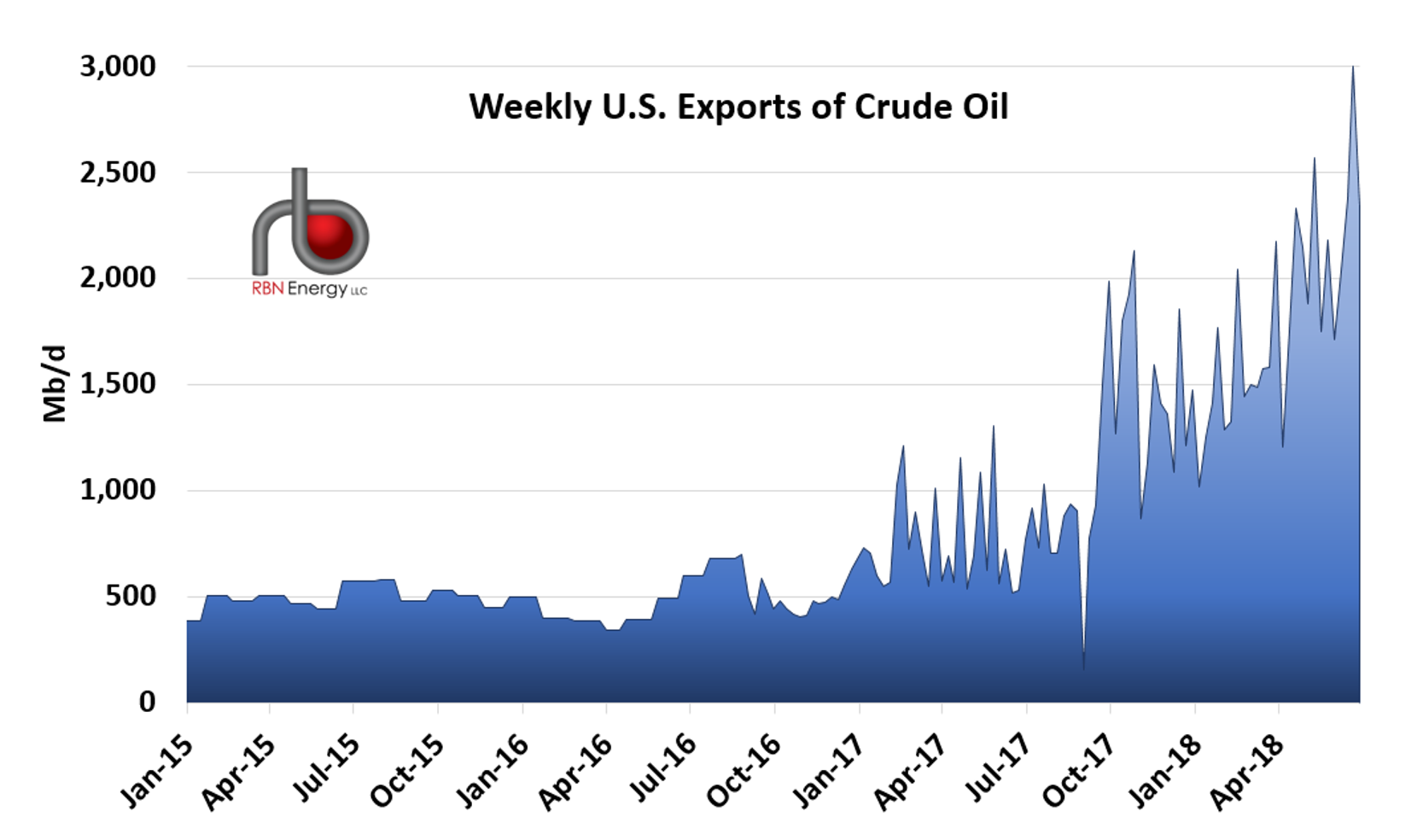
Figure 1. U.S. Crude Exports by Week (in Mb/d). Source: EIA
Export volumes continued rising through the first half of 2018, averaging 1.8 MMb/d so far and hitting an all-time high — an even 3 MMb/d — in the week ended June 22.
VLCCs are the Airbus A380s of the crude-shipping world — highly efficient, long-distance conveyors of valuable cargo (crude and people, respectively). An A380 is a double-decker, wide-body jet airliner that can transport up to 850 (!) passengers in (God forbid) an all-economy configuration (or 525 in a typical first-class/business/economy layout) more than 8,000 miles at a cruising speed of about 560 miles per hour (mph). VLCCs may be much, much slower (traveling at about 14 knots, or 16 mph), but they can move about 2 MMbbl of crude oil, the equivalent of about five hours’ worth of U.S. production. The supertankers have an average length of about 1,100 feet, with an average beam (or width) of nearly 200 feet and an average fully loaded draft of 72 feet.
There are about 800 VLCCs operating in the world today, with an increasing number being filled with U.S. crude along the Gulf Coast and sent to faraway ports in Europe and Asia. The vast majority of the VLCCs being used to export crude from the U.S. are reverse-lightered in designated trans-shipment areas (TSAs) off the Texas and Louisiana coasts. Reverse lightering is a multi-day process that involves anchoring an empty VLCC in a TSA and using Aframax-class tanker (capacity ~750 Mbbl) or other smaller vessels to ferry crude from the terminal to the VLCC. According to our friends at Navigistics, transporting crude from a fully reverse-lightered VLCC from a TSA off Corpus Christi to various Asian destinations (Singapore and Ulsan, South Korea) would cost about $3/bbl less than shipping it the same distance on a smaller tanker. That’s half the transportation cost — quite a savings when you consider the VLCC’s 2-MMbbl capacity.
About the song
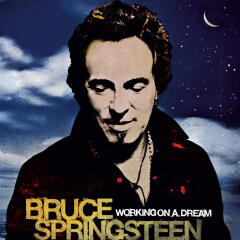
“Working on a Dream” is a single off a Bruce Springsteen album of the same name. The song, like all the others on the LP, was written by The Boss himself, and was first heard when Bruce and his wife, Patti Scialfa, sang it during a campaign appearance with Barack Obama a few days before the 2008 election. The single was released three weeks later.
The Working on a Dream album was recorded between the summer of 2007 and the fall of 2008 during breaks in Springsteen and the E Street Band’s "Magic Tour." Bruce has said of the LP, "I hope Working on a Dream has caught the energy of the band fresh off the road from some of the most exciting shows we've ever done." The LP, released in January 2009, shot to #1 on Billboard’s Top 200 Albums chart, and has sold more than 3 million copies to date. The personnel on the record were: Bruce Springsteen (lead vocals, guitar, keyboards and percussion), Roy Bittan (piano, organ and accordion), Clarence Clemons (sax and backing vocals), Danny Federici (organ), Nils Lofgren (guitar and backing vocals), Patti Scialfa (backing vocals), Garry Tallent (bass), Steve Van Zandt (guitar and backing vocals), Max Weinberg (drums), and Soozie Tyrell (violin and backing vocals).
Bruce Springsteen has made 18 studio albums, and five live albums. He has won one Academy Award, four American Music Awards, two Golden Globes, 20 Grammys and five MTV Music Video Awards. He was inducted into the Rock and Roll Hall of Fame and the Songwriters Hall of Fame in 1999, and was a 2009 Kennedy Center Honors recipient. In 2016, Bruce was given a Presidential Medal of Freedom.