Everyone knows the old saw, “Make hay while the sun shines.” Oil and gas producers have historically honored this sentiment by boosting their capital spending when commodity prices were high and cutting back when realizations dipped. Their investment peaked in 2014, when oil prices were hovering over $100 per barrel, plunged with the price crash in 2015-16, recovered with $70 oil in 2018, and crashed again in the ugly early days of the COVID-19 pandemic. The sun is out again in 2021, but E&Ps seem to have tossed out their old mantra in favor of fiscal discipline, setting and maintaining investment at historic lows despite solid oil prices and surging gas futures. In today’s RBN blog, we review mid-year changes to E&P capital budgets and their impact on oil and gas production.

Before we get to 2021, let’s take a deeper dive into historical spending patterns. Capital spending by the 38 E&Ps we monitor peaked at just under $130 billion in 2014, when the price of WTI (blue area and right axis in Figure 1) was in triple-digit territory. That investment funded an extraordinary level of drilling activity: as many as 1,600 oil-focused drilling rigs (dashed green oval, orange line, and left axis) were at work at the time. After oil prices plunged below $40/bbl in late 2015, investment and drilling activity dipped below $40 billion and 350 rigs, respectively, in 2016 (dashed yellow oval). Capital spending and rig counts doubled in 2018 when oil prices surged above $70/bbl. Then the pandemic brought drilling activity nearly to a halt in early 2020 (dashed white oval) and total capital spending fell to $36.5 billion for the year. As we discussed in A Well-Respected Man, oil and gas producers maintained a conservative investment approach to 2021 as we emerged from the darkest clouds of the pandemic and prices began to recover. However, oil prices have surged to over $70/bbl, nearing their previous 2018 highs. The big question was, would E&Ps revert to their historical pattern and resume drilling to capture increasingly attractive margins. The answer so far is no.
About the song
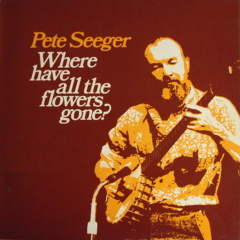
"Where Have All the Flowers Gone" was written by Pete Seeger and Joe Hickerson. Seeger has said that he derived the melody for the tune from a traditional Irish lumberjack song. The lyrics were inspired by a traditional Cossack folk song, "Kolda-Duda," that was referenced in the 1934 Mikhail Sholokhov novel, And Quiet Flows the Don. He sang the first version of the freshly written song live at Oberlin College in Ohio in 1955. Seeger first recorded an a cappella version of the song in July 1960. The Kingston Trio released the most recognized version of "Where Have All the Flowers Gone" in 1962 as the B-side to their single, "O Ken Karanga." The B-side was picked up by programmers in radio across America, and it went to #21 on the Billboard Hot 100 Singles chart and #4 on the Easy Listening Singles chart. Peter, Paul, and Mary included the song on their debut album in 1962. Their album went to #1 on the Billboard Top 200 Albums chart and has been certified 2x Platinum by the Recording Industry Association of America. The tune has been inducted into the Grammy Hall of Fame in the Folk category. It has been covered by many artists over the decades, such as: Bobby Darin, Roy Orbison, The Searchers, Johnny Rivers, Joan Baez, Dolly Parton, and Earth, Wind & Fire.
Pete Seeger was an American folk singer, songwriter, and social activist. He started his career as a folk artist in the early 1940s as a member of The Almanac Singers, a New York City group that also included Woody Guthrie, Lee Hays, and Millard Lampell. After serving in the Army in World War II, Seeger sang folk music on radio programs before joining The Weavers in the early ‘50s. As a solo artist, he released 52 studio albums, 22 live albums, 23 compilation albums, and 31 singles. He is a member of the Songwriters Hall of Fame and the Rock and Roll Hall of Fame. He is a recipient of a Grammy Lifetime Achievement Award, a Kennedy Center Honor, a George Peabody Award, a Woody Guthrie Prize, and a National Medal of Arts. Seeger died in New York City in January 2014 at the age of 94.