Permian natural gas prices have been on a wild ride lately, trading more than $5/MMBtu below zero in early April before recovering to just above zero over the last few weeks. It’s hardly a secret that the Permian’s gas market woes have been the direct result of production exceeding pipeline capacity. That situation is set to change in a few months, when Kinder Morgan starts up its 1.98-Bcf/d Gulf Coast Express Pipeline, providing much needed new takeaway capacity. And that’s not all GCX will do. Its start-up will shift huge volumes of gas toward the Texas Gulf Coast that currently flow out of the Permian to other markets, likely causing a ripple effect across more than just the West Texas gas market. Today, we look at how Kinder Morgan’s new gas pipeline will redirect significant volumes of Permian gas currently flowing north to the Midcontinent.
To truly understand Cushing — what it does and how it works — you need to know the hub’s assets and how they fit together. RBN’s Cushing Crude Oil Playbook provides the first one-stop, comprehensive guide to the hub’s assets.
Before we focus on today’s topic — GCX-driven flow shifts — we first want to provide a quick update on Permian natural gas and our recent blogs on the subject. About a month ago, in Money For Nothing, Gas For Free, we outlined some of the beneficiaries of the Permian gas price crash. Since then, prices have improved somewhat in the basin, with daily average prices at the Waha Hub hovering just above zero for the past month or so (dashed green oval in Figure 1 below). The improvement has been driven largely by producers deciding to curtail their dry gas production in the basin, with Apache Corp. alone announcing it has deferred 250 MMcf/d. Before those adjustments, prices at Waha crashed to all-time low levels in early April (dashed red oval), a situation we detailed in Don’t Dream It’s Over. Prior to that dramatic event, Permian gas prices had only flirted with subzero prices, back in February (dashed orange circle, see King of Pain), after falling below zero in intraday trading for the first time ever in November 2018 (dashed purple circle; see Keep Breathin’). While we doubt that Permian gas prices will be out of the woods fully until GCX starts, it’s fair to say that the extremely negative prices were enough to correct — at least for now and to the extent it can, given ongoing transportation constraints — the Permian gas supply and demand imbalance that had emerged over the past few weeks. That said, we do expect the Permian gas market to struggle to handle ever-increasing volumes of associated gas from crude oil wells this summer and wouldn’t be surprised to see another round or two of negative prices at some point during the injection season.
About the song
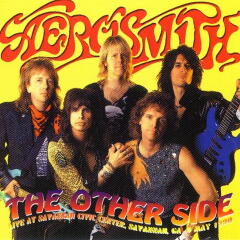
"The Other Side," written by Jim Vallance and Steven Tyler, was the fourth single from Aerosmith's 10th studio album, Pump. The song went to #1 on the Billboard Top Mainstream Rock Tracks chart and #22 on the Billboard Hot 100. The Bruce Fairbairn-produced single was released in June 1990. After threatening a lawsuit, Detroit songwriter team Holland-Dozier-Holland were given songwriter credits on the tune due to the similarity of "The Other Side" and the Holland-Dozier-Holland-penned Four Tops hit, "Standing in the Shadows of Love." The video of “The Other Side” won the MTV Video Music Award for Best Rock Video in 1991.
Pump incorporated the use of a horn section and keyboards on its hit singles and utilized a glossier pop production ethos that would characterize most of Aerosmith's albums in the next decade. Pump would go to #5 on the Billboard Top 200 Albums chart and be certified 7x Platinum by the Recording Industry Association of America. The single of "Janie's Got a Gun" from Pump would win a Grammy Award for Best Rock Performance by a Duo or Group with Vocal in 1990. Personnel on the record were: Steven Tyler (lead vocals, guitar, keyboards, harmonica), Joe Perry (guitar, slide guitar, backing vocals), Brad Whitford (guitar), Tom Hamilton (bass, backing vocals), Joey Kramer (drums), John Webster (keyboards) and The Margarita Horns (horn section).
Aerosmith is an American rock band formed in Boston in 1970. The group has released 15 studio albums, six live albums, 13 compilation albums and 76 singles. Aerosmith has won six American Music Awards, four Billboard Music Awards, four Grammy Awards and 10 MTV Video Music Awards. The band has sold over 150 million records worldwide and still records.