The CME/NYMEX Henry Hub prompt natural gas futures contract last week settled at $3.213/MMBtu, the highest daily settlement since late May 2017. Despite natural gas production climbing nearly 3.0 Bcf/d over the past couple of months to record highs, the U.S. gas supply and demand balance has tightened considerably in recent weeks, particularly relative to last year at this time. Moreover, U.S. gas storage inventory has remained below year-ago levels and also moved below the five-year average level in recent weeks. That’s because gas demand has managed to more than offset the incremental supply in the market. How did that happen and what can it tell us about what to expect this winter? Today, we analyze recent shifts in gas market fundamentals.
When we last checked in on the gas market a few months ago, in Summertime Blues, the market balance heading into the fall was looking increasingly bearish relative to last year, as summarized in Figure 1 below using monthly average supply and demand volumes from RBN’s NATGAS Billboard report. Until September, gas supply this year had been mostly lagging well behind 2016 and was averaging 1.0 Bcf/d lower year-on-year. From April through August, production was averaging down 0.4 Bcf/d, and imports from Canada also were lower, by another 0.6 Bcf/d, while receipts from LNG imports were flat. Despite the lower supply, however, the market was long gas by more than 1.0 Bcf/d compared to the same period in 2016. That’s because relatively milder weather and higher gas prices (versus last year) were doing a number on demand.
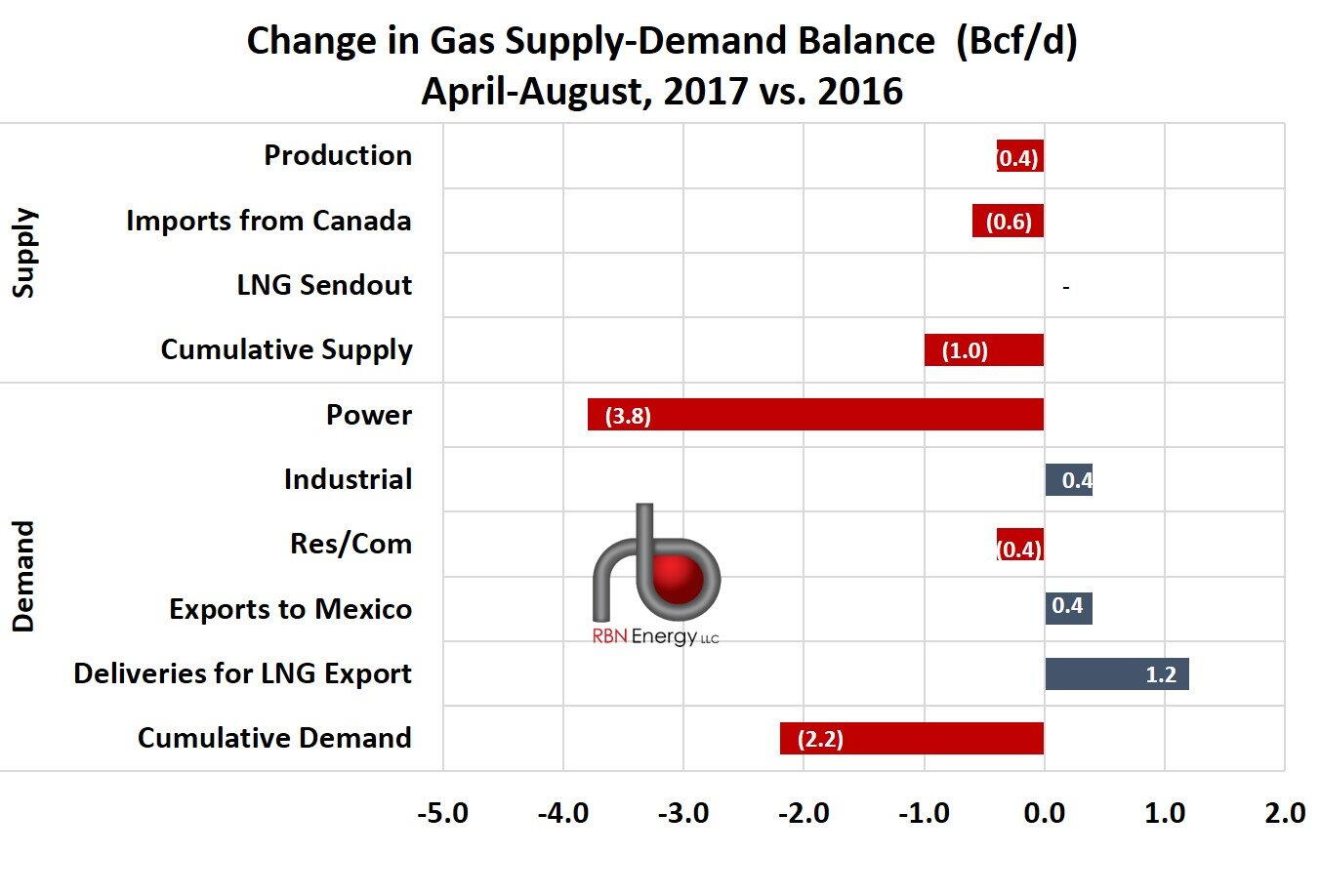
Figure 1 Source: NATGAS Billboard
Gas demand during the summer is driven primarily by gas-fired power generation for air conditioning use, which is dependent on weather, and weather was less than favorable for gas demand through much of the injection season, including through July and August, which are typically the hottest, highest demand months of the season. From April to August, while temperatures were coming in above normal on average, they were not quite as high as they were in 2016. Additionally, gas competes for generation demand with coal, and spot gas prices this season were averaging about 60 cents higher than last year. As a result, on top of losing weather-related demand, gas also lost some market share to coal for economic reasons. Between the two factors, power generation demand for gas from April through August was averaging nearly 4.0 Bcf/d lower year-on-year. While incremental demand from exports helped offset about half of that, it wasn’t enough to overcome the loss of power demand, and, as a result, total demand was averaging more than 2.0 Bcf/d lower year-on-year.
So, while gas supply was down 1.0 Bcf/d year-on-year, demand was down double that, leaving on average about 1.0 Bcf/d more supply in the market from April to August than last year. That meant that, overall, more gas was being shuttled into storage than last year. The inventory had started injection season about 430 Bcf lower year-on-year and as of late August, that inventory “deficit” was still in place, but it had shrunk by nearly half to less than 250 Bcf. What’s more is that the supply/demand balance was looking increasingly bearish going forward, unless some demand-boosting weather showed up. It was clear production was not done growing, and weather remained a big question mark, with near-term forecasts at the time indicating mild weather persisting. Thus, there was still an outside chance that the combination of production growth and modest demand could accelerate and prolong storage injections enough to carry the inventory back to the 2016 record level before winter arrived.

About the song
“Signs (Sign, Sign, Everywhere A Sign)” was recorded by Tesla in 1990, as part of a live album titled Five Man Acoustical Jam (a reference to the original recording artists — Five Man Electrical Band). The Tesla album featured some of the hits from the band’s prior two albums, as well as some covers, including the song "Signs," which received massive airplay upon its release. Tesla — named after inventor/electrical pioneer Nikola Tesla — is a five-piece hard rock band from Sacramento, CA, that features the lead vocals of Jeff Keith. Their first album, "Mechanical Resonance," was released in 1986 and reached #32 on the charts, achieving platinum status. Their second release, "Great Radio Controversy" in 1989, reached #18 and double-platinum status. The live album Five Man Acoustical Jam reached #12 on the charts and went platinum.
The original song, "Signs," was written by Les Emmerson, the lead vocalist and guitarist for Ottawa, Canada-based Five Man Electrical Band. Various versions of that band had been around since 1963, when they were known as The Staccatos. In 1970, they changed their name, and went for a more hard rock sound. That same year, they released their album Good-Byes and Butterflies, which included "Signs.” After a false start as a B-side of the single, it was re-released as an A-side single and went to #3 on the Billboard Top 100 in 1971, earning a gold record.
Both versions of the song have sold over 1.5 million copies each.