So far, most of the merger-and-acquisition activity among crude-oil-focused producers in the COVID era has occurred where you would expect it: the Permian, which seems to dominate almost every discussion about the U.S. energy industry. More recently, though, there has been an uptick in E&P consolidation in the Denver-Julesburg Basin in the Rockies and, earlier this month, in the Bakken. There, Whiting Petroleum and Oasis Petroleum — two once-struggling producers — have agreed to a merger of equals that will create the Bakken’s second-largest producer and the largest pure-play E&P. In today’s RBN blog, we discuss the companies’ stock-and-cash deal, which will result in a yet-to-be-renamed entity with an enterprise value of about $6 billion.
As we said in Buy Buy Buy back in January, the period since the COVID-related meltdown in crude oil prices in April 2020 has been marked by the most impactful wave of big-dollar consolidation among E&Ps since the turn of the century, when a plunge in oil prices spurred deals that helped to form many of today’s supermajors and large independents. The current round of M&A hasn’t been about getting bigger for bigness’s sake. Instead, the common goals among the companies acquiring or merging have been to boost their inventories of high-margin assets, accelerate free cash flow generation, and grow shareholder returns while slashing capital and corporate expenditures.
It is not only the bigger E&Ps that are joining forces. Many small-and-midsize deals have been announced in recent months, a trend we covered last month in Baby I’m-a Want You. As we said then, these have been a mixed bag — some have been mergers, some have been acquisitions of entire companies, and others have involved purchase of specific production assets or groups of assets of particular interest to their buyers. In many cases, participants are seeking to combine acreage with complementary footprints (mostly in either the Permian or the DJ Basin) that will allow for longer lateral drilling, more efficient operations, and enhanced production capacity that would be difficult to achieve independently.
The Whiting-Oasis merger we zero in on today fits nicely between the big and small-to-midsize M&A activity we discuss in those blogs. Whiting and Oasis have very similar backstories, including long histories in the Bakken. Both expanded their holdings and their indebtedness at what turned out to be inopportune times, filed for federal bankruptcy protection and, after emerging from Chapter 11, divested their production assets outside the Bakken (Whiting’s in the DJ and Oasis’s in the Permian), beefed up their holdings in western North Dakota and further improved their balance sheets. (Last fall, we discussed Oasis’s recent history in Midnight at the Oasis and the sale of its Oasis Midstream Partners, a master limited partnership, to Crestwood Equity Partners in Just the Two of Us.)
About the song
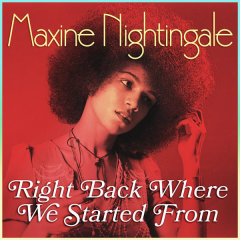
“Right Back Where We Started From” was written by Pierre Tubbs and Vincent Edwards. It appears as the third song on side one of Maxine Nightingale’s debut album of the same name. Released as a single in the U.S. in February 1976, the song went to #2 on the Billboard Hot 100 Singles chart. It was featured prominently in the 1977 film Slap Shot and has appeared in several feature films since. Personnel on the record were: Maxine Nightingale (lead vocals), Mick Barker, Glenn Nightingale, Pierre Tubb (guitars), Theo Thunder, Pete Kershaw (drums), Mike de Albuquerque (bass), Ben Andrews, Lynton Naiff (keyboards), Dave Ulm (percussion), Frank Ricotti (vibraphone), Raphael Ravenscroft, Bill Skeat (brass arrangements), Gerry Shury, Wilf Gibson (string arrangements), and Tony Rivers, John Perry, Ken Gold, Vince Edwards, Al Matthews, Pete Kershaw, Pierre Tubbs, Maxine Nightingale, Liza Strike, Helen Chappell (backing vocals).
The album Right Back Where We Started From was recorded between June 1975 and March 1976 at Central Sound, Olympic Sound, Morgan Studios, Island Studios, and Eden Studios in London. Produced by Pierre Tubbs, the LP was released in June 1976 and went to #53 on the Billboard 200 Albums chart. Three singles were released from the album.
Nightingale is a British R&B and disco singer. Her professional career started in 1969, when she released three singles for the British label Pye Records. She was also featured in the British and German stage productions of the musical Hair and also starred in German productions of Jesus Christ Superstar and Godspell. While starring in the British stage production of Savages, Nightingale was discovered by record producer Tubbs. She has released six studio albums, one compilation album, and 19 singles. Nightingale currently resides in the U.S. and makes live appearances occasionally.