Shell’s new, multibillion-dollar steam cracker in Monaca, PA — the first of its kind in the Marcellus/Utica shale play — is finally up and running and breathing new life into a small town on the Ohio River. When it’s running flat-out, the cracker will churn out up to 9 million pounds of ethylene a day to supply three adjoining polyethylene units. Shell Polymers Monaca, as the petrochemicals complex is formally known, is a world-scale giant, consuming about 95 Mb/d of ethane, which raises this question: How is the start-up of the region’s only large ethane consumer affecting the broader market? In today’s RBN blog, we provide the answer.
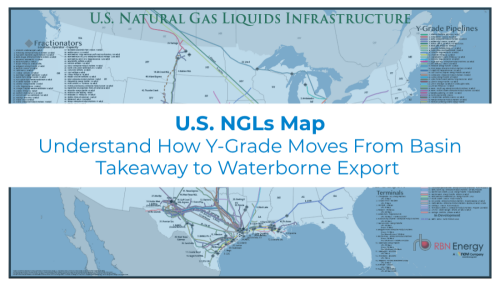
Visualize the infrastructure behind U.S. NGL movement.
The U.S. NGLs Map provides a comprehensive view of the transport, processing, and export networks moving NGLs across the U.S.
In energy-industry circles, it’s often said that you can’t get anything permitted and built in the northeastern U.S. — there are simply too many regulatory and legal hurdles to clear. There are certainly many tried-but-failed projects you could point to as evidence — natural gas takeaway pipelines into New York, New England and New Jersey come to mind, and the long-planned Mountain Valley Pipeline into Virginia remains in limbo. But it’s also true that many energy-related projects do advance to construction and operation. A prime example is the subject of today’s blog, Shell’s ethylene-and-PE complex northwest of Pittsburgh, which the company committed to building in 2016 and which recently came online, very close to Shell’s original schedule (despite some COVID-related setbacks).
As we said in our Ain’t Wastin’ Time No More and Only Time Will (Sh)ell blogs six years ago, Shell received strong local support for its Shell Polymers Monaca project in Beaver County (see photo below), as well as substantial financial incentives from the commonwealth of Pennsylvania. Under the Keystone State’s Local Resource Manufacturing Tax Credit (which was enacted to bolster Shell’s prospective cracker project), any company that develops an ethane-consuming ethylene plant valued at $1 billion or more and that creates at least 2,500 jobs during the construction phase would be eligible for a tax credit equal to 5 cents/gal (or $2.10/bbl) of ethane purchased and used to produce ethylene. (For perspective, the current price of ethane at Mont Belvieu is 41 cents/gal.) The tax credit, which applies to ethane purchased between January 2017 and December 2042, can be used to reduce Shell’s overall tax liability to the state by up to 20%. Assuming that the cracker remains operational through December 2042 (20 years and two months in total) and consumes an average of 85 Mb/d (close to full capacity, that is), the tax credit’s value would total more than $1.3 billion ($2.10/b x 85,000 b/d x 365 days x 20.167 years). Separately, Shell reached "payments in lieu of taxes” agreements with the local government and school district.
About the song
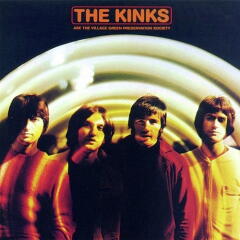
“Monica” was written by Ray Davies and appears as the fifth song on side one of The Kinks’ sixth studio album, The Kinks Are the Village Green Preservation Society. Ray Davies’s lyrics on the song were inspired by Welsh poet Dylan Thomas’s 1954 radio drama Under Milk Wood. The tune also features congas with an Afro-Cuban rhythm, reflecting Davies’s interest in calypso music. Personnel on the record were: Ray Davies (lead vocals, guitar), Dave Davies (guitar, backing vocals), Pete Quaife (bass, backing vocals), Mick Avory (drums, congas, percussion), Nicky Hopkins (Fender Rhodes electric piano), and Rasa Davies (backing vocals).
The Kinks Are the Village Green Preservation Society was recorded between February 1967 and October 1968 at Pye Studio 2 in London, with Ray Davies producing. Released in November 1968 in the UK and February 1969 in the U.S., the album failed to reach the charts in the U.S. The Kinks’ American label, Reprise, released a single of “Starstruck” off the LP in the U.S., but it failed too to chart. Sales of the album were estimated to be around 25,000. Despite of the commercial disappointment of the album, The Kinks Are the Village Green Preservation Society is treasured by many rock critics, reviewers, and hard-core Kinks fans. Noel Gallagher, formerly of Oasis, and Graham Coxon and Damon Albarn of Blur have named the album as one of their favorites.
The Kinks were an English rock band formed in London in 1963 by brothers Ray and Dave Davies, Pete Quaife and Mick Avory. They have released 24 studio albums, six live albums, 32 compilation albums, 10 EPs and 78 singles and have sold more than 50 million records worldwide. The Kinks are members of the Rock and Roll Hall of Fame and the UK Music Hall of Fame. In 2004, Ray Davies received a CBE from Queen Elizabeth II for services to music. In 2017, he was knighted for services to the arts. Twelve people passed through the band until The Kinks officially broke up in 1997 due to creative tensions between the Davies brothers. Original bassist Pete Quaife passed away in 2010. Brothers Ray and Dave Davies continue to record and tour as solo acts.