


Well, it took a hot war in Europe, constrained capital spending by U.S. producers, continued restrictions in OPEC+ production, and ongoing economic recovery from a global pandemic, but it’s finally happened: Brent shot past $100 and even $105/bbl Thursday before dropping in the last hour of trading to settle a hair above $99. Even WTI touched $100/bbl briefly. The market has been buzzing about the prospects for the breach of this threshold since October, coming along with waves of speculative trades, a dozen false starts, and countless pundit predictions. Now that it has happened, what does it mean — other than higher gasoline prices, of course? In the good ole days, high prices would spur production growth that would help bring prices back down — eventually. But this time, things are different. Which begs the #1 question: Will triple-digit oil prices last? In today’s RBN blog, we’ll consider these issues in the context of historical price behavior and what we might expect this time around.

Join industry leaders in Calgary on October 29 for market insights, technical presentations, Duvernay inventory analysis, an expert panel, and networking focused on the next chapter of Canadian energy.
It would be impossible — and, frankly, wrong — to discuss yesterday’s surge in crude oil prices without first pausing to acknowledge the terrible human tragedy unfolding in Ukraine. We are living through a defining moment in history, and our hearts are with those fighting to defend freedom.
It was more than seven years ago, on September 5, 2014 — a few months after Russia invaded Ukraine’s Crimean Peninsula — that Brent last settled above $100/bbl (yellow “blast” icon to left in Figure 1). Brent had averaged $110/bbl for the previous four years. After the crash of late 2014 took Brent down to $55/bbl by year’s end, the price of Brent then averaged $55/bbl for the next six years (dashed gray line). The crude oil benchmark hit rock bottom on April 21, 2020 (red blast icon), the day after WTI famously went negative, down to minus $37.63/bbl. Since then, it’s been a pretty steep run back to $100+/bbl (yellow blast icon to right) — on Thursday, after rising as high as $105.79/bbl, the Brent April contract settled at $99.08/bbl.
About the song
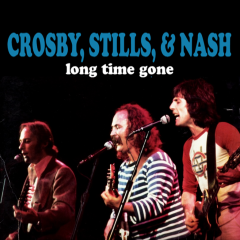
“Long Time Gone” by Crosby, Stills & Nash is known for the chorus refrain of “It's been a long time comin,' it's goin' to be a long time gone.” The song was written by David Crosby. It appears as the fourth song on side two of Crosby, Stills & Nash's debut album of the same name. Personnel on the record were: David Crosby (lead vocals, rhythm guitar), Stephen Stills (lead guitar, bass, keyboards, percussion, backing vocals), Graham Nash (backing vocals), and Dallas Taylor (drums).
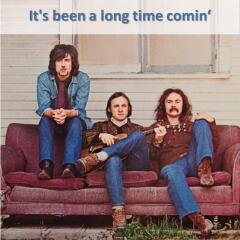
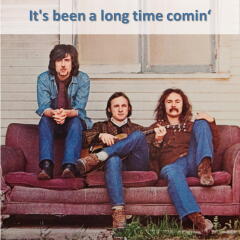
The Crosby, Stills & Nash LP was recorded in February and March 1969 at Wally Heider's Studio III in Hollywood, CA. Produced by Crosby, Stills, and Nash, the album was released in May 1969 and went to #6 on the Billboard 200 Albums chart. It has been certified 3x Platinum by the Recording Industry Association of America. Two singles were released from the LP. An interesting side note is the story of the cover photo, shot by Henry Diltz. The group was placed seated on a dilapidated couch on the porch of an old house, before the band had decided on the name, Crosby, Stills, and Nash. The problem was they were seated on the couch in the left-to-right order of Nash, Stills, and Crosby. The group went back to re-shoot the photo, but the house had been demolished, so they used the original photo for the cover.
Crosby, Stills & Nash was a folk-rock supergroup formed in Los Angeles in 1968 by David Crosby (The Byrds), Stephen Stills (Buffalo Springfield), and Graham Nash (The Hollies). When joined by Neil Young (Buffalo Springfield) as a fourth member, they were called Crosby, Stills, Nash & Young. The group played its second public gig at the Woodstock Festival in New York in August 1969. Crosby, Stills, Nash & Young released eight studio albums, five live albums, six compilation albums, and 19 singles and was inducted into the Rock and Roll Hall of Fame in 1997. The group has been inactive since last playing together in 2015. All four members have gone on to successful solo careers, and still record and perform live.




Comments
Great article! How about doing a version for natural gas prices? and also one for NGLs?