Much as production growth in the Permian required the development of new pipeline capacity to take away crude oil, natural gas and NGLs, increasing activity in the Williston Basin has spurred the need for incremental capacity to move all three of the energy commodities out of western North Dakota and eastern Montana. For NGLs, the recent start-up of ONEOK’s Elk Creek Pipeline has been the answer to producers’ prayers — not just in the Williston Basin (home of the Bakken formation), but also in the Rockies’ Powder River and the Denver-Julesburg (D-J) basins, through which the new, 240-Mb/d pipeline passes on its way to Bushton, KS. Elk Creek’s timing couldn’t have been better: it came online just as a number of new gas processing plants entered commercial service in the Williston Basin, and just in advance of possible Btu restrictions on the all-important Northern Border gas pipeline that may force cutbacks in ethane rejection. Today, we explain why the Elk Creek NGL Pipeline helps resolve a number of challenges Bakken producers have been facing.
As we discussed in a few recent blogs, Here We Go Again and The Battle Rages On among them, increased drilling-and-completion activity in the Williston Basin has resulted in record-shattering production of crude oil and associated gas there, and the development of new crude-pipeline and gas-processing capacity to try to keep pace. And with that new processing capacity — 710 MMcf/d this year alone — has come increasing flows of mixed NGLs that need to be either fractionated into so-called “purity products” locally (and there is only a small amount of fractionation capacity in North Dakota) or piped to distant fractionation centers in Bushton or Conway, KS, or Mont Belvieu, TX.
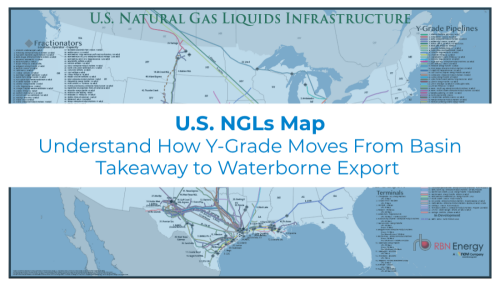
Visualize the infrastructure behind U.S. NGL movement.
The U.S. NGLs Map provides a comprehensive view of the transport, processing, and export networks moving NGLs across the U.S.
For a time, Williston Basin producers and midstreamers managed to get by using the NGL takeaway capacity that was already in place, primarily ONEOK’s 140-Mb/d Bakken NGL Pipeline (orange line in Figure 1). Bakken NGL flows mixed, unfractionated NGLs (a.k.a. y-grade) south into ONEOK and Williams’s jointly owned 245-Mb/d Overland Pass Pipeline (green line), which runs from the Powder River and D-J to Conway. When ONEOK announced plans for the new Elk Creek Pipeline almost two years ago, it said the Bakken NGL and Overland Pass pipelines were running at or near capacity — an assertion backed up by data from the Energy Information Administration (EIA). Elk Creek Pipeline (blue line), which started flowing y-grade earlier this month, is a biggie. Twenty inches in diameter and about 900 miles long, with an initial capacity of 245 Mb/d (expandable to 400 Mb/d), the pipe originates near ONEOK’s Riverview terminal (purple triangle) in Richland County, MT, runs south through the eastern edges of Montana and Wyoming, then cuts across the northeastern corner of Colorado on its way to Bushton. The pipeline is anchored by 10-to-15-year contracts totaling about 100 Mb/d, primarily with minimum volume commitments, or MVCs.
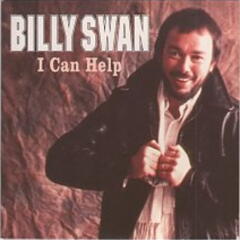
About the song
"I Can Help" was written by Billy Swan and appears on Swan's album of the same name. It was released as a single in July 1974, and went to #1 on the Billboard Hot 100 and Hot Country Songs charts. The record has been certified Gold by the Recording Industry Association of America. Swan says he wrote the song in about 20 minutes in his Nashville duplex, using an early drum machine and the RMI organ that Kris Kristofferson and Rita Coolidge gave him as a wedding present. The song was recorded at Young'un Sound Studio in Murfreesboro, TN, and was produced by Chip Young and Billy Swan. Personnel on the record were: Billy Swan (lead vocals, Farfisa organ), Reggie Young (electric guitar), Dennis Linde and Johnny Christopher (acoustic guitar), Mike Leech (bass), Hayward Bishop (drums), and Lea Jane Berinati and the Holliday Sisters (backing vocals). Swan recorded the I Can Help album after the success of the single. The LP went to #1 on the Billboard Top Country albums chart, and #21 on the Billboard Top 200 Album chart. Elvis Presley, Ringo Starr and The Replacements have all recorded cover versions of "I Can Help."
Billy Swan is an American country singer-songwriter. His first big break in the music business came in 1962, when he wrote "Lover Please," which became a hit for Clyde McPhatter. He has also written hits for Conway Twitty, Waylon Jennings and Mel Tillis. Swan produced Tony Joe White's 1969 Top 10 hit, "Polk Salad Annie." He has released six solo studio albums and 18 singles, and continues to write and do session work.