


E&Ps have long been accustomed to negative investor sentiment and the depressed stock valuations that come with it. But who among them could have anticipated the first quarter’s devastating one-two punch of coronavirus-related energy demand destruction and the collapse of the OPEC+ supply-management effort that for more than three years had propped up crude oil prices? E&Ps responded by slashing their 2020 capital spending plans and touting how much of their 2020 production is hedged. But there’s no doubt about it, the E&P sector is in for particularly hard times, as evidenced by Whiting Petroleum’s Chapter 11 filing last week. A major impediment for Whiting and other already hobbled E&Ps is a cost structure that, for many, significantly exceeds the current price of oil. Today, we discuss what an examination of more than 30 E&Ps’ lifting, DD&A and other costs reveals about the companies’ ability to stay afloat in rough seas.
In order to identify the companies with the weakest and strongest outlooks in this low commodity price environment, we analyzed the cost structures of the 34 companies in our Oil-Weighted and Diversified E&P peer groups. The data points we analyzed are: lifting costs (including production taxes); depreciation, depletion and amortization (DD&A) expenses; cash interest expense paid (including capitalized interest); and general and administration (G&A) outlays, all using 2019 data found in the company’s 10-Ks. In other words, we’ve tracked the costs of producing oil and gas, paying interest on debt, and paying staff and office overhead. We have excluded impairment charges from this analysis, since they are not regularly occurring expenses; exploration outlays, which tend to be deferred in low-price environments; and income taxes. We computed two metrics: total costs per barrel of oil equivalent (boe) and cash costs per boe. Total costs per boe is the sum of all the data points we highlighted above and can be considered a breakeven point for E&P operations. Cash costs are defined as total costs excluding DD&A expenses, and, in theory, represent the point at which production would be shut-in — i.e., when a producer would see negative cash flow per boe produced.
This analysis also excludes capital expenditures, which we recently analyzed in our blog, “Paint It Black.” In recent weeks, the Oil-Weighted and Diversified companies that we track have announced additional reductions in 2020 capex of more than 40%, which suggest at least a 6% overall decline in their production from initial 2020 estimates. We expect even more reductions in spending and production guidance to be announced in upcoming first-quarter earnings releases. E&Ps are also slashing or eliminating dividends and suspending share repurchase programs to preserve liquidity. Note that we are not considering balance sheets in our analysis, so this is not an assessment of which companies are the ones most likely to succumb to market conditions.

About the song
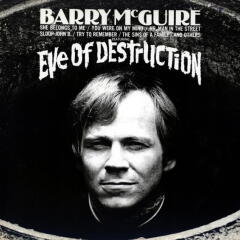
"Eve of Destruction" was written by P.F. Sloan (Philip Gary Schlein), and became a hit single for American folkie Barry McGuire after its release in August 1965. The song was recorded in Los Angeles, with Lou Adler, P.F. Sloan and Steve Barri producing. According to McGuire, the song was recorded in one take on a Thursday, with just a rough "scratch" vocal on the recording. By the following Monday, a leaked tape of the recording was being played on Los Angeles radio stations. The listener response was so overwhelmingly positive that McGuire's label, Dunhill, decided to rush-release the song as a single, scratch vocals intact. The song quickly rose to the #1 spot on the Billboard Hot 100 Singles chart. In spite of its hit status, the tune was banned by some radio stations due to its controversial lyrical content. It would be McGuire's only Top 40 hit. The follow-up McGuire LP, also called Eve of Destruction and released a couple of weeks later, would go to #37 on the Billboard Top 200 Albums chart.
The song "Eve of Destruction" has been covered by Jan and Dean (using the same backing tracks as the McGuire version!), The Turtles, The Grass Roots, Tiny Tim, The Dickies, Johnny Thunders, D.O.A. and Public Enemy. Personnel on the original record were: Barry McGuire (lead vocal, harmonica), P.F. Sloan (guitar), Larry Knechtel (bass) and Hal Blaine (drums).
Barry McGuire is an American singer-songwriter. Mainly known for his hit single, "Eve of Destruction," he later gained fame as a pioneering singer-songwriter in the contemporary Christian music field. His professional career started in the early 1960s as part of a duo with Barry Kane called Barry and Barry; both would later both join The New Christy Minstrels. McGuire went solo in 1965. He last toured professionally in 2017.





Comments
I think your oil percentage (and likely BOE) calculations are not differentiating two stream and three stream companies properly. CLR has almost the same percentage gas as EOG on a two stream basis. If you are implicitly looking at three stream (by talking about "liquids"), than CLR should have a higher percentage than you are showing.
Really, I think it would have been simpler and more economically meaningful to just do everything two stream (assign the NGLs to wet gas).
Hi chemgeek:
Sorry about the delayed response.
I agree with your assertion about three stream production reporting is better than two stream reporting. However, CLR only reports its production on a two stream basis most likely because it sells its unprocessed gas directly to a midstream company. Unfortunately, there isn't anything we can do about that. The good news is there are only a few companies that report this way with CLR being the most prominent.
Thanks for your question.