How about some good news to start the year? Over the past few weeks, ethylene margins have blasted into the stratosphere. These are good times for steam crackers, those petrochemical plants that use mostly NGL feedstocks to produce ethylene and other building-block chemicals. As you might expect, this newfound prosperity has a lot to do with ethylene’s price. In December alone, the price of ethylene was up 50%; versus April it’s up a whopping 4X, coming in yesterday at 37.5 cents per pound (c/lb). There are a whole range of factors responsible, including petchem outages due to the hurricanes, new downstream derivative units coming online, robust exports from the Enterprise Morgan’s Point dock, and, oh yes, strong demand for downstream products — everything from food packaging to construction materials. Is the spike in ethylene prices going to last? And what does it mean for NGLs, which account for more than 95% of the feedstock supply for U.S. ethylene. We’ll explore those questions and more in this blog series we begin today.
The petchem feedstock market is a frequent topic here in the RBN blogosphere, usually with NGLs in the spotlight, since about one-third of all NGLs end up in U.S. steam crackers, including 85% of produced ethane. (The other 15% of ethane is exported to crackers in other countries; see It Takes Two for more on ethane exports.) Back in the depths of the COVID meltdown, it was looking ruinous for the petchem sector as large swaths of the economy that rely on petchems — everything from auto parts to appliances — were shutting down. But it was a short-lived crash. Petchems started turning around in May and along with ethylene prices have been rebounding ever since.
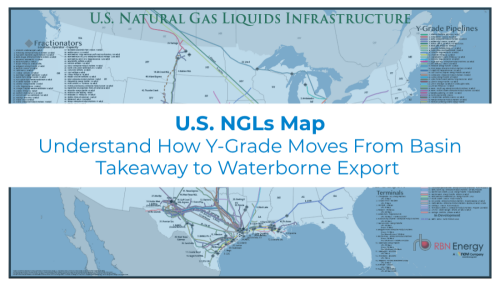
Visualize the infrastructure behind U.S. NGL movement.
The U.S. NGLs Map provides a comprehensive view of the transport, processing, and export networks moving NGLs across the U.S.
As shown in the left graph in Figure 1, the average annual price for ethylene in 2016-17 was a respectable 26-27 c/lb. Back then, the demand for ethylene from downstream derivative plants was relatively balanced with supplies coming from steam crackers (the facilities that produce ethylene and other building-block petrochemicals). That all started changing in 2018, as seven new, world-scale steam crackers began coming online along the Gulf Coast, sponsored by major players such as Dow Chemical, CP Chem, ExxonMobil, Westlake-Lotte, and Sasol. Although most of those crackers were associated with new, integrated downstream derivative plants, some of those new downstream units did not come on at the same time as the steam crackers. Consequently, the market had more ethylene supply than downstream derivative demand. Ethylene prices dropped to the 17-18 c/lb range. That’s where we started 2020, but early on the prospects for all petchem products dimmed with the COVID-induced economic meltdown. Ethylene prices turned south in February and continued down until sinking to a paltry 8.5 c/lb by mid-April. At that point, shares in petchem companies were down by 50% and things looked bleak.
About the song
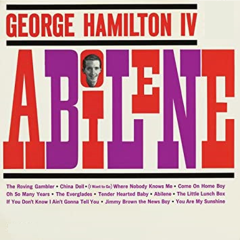
“Abilene” was written by Bob Gibson, Lester Brown, and John D. Loudermilk. Although most people associate the song with Abilene, TX, songwriter Bob Gibson was inspired to write the song after watching the Randolph Scott film, Abilene Town. The setting for the film is Abilene, KS, which at that time was the railhead town at the end of the Chisholm Trail. “Abilene” appeared as the eighth song on George Hamilton IV's fourth studio album of the same name. It was released as a single in May 1963, and went to #1 on the Billboard Hot Country Songs and #15 on the Billboard Hot 100 Singles charts. Hamilton performed the song in the 1963 movie, Hootenanny Hoot. Personnel on the record were: George Hamilton IV (vocals), and unnamed Nashville studio musicians.
The album Abilene was recorded in the spring of 1963 in Nashville, with Chet Atkins producing. Released in May 1963, the album went to #18 on the Billboard Country Albums chart, and #77 on the Billboard Top 200 Albums chart. Three singles were released from the LP.
George Hamilton IV was an American country music singer and musician. He started his professional career as a rockabilly singer in 1956, switching to country music in the early sixties. His first breakthrough came in 1961, with the single “Before This Day Ends.” Two years later, he would release his biggest hit, “Abilene.” He released 40 albums and 63 singles during his career. Hamilton died in Nashville in 2014 at the age of 77.