The ethane market isn’t for the faint at heart — it’s got lots of ups and downs, and it’s impacted by an unusually wide range of variables. A year ago this month, a combination of fractionation constraints in Mont Belvieu and rising demand from new ethane-only steam crackers sent ethane prices north of 60 cents/gallon. For most of the time since then, though, ethane prices were in something close to freefall, bottoming out at only 10 cents in late July before rebounding in recent weeks to 20 cents or so. During the big, months-long price decline, ethane traders and cracker operators did what anyone does when they can buy something they’ll need in the future for next to nothing — they stocked up. Today, we examine recent trends in ethane supply, demand, prices and storage levels, and take a look ahead.
Ethane is the Lady Gaga or Lil Nas X of hydrocarbons: there’s nothing else quite like it. As we said in our recent (and appropriately named) One of a Kind blog, ethane — the lightest of the so-called NGL “purity products” — is a chameleon: it can either be “rejected” into the natural gas stream at the gas processing plant and sold (at the price of gas) for its Btu value or extracted from mixed NGLs (through fractionation) like its purity-product brethren and sold to steam crackers (to produce ethylene and other petrochemical byproducts). Another quirk is that, unlike propane, normal butane and natural gasoline, extracted or “produced” ethane has very limited use: it goes into crackers, a very small number of power generation plants or nothing.

Canadian crude output is rising, requiring new export routes. As traditional pathways face constraints, the U.S. Rockies—especially the Guernsey, WY hub—are emerging as key corridors for moving Canadian heavy crude to downstream markets, including the Gulf Coast.
The blue line in the left graph in Figure 1 shows that ethane consumption by U.S. steam crackers grew through most of 2017 and 2018. There was a major downward spike in August and September 2017 (dashed red oval) — that was caused by Hurricane Harvey, which (as locals will surely recall) dumped several feet of rain in the greater Houston area and temporarily shut down as much as 90% of Texas’s steam-cracker capacity, or more than half of total U.S. cracker capacity. A second, smaller dip came last September and October (dashed yellow circle), when a shortfall in fractionation capacity at the Mont Belvieu hub put a big squeeze on ethane supplies, sent ethane prices soaring, and put the margin for producing ethylene from ethane — and propane and butane — into negative territory (more on ethane prices and ethylene margins in a moment). Besides those two relatively brief periods, though, 2017 and 2018 were good times for ethane producers. According to Jacobs Consultancy’s Hodson Report, ethane consumption by U.S. steam crackers increased from 1.059 MMb/d in January 2017 to 1.536 MMb/d in December 2018 — a 45% gain — and, according to the Energy Information Administration (EIA), U.S. ethane exports (yellow-shaded area in right graph in Figure 2) rose from an average of 95 Mb/d in 2016 to 178 Mb/d in 2017 and 255 Mb/d in 2018 (stair-stepping red line).
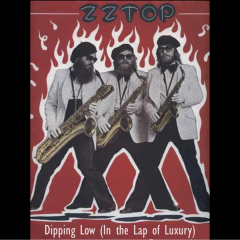
About the song
“Dipping Low (In the Lap of Luxury)" was written by Billy Gibbons, Dusty Hill and Frank Beard. It appears as the fourth song on side two of ZZ Top's ninth studio album, Afterburner. The record was produced by Bill Ham and released in October 1985 as the follow-up to ZZ Top’s highly successful multi-platinum Eliminator LP. Afterburner went to #4 on the Billboard Top 200 Albums chart, and has been certified 5x Platinum by the Record Industry Association of America (RIAA). Personnel on the record were: Billy Gibbons (guitar, lead vocals), Dusty Hill (bass, backing vocals) and Frank Beard (drums).
ZZ Top is an American blues rock trio formed in Houston in 1969. Billy Gibbons had been playing in the popular Houston psychedelic band, Moving Sidewalks. After the Vietnam War-era draft claimed one half of the band in 1969, Gibbons teamed up with Sidewalks drummer Dan Mitchell, recruited bassist Lanier Greig, and started ZZ Top. This lineup produced one indie single called “Salt Lick.” Frank Beard and Dusty Hill, from Dallas-based psychedelic/garage band American Blues, would replace Mitchell and Greig in 1970, at which time the band secured a deal with London Records. This lineup made their debut at a Knights of Columbus hall in Beaumont, TX, in February 1970; there have been no personnel changes since then. ZZ Top has made 15 studio albums, four live albums, seven compilation albums and 44 singles. According to the RIAA, the band has sold more than 25 million records worldwide to date. The group was inducted into the Rock and Roll Hall of Fame in 2004. They still tour and record, and are currently on their 50th Anniversary Tour through the end of this year.