ExxonMobil earlier this month told analysts in New York that the company expects to add a total of 400 Mb/d of capacity to its three giant Gulf Coast refineries by 2025. Exxon plans to upgrade existing refineries in Houston (Baytown) and Baton Rouge, LA, to increase production of higher-value products and to add a new crude distillation unit to its 362-Mb/d Beaumont, TX, plant after 2020. A final investment decision on the Beaumont expansion — which reportedly would double the refinery’s throughput capacity and make it the largest refinery in the U.S. — is expected later this year and follows a $6 billion investment by Exxon to triple crude output from its Permian Basin production assets in West Texas. Today, we discuss the existing Beaumont operation, its feedstock sources, and the refined-product demand that supports the plant’s expansion.
Largest U.S. Refinery
Doubling the Beaumont refinery’s capacity by adding a new crude distillation unit to process an additional 300-400 Mb/d would make Beaumont the largest refinery in the U.S.; it would overtake the nearby Saudi Aramco-owned 635 Mb/d Motiva refinery in Port Arthur, TX (that itself underwent a $10 billion expansion in 2013 to add 325 Mb/d of capacity). The proposed Beaumont expansion would represent significant new investment in the domestic refining sector by a firm that sold its interest in two refineries in Louisiana and California to PBF Energy in 2015 and 2016, respectively. It’s yet another indication of how rapidly expanding shale production is changing the U.S. energy landscape. Less than a year ago, in June 2017, we described how refinery capacity additions in the next five years are mostly expected to be in Asia and the Middle East, where product demand is expanding rapidly (see Can’t You Hear Me Knocking). Now, growing Permian crude production and a thriving export market for refined products from the Gulf Coast have persuaded at least one major oil company to consider changing that mindset.
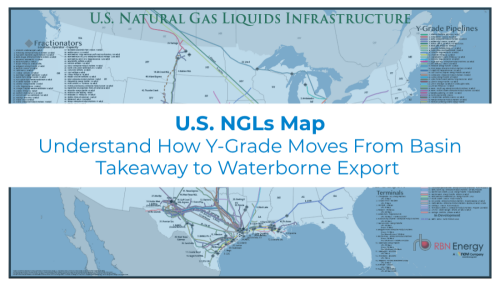
Visualize the infrastructure behind U.S. NGL movement.
The U.S. NGLs Map provides a comprehensive view of the transport, processing, and export networks moving NGLs across the U.S.
The existing Beaumont refinery can process up to 362 Mb/d of crude feedstock. An expansion in 2016 added 20 Mb/d of light crude processing capacity and a similar project is expected to add another 40 Mb/d this year. The refinery is situated next to two chemical plants (one steam cracker and one polyethylene plant) as well as a specialty lubricants facility. Beaumont is one of four refineries in the Beaumont/Port Arthur region near the Texas/Louisiana border that together have over 1.5 MMb/d of capacity. The refinery is part of Exxon’s fleet of five U.S. refineries — the others being the 561-Mb/d Baytown plant in Houston, a 502-Mb/d plant in Baton Rouge, LA; a 239-Mb/d plant in Joliet, IL; and a 62-Mb/d plant in Billings, MT.

About the song
“Bohemian Rhapsody” is the lead single from Queen’s 1975 album, A Night at the Opera. The song was written by Queen’s frontman and lead vocalist, Freddie Mercury. No synthesizers were used on this recording. The song clocks in at just under six minutes, has no chorus, has multiple tempo changes, four key changes, has elements of the opera in it, and has lyrical content that refers to murder and nihilism ... all the elements for failure in the pop singles world! It was one of the earliest songs to have a promotional video with it — considered groundbreaking in 1975. The song shot to #1 on the UK charts after its release and peaked at #9 in the U.S.
After Freddie Mercury's death in November 1991, “Bohemian Rhapsody” re-entered the charts, and it did so again the following year after it was featured in the infamous AMC Pacer scene in the movie "Wayne's World." The song has sold over 6 million copies to date worldwide, was inducted into the Grammy Hall of Fame in 2004, and is listed in the Guinness Book of World Records as the UK's best single of the past 50 years.
When Queen was formed in London in 1970, its members were: Freddie Mercury (lead vocals and piano), Brian May (guitar and backing vocals), Roger Taylor (drums and backing vocals) and John Deacon (bass). The original foursome released 15 albums. After Freddie Mercury passed away in November 1991, May and Taylor toured under the Queen banner, using Paul Rodgers and then Adam Lambert as the group’s lead vocalist. Queen was inducted into the Rock and Roll Hall of Fame in 2001, and into the Songwriters Hall of Fame in 2003.