After a decade in which unprecedented upstream production growth triggered massive investment in infrastructure to get crude oil, natural gas and NGLs to market, 2020 is a major inflection point for the U.S. midstream industry. The good news is that after peaking at a whopping $37 billion in 2019, midstream capital expenditures are forecast to steeply decline over the next few years as the lion’s share of the infrastructure needed to gather, transport, process, and store current and expected hydrocarbon volumes has already been built or is nearing completion. And, despite continued cutbacks in capex by exploration and production companies, output is still forecast to rise in 2020, which should boost earnings growth for the midstream sector. But all midstream companies aren’t alike, and the prospects for individual entities vary widely because of the specific basins and hubs where they’ve decided to build, acquire, expand or divest. Today, we analyze the headwinds and tailwinds these companies will experience, and how their decisions over the past few years will help determine their prospects.
As we said a couple of weeks ago in Farther Up the Road, while all midstreamers are impacted to some degree by what happens to the broader energy industry on a macro-level, the relative success of each company is heavily influenced by the myriad micro-level actions its leaders take. Put another way, the financial outlook for each midstreamer is, in many ways, the sum of the prospects for the specific set of midstream assets it has bought or constructed, and an informative way to assess each company’s financial future is to focus on its asset-level fundamentals.
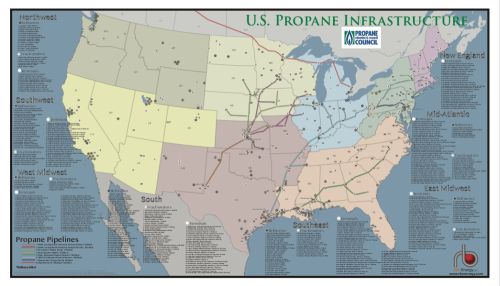
The RBN Energy U.S. Propane Infrastructure map provides a comprehensive view of the propane supply network in the lower 48 states.
Assessing the net impact of headwinds from legacy asset declines and the tailwinds from efficient capital spending on new infrastructure in recent years is critical in identifying which companies will be top performers through the early 2020s — and which will struggle. But an in-depth understanding of the midstream industry going forward requires a comprehensive analysis of the many strategic decisions that each of these companies have made. That’s why we’re partnering with our friends at East Daley Capital on a series of Spotlight Reports, each of which will examine in detail the earning power of the midstreamer’s unique portfolio of pipelines, storage and other assets.

About the song
“Against the Wind” was written by Bob Seger and is the second single from Seger’s 11th studio album of the same name. Seger says the lyrics in the song are “about trying to move ahead and keeping your sanity and integrity at the same time.” The “Janey” that is referred to in the first verse is a nod to Seger’s longtime girlfriend at the time, Jan Dinsdale. The nostalgic feel of the lyrics is similar to Seger’s previous hit, “Night Moves.” The “Against the Wind” single was released in April 1980 and went to #5 on the Billboard Hot 100 chart. Personnel on the record were: Bob Seger (lead vocals, backing vocals, guitar), Drew Abbott (guitar), Chris Campbell (bass), Alto Reed (saxophone) and David Teegarden (drums, percussion). Paul Harris played piano and organ on the song, and The Eagles’ Don Henley and Glenn Frey sang backing harmonies.
The Against the Wind LP was recorded at Muscle Shoals Sound Studios in Sheffield, AL, during 1979. It was produced by Bob Seger, Punch Andrews and Bill Szymczyk, and released in February 1980. The album went to #1 on the Billboard Top 200 Albums chart and has the distinction of being the album that knocked Pink Floyd's The Wall out of its long-running perch at the top position. It was the fourth album to feature The Silver Bullet Band, although the Muscle Shoals Rhythm Section was used on half of the record. Against the Wind earned Seger two Grammy Awards: one for Best Rock Performance by a Duo or Group with Vocal, and the other for Best Recording Package. The LP has been certified 5x Platinum by the Recording Industry Association of America.
Bob Seger is an American singer, songwriter and musician from Detroit. He has released 18 studio albums, two live albums, five compilation albums and 66 singles. He has sold over 75 million records worldwide. Seger has won two Grammy Awards and is a member of the Rock and Roll Hall of Fame and Songwriters Hall of Fame. He completed his farewell tour in 2019.