


It’s been eight weeks since the steady flow of crude oil and refined product tankers out of the Persian Gulf ended, and the impacts of the still-simmering U.S.-Iran conflict on refineries and product suppliers in the U.S., Europe and the Asia-Pacific (APAC) region are becoming clearer. For many refineries on both sides of the Atlantic, their relatively minor reliance on Middle East crude and the higher prices they are now receiving for their gasoline, diesel and (especially) jet fuel put them in a great spot, at least for now. It’s much different for refineries in many Asian countries, however. Heavily dependent on Persian Gulf oil, they are drawing down their reserves, scrambling for replacements, and hoping the Strait of Hormuz is reliably reopened very soon. In today’s RBN blog, we discuss the current state of refining and refined product supply in the U.S., Europe and APAC.
We should emphasize up front that you can’t make broad generalizations about all U.S. refineries or all refineries in Europe or Asia. Sure, they can be put into categories or groups — for example, complex refineries along the U.S. Gulf Coast (USGC) or “teapots” in China — but each refinery is ultimately unique, with its own location, set of refining/processing equipment, crude slate, and approach to feedstock contracting and refined product sales, among other things. That said, many refineries in each of the three areas we’re focusing on (the U.S., Europe and Asia) are facing similar situations a couple of months into the Iran conflict. As for refined product supply, the U.S. is just fine for the foreseeable future, but Europe and Asia already are struggling and things could get far worse in the coming weeks.
We’ll start with the U.S., whose refineries have been relying less and less on Persian Gulf crude oil in recent years. As we discussed a couple of weeks ago in How Am I Supposed to Live Without You, total oil imports from the region averaged only 491 Mb/d in 2025, down from a peak of more than 2.6 MMb/d in 2001 and the lowest level since 1985. PADD 3 (Gulf Coast; middle chart in Figure 1 below), the only U.S. region to export vast amounts of refined products, imported only 176 Mb/d of Persian Gulf crude last year, less than half of what it did in 2020. That mostly heavier, higher-sulfur oil is readily replaceable by a mix of light shale oil, medium crude from the offshore U.S. Gulf, and heavy oil from Canada or Venezuela. Of note, more than two-thirds of the PADD 3 imports in Q4 2025 were Saudi imports going to Aramco’s wholly-owned Motiva refinery in Port Arthur, TX.
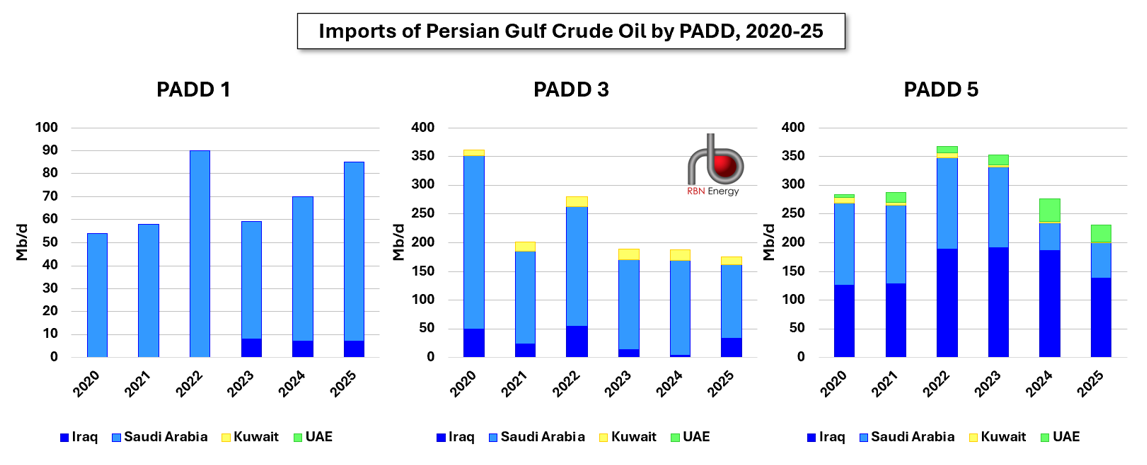
Figure 1. Imports of Persian Gulf Crude Oil by PADD, 2020-25. Source: EIA
Q1 2026 Earnings Calls: BP Says Full Effect of Higher Crude Prices Won't Be Felt Until Q2
BP, which saw its earnings more than double to $3.2 billion in Q1 2026 due in large part to a spike in crude oil prices as a result of the war in Iran, said April 28 that the full effect of those higher prices on earnings and refinery margins won’t be felt until the second quarter.
About the song
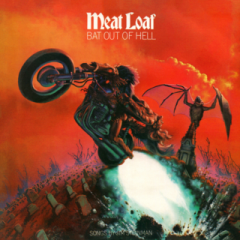
“Two Out of Three Ain’t Bad” was written by Jim Steinman and appears as the first song on side two of Meat Loaf’s debut solo studio album, Bat Out of Hell. It was the last of the tunes Steinman wrote for the album. He needed a simple pop song with a twist, so, inspired by an Elvis song, he came up with the lyrics: “I want you, I need you, but there ain’t no way I’m ever gonna love you. Don’t be sad, two out of three ain’t bad.” The power ballad is about romance, heartbreak, and the inability to have true love. Released as a single in March 1978, it went to #11 on the Billboard Hot 100 Singles chart and has been certified Platinum by the Recording Industry Association of America (RIAA). It remains one of Meat Loaf’s career signature songs. Personnel on the record were: Meat Loaf (vocals), Todd Rundgren (guitar, backing vocals), Kasim Sulton (bass), Roy Bittan (piano), Roger Powell (synthesizer), John Wilcox (drums), Rory Dodd (backing vocals), and Kenneth Ascher (string arrangements).
Bat Out of Hell was recorded during 1975 and 1976 at Bearsville in Woodstock, NY; Utopia Sound in Lake Hill, NY; The Hit Factory in New York City; and House of Music in West Orange, NJ. The album was an adaptation of a Jim Steinman musical, Neverland, a rock version of Peter Pan that Steinman wrote in 1974. Produced by Todd Rundgren, the album was released in October 1977. It went to #1 on the Billboard Top Rock, and #13 on the Billboard 200 Albums charts. It has been certified 14X Platinum by the RIAA. Five singles were released from the LP.
Meat Loaf (Marvin Lee Aday) was an American singer and actor. He played in various rock bands in the Los Angeles area in the late 1960s and early ’70s, and did a stint in the Los Angeles production of the musical Hair before relocating to Detroit, singing with Ted Nugent, and releasing an album on Motown Records in 1971 titled Stoney & Meatloaf. He moved to New York City in 1972 and was involved in various musical theater productions before moving back to Los Angeles in 1973, joining the original cast of The Rocky Horror Picture Show and playing the part of “Eddie” in the motion picture of the musical. He started working with Jim Steinman in 1974, and the rest is history. He released 12 studio albums, six live albums, seven compilation albums, one EP and 39 singles and has sold over 100 million records worldwide. Meat Loaf won a Grammy Award and a Brit Award and appeared in more than 50 motion pictures and television shows. He died in Nashville in January 2022 at 74.
"About the Song" -- written by Mickey McMahan , RBN Director of Musicology






Comments
you have a "stenman" / "steinman" typo i think