


U.S. refineries are, of course, far less dependent on crude oil from the Middle East than they were before the Shale Revolution and the ramp-up in Western Canadian production. But the ongoing war on Iran and the cutoff in oil supplies from the Persian Gulf is forcing several East Coast, Gulf Coast and West Coast refiners to look elsewhere for the mostly medium-sour crude they had been sourcing from Saudi Arabia, Iraq, the United Arab Emirates (UAE) and Kuwait before recent hostilities started and the Strait of Hormuz was shut down to most shipping. In today’s RBN blog, we look at which U.S. refineries had been receiving Persian Gulf oil, the qualities of that crude, and the alternative sources of replacement oil — at least until the Middle East returns to normal.
U.S. imports of crude oil from the Persian Gulf have experienced many ups and downs over the past 60-plus years, rising from about 500 Mb/d in the early 1960s to a then-record 2.4 MMb/d in 1977, then falling to less than 250 Mb/d in the mid-1980s — mostly due to new Alaska North Slope production and a post-embargoes shift to non-OPEC alternatives. Another round of rising imports from the Persian Gulf followed, however, and by 2001 a new record (more than 2.6 MMb/d) had been set, followed by a gradual and then accelerating decline as the Shale Era took hold. By 2025, the U.S. was receiving just under 500 Mb/d, about as much as it did when JFK was taking office and The Beatles were playing their first gigs.
To put that in perspective, U.S. crude oil imports from the Persian Gulf accounted for only 8% of the 6.2 MMb/d of total imports in 2025 and only 3% of the 16.1 MMb/d of U.S. refinery input last year, compared to 17% of the 15.1 MMb/d of refinery input in 2001, when imports from Saudi Arabia and its Gulf neighbors peaked.
As shown in the three charts in Figure 1 below, U.S. imports of crude oil from the four Persian Gulf producers (not including Iran, which last sent small volumes of crude to the U.S. in 2023) declined through most of the early 2020s (stacked layers), from 699 Mb/d in 2020 to 491 Mb/d in 2025. But imports to PADD 5 (West Coast; right chart) have remained steady and last year the region was the #1 importer from the Persian Gulf for the third year in a row, receiving an average of 230 Mb/d. PADD 3 (Gulf Coast; middle chart) started out this decade as the top importer, taking 362 Mb/d in 2020 — and topping PADD 5’s 283 Mb/d that year— but by 2025 the volumes sent to the Gulf Coast had fallen to only 176 Mb/d. Persian Gulf deliveries to refineries in PADD 1 (East Coast; left chart) averaged 85 Mb/d last year, the second-highest level in the 2020s.
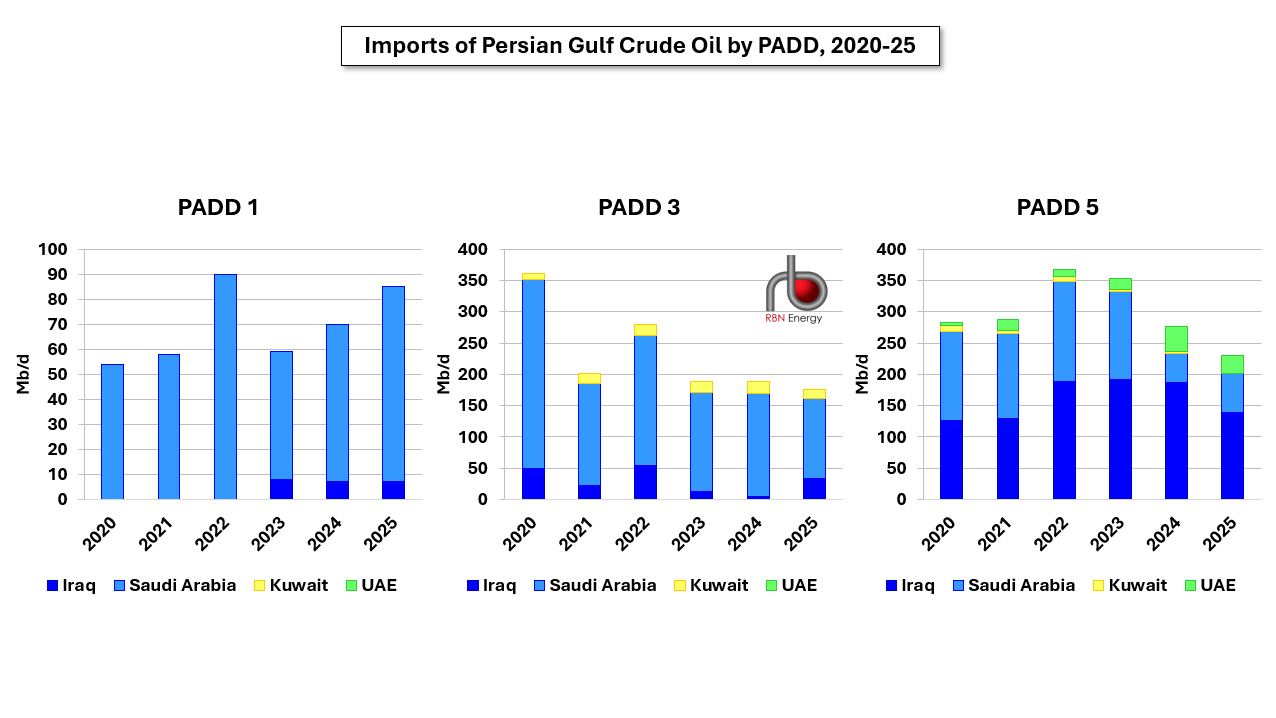
Figure 1. Imports of Persian Gulf Crude Oil by PADD, 2020-25. Source: EIA
EPA Approves Carbon-Capture Project in Indiana
Indiana is a step closer to getting its first active carbon capture and sequestration project after the Environmental Protection Agency (EPA) approved the Class VI injection well for the One Carbon Partnership CCS project near Union City, which is about halfway between Indianapolis and Dayton, OH.
About the song
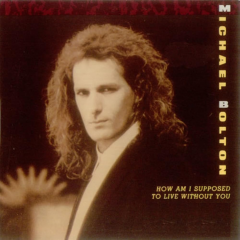
“How Am I Supposed to Live Without You” was written by Doug James and Michael Bolton. It appears as the fourth song on Michael Bolton’s sixth studio album, Soul Provider. The song was originally released as a single by Laura Branigan in July 1983 and went to #12 on the Billboard Hot 100 Singles chart. Bolton released his version of the love song as a single in October 1989, and it went to #1 on the Billboard Hot 100 Singles chart and has been certified 2X Platinum by the Recording Industry Association of America (RIAA). Personnel on the record were: Michael Bolton (vocals), Michael Omartian (keyboards), Michael Landau (guitar), Neil Stubenhaus (bass), and John Keane (drums).
Soul Provider was recorded in 1987-89 at Alpha Studio and Ground Control Studios in Burbank, CA; Lion Share Studios, Lighthouse Studios, Homelands Studio and Studio Masters in Los Angeles; Criterion Studios, The Bunny Hop, and Conway Studios in Hollywood, CA; The Plant in Sausalito, CA; and Hit Factory, Right Track Recording, The Power Station, RPM Studios, Automated Sound Studios, Paradise Studios, and Record Plant in New York City. Produced by Michael Omartian, Peter Bunetta, Rick Chudacott, Michael Bolton, Desmond Child, Barry Mann, Guy Roche, Susan Hamilton and Walter Afanasieff, the album was released in June 1989. It went to # 3 on the Billboard 200 Albums chart and has been certified 6X Platinum by the RIAA. Six singles were released from the LP.
Michael Bolton (Michael Bolotin) is an American singer and songwriter. He released his eponymous debut studio album, recorded at The Church Studio in Tulsa, on RCA Records in 1975. Bolton briefly sang in the hard rock band Blackjack in the late 1970s. He has released 26 studio albums, one live album and 35 singles and has sold over 75 million records worldwide. Bolton has won four ASCAP Awards, six American Music Awards, nine BMI Awards and two Grammy Awards and is a member of the Songwriters Hall of Fame. He has appeared in 12 motion pictures and seven television shows. He has recently stepped away from recording and touring to focus on his health and recovery since undergoing surgery and treatment for brain cancer.
"About the Song" -- written by Mickey McMahan , RBN Director of Musicology






Comments
Great blog. Would production from the Eastern Canadian offshore be a good fit for PADD1?
Yes. In fact, PADD 1 refineries are already the biggest consumers of Eastern Canadian crude.