



Fast-rising hydrocarbon production of “wet” natural gas in the eastern Utica and southwestern Marcellus has been creating tremendous opportunities for the small group of midstream firms that saw what was coming—and pounced. Gas processing capacity in the Utica/Marcellus as a whole now tops 7.6 Bcf/d, more than 12 times higher than five years ago. The processing-capacity expansion is continuing, as is the build-out of NGL extraction plants and pipelines, and a broader, well-thought-out plan to integrate all this new infrastructure to allow the region to operate without the luxury of significant NGL storage capacity is finally coming into focus. Today, we continue our look at infrastructure development in the nation’s fastest-growing gas and NGL play.
Driving through the bucolic hills of the Upper Ohio River Valley a short jaunt southwest of Pittsburgh, you’d never guess you were in the heart of what has become a massive, well-planned and well-oiled machine capable of processing ever-increasing volumes of natural gas and separating out purity natural gas liquids (NGLs). As we said in Episode 1 of this series, just five years ago there was only 600 MMcf/d of gas processing capacity in the entire northeast region. Most of that capacity was scattered widely, with each facility operating pretty much on a stand-alone basis. Since then, however, gas production in the overall Utica/Marcellus region has seen a 10-fold increase (from 2 Bcf/d to nearly 20 Bcf/d). Production of dry Marcellus gas (which needs little or no processing before being piped to consumers) in northeastern Pennsylvania seems to be holding its own, even though local prices (TGP Zone 4 Marcellus) have averaged less than $1.30/MMbtu since the first of the year. But the big growth is coming from the wet Marcellus in southwestern Pennsylvania and northern West Virginia and in the Utica in eastern Ohio (mostly so producers can benefit from the financial uplift of selling NGLs as well as gas).
The wet or NGL-rich gas in these plays has supported a multibillion-dollar build-out of new gas processing facilities to remove ethane, propane and other NGLs from the raw gas so the resulting processed gas meets pipeline specifications, and the NGLs can be sold at what are mostly higher prices than gas on a BTU basis. In Episode 2, we described the Utica/wet Marcellus region in more detail, and in Episode 3 we discussed the eight major pipelines that move natural gas through and out of the region—and unveiled our spanking-new gismo we call Pipeline GIS. This Geographical Information System (GIS) lets you pull together the region’s gas and NGL infrastructure in a single view, and, as this blog series continues, will help explain how individual elements of this infrastructure are designed to (as our series title hints at) “join together with demand.”
MarkWest Overview
Much as Andrew Carnegie is largely responsible for the region’s steel-making boom a century ago, MarkWest—the first gas/NGL infrastructure firm we look at in depth in this series—has been the big dog when it comes to gas processing and NGL extraction facilities in the Utica/wet Marcellus. MarkWest, which was founded in 1988, initially focused on midstream opportunities in Texas and Oklahoma, but in June 2008 the company and Range Resources (a Marcellus production pioneer) reached an agreement to work in tandem to time the expansion of Range’s raw gas production and MarkWest’s nearby processing capacity. Four months later (October 2008) MarkWest started up its first gas processing plant in the wet Marcellus: a pint-sized, 30 MMcf/d unit at what is now its Houston complex in Washington County, PA, southwest of Pittsburgh, to support Range’s growing gas production (and need for gas processing) in the area. In March 2009, MarkWest and Midstream & Resources (later called Energy & Minerals Group, or EMG) closed on a partnership called MarkWest Liberty Midstream & Resources to develop processing and NGL extraction capacity to help meet Range’s needs, and subsequently those of Chesapeake Energy, Statoil Natural Gas, CONSOL Energy and other producers as well. (In December 2011, MarkWest bought out EMG’s then-49% stake in MarkWest Liberty, but MarkWest and EMG established another joint venture called MarkWest Utica EMG to develop Utica-related midstream projects.)
This episode zeroes in on MarkWest’s (and MarkWest Utica EMG’s) seven key gas processing plants in the Utica/wet Marcellus (see blue dots in Figure #1). The “yellow blob” in the map shows the primary Marcellus/Utica producing region in SW PA, WV and OH as described in Episode 3. We’ll get to the firm’s various NGL fractionators, de-ethanization units, and NGL pipelines (transporting ethane, propane, C3+ and y-grade) in upcoming blogs. In those same future postings, we’ll also describe how all these separate and distinct pieces of infrastructure are designed to operate as an integrated whole, standing at the ready to minimize the operational risks associated with extracting and consuming NGLs in a region that has next-to-no NGL storage capacity. (In sharp contrast, Mont Belvieu, TX, the center of NGL fractionation, has more than 200 MMBbl of NGL storage capacity--most of it underground—which provides a hugely important logistical buffer in that region.)
Note that Figure#1 also includes the Columbia Gas (TCO) natural gas pipeline, which provides take away capacity for many of MarkWest’s gas processing plants. RBN Pipeline GIS shows not only the geography of TCO but also all the other natural gas pipelines that were detailed in Episode 3 of this blog series.
This Map is Alive! (or at least live)
The Map below utilizes RBN’s new Pipeline GIS, a Geographical Information System (GIS) capability provided for RBN members and Backstage Pass subscribers. For more information, click on the map below.
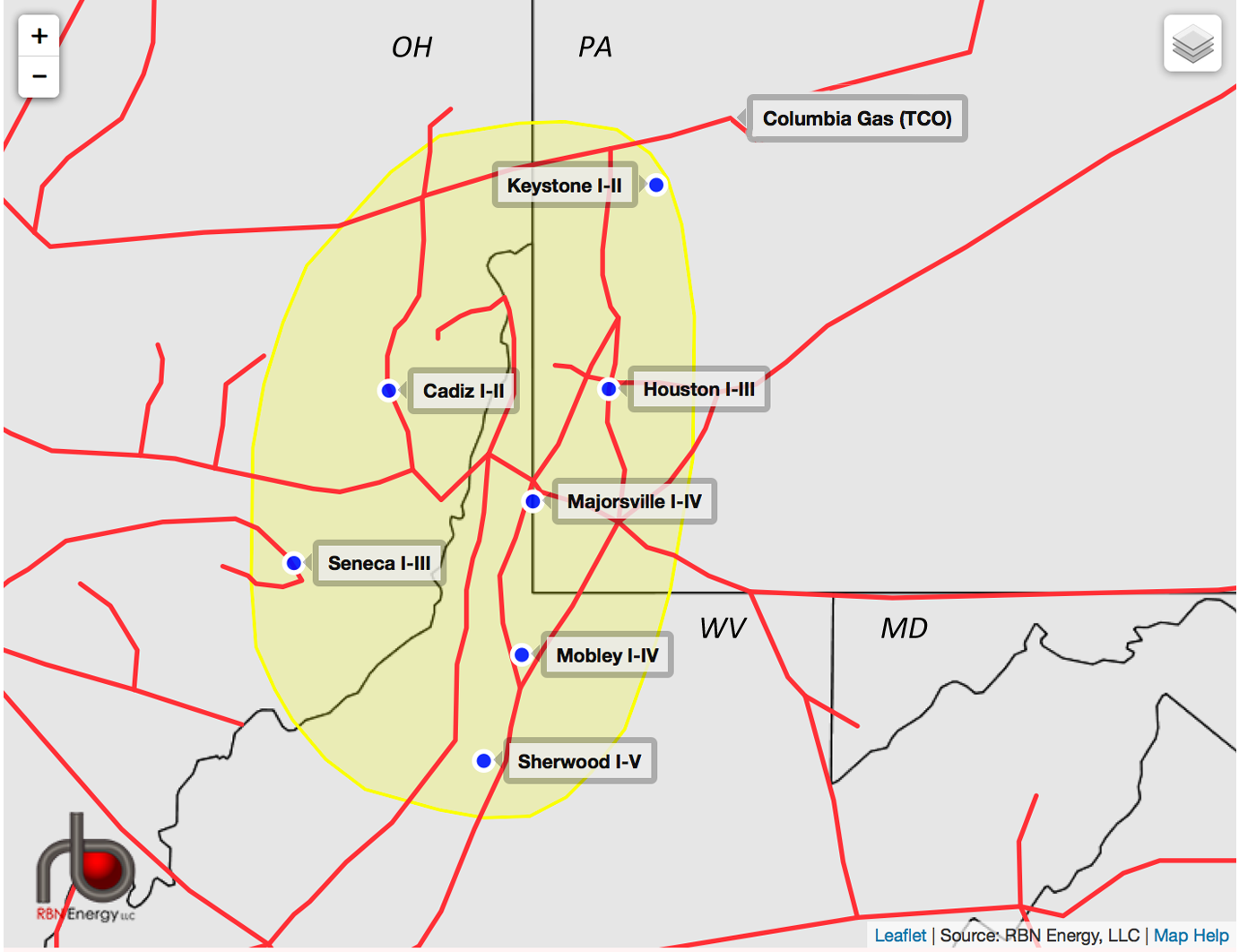
Figure #1 – MarkWest Appalachia Processing Plants (click to open in Pipeline GIS)
MarkWest and its sister entity own two plants in PA, three plants in WV and two plants in OH that together have a combined capacity of nearly 4.1 Bcf/d. MarkWest expects an additional 1.4 Bcf/d of capacity to come online later this year (1 Bcf/d of that by July 1). In addition, several expansions of existing plants and a couple of new-builds (not shown in Figure #1) are expected to begin operation in 2016 or soon thereafter. In the following paragraphs we provide basic information on MarkWest’s key gas processing facilities.
Houston/Washington County, PA
As we noted, the Houston complex got its start in October 2008 as a 30 MMcf/d processing plant; its processing capacity has since grown to 355 MMcf/d, and another 200 MMcf/d of capacity is scheduled to come online in the second quarter of 2015. Residue/ gas exiting the complex is fed into either Columbia Gas Transmission (also known as TCO; red lines in Figure #1) or National Fuel Gas (NFG) Supply pipeline. Houston also has C3+ and de-ethanization capacity, as we’ll get to next time. As it has been from the start, Range Resources is the key producer customer at Houston.
Majorsville/Marshall County, WV
The initial 120 MMcf/d of processing capacity at Majorsville came online in September 2010, as did a 35-mile NGL pipeline from Majorsville to Houston (MarkWest’s Houston complex in Washington County, PA that is; Houston, TX, for the spatially challenged, is somewhat farther away). The complex was expanded over the following five years and its processing capacity now totals 870 MMcf/d; another 200 MMcf/d will be added in the second quarter of 2015, and still another 200 MMcf/d is planned for the first quarter of 2016. (Majorsville also has a de-ethanization unit.)
Majorsville’s primary producer customers are Southwestern Energy, CONSOL Energy, Noble Energy, Range Resources and Statoil Natural Gas. Residue gas from Majorsville is delivered into the TCO or Texas Eastern (TETCO) pipelines. Click the box next to TETCO in Pipeline GIS to see how it ties into Majorsville.
Mobley/Wetzel County, WV
MarkWest’s first 200 MMcfd/d gas processing plant at what would become the Mobley complex came online in December 2012; the initial plant served several area gas producers, including EQT Corp. and Magnum Hunter Resources. Processing capacity at Mobley now totals 720 MMcf/d, and (this is a recurring theme, you might have noticed) another 200 MMcf/d of capacity is being built as you read this (it is planned to come online in the fourth quarter of 2015). Other key producer customers at Mobley include CONSOL, Noble and Stone Energy. Mobley’s residue gas enters either the Dominion Transmission, EQT Midstream or TCO systems, all of which are available in the Pipeline GIS map.
Sherwood/Doddridge County, WV
Like Mobley, the Sherwood complex started out as a lone 200 MMcf/d gas processing plant that came online in late 2012 (October, in Sherwood’s case); the initial capacity served Antero Resources production in northern West Virginia. Sherwood’s processing capacity has since been expanded to a staggering 1 Bcf/d through the addition of four more 200 MMcf/d plants, and the roster of producers using the facility has expanded to include CONSOL and Noble. Not content with only 1 Bcf/d, Sherwood plans to add another 200 MMcf/d plant in the second quarter of 2015 and yet another in the second quarter of 2016. Like Mobley, residue (processed) gas from Sherwood flows into either the Dominion Transmission, EQT Midstream or TCO pipelines.
Keystone/Butler County, PA
MarkWest took a different tack at the Keystone processing complex—instead of building it from scratch, in acquired the facility (then with two processing plants totaling 90 MMcf/d) in May 2012 as part of a larger deal to acquire Keystone Midstream Resources from Stonehenge Energy Resources and Rex Energy. (Rex remains the complex’s key producer customer.) The Keystone complex was later expanded to 210 MMcf/d and—everyone sing along—another 200 MMcf/d will come online in the fourth quarter of 2015; it will support Rex Energy production. (Still another 200 MMcf/d will be added in the third quarter of 2016.) Residue gas from Keystone is fed into the Dominion Transmission system or into a local distribution company called Peoples TWP (the acronym comes from the LDC’s old name, T.W. Phillips Gas & Oil).
Cadiz/Harrison County, OH
Cadiz is owned by the MarkWest Utica EMG joint venture. The first gas processing capacity at Cadiz was a 125 MMcf/d plant that started operating in May 2013, in support of Gulfport Energy production in the area. The complex’s capacity was later expanded to 325 MMcf/d and now supports production by American Energy Utica (AEU, a division of American Energy Partners) as well. Two more 200 MMcf/d plants are planned at Cadiz: one to come online in the second quarter of 2015 and the other to follow in the first quarter of 2016. Residue gas flows into either TCO, Dominion East Ohio, or Texas Eastern.
Seneca/Noble County, OH
MarkWest Utica EMG’s Seneca complex started in November 2013, when the first 200 MMcf/d of gas processing capacity was developed to support Antero Resources’ production in that part of the Utica. Another 400 MMcf/d of processing capacity has come online there since, supporting not only Antero but AEU (American Energy Utica), Gulfport Energy, PDC Energy and Rex Energy And yes, as at all other MarkWest processing complexes in the Utica/wet Marcellus, another 200 MMcf/d of capacity is under construction at Seneca; it will begin operation in the second quarter of 2015. Seneca’s residue gas flows into the Texas Eastern system and TCO.
MarkWest Capacity Utilization
MarkWest helpfully provides information about how extensively its processing plants are used—also known as the utilization factor. See Figure #2, which shows that its five processing complexes in southwestern Pennsylvania and northern West Virginia had a combined utilization factor of 88% in the fourth quarter of 2014, and its two complexes in eastern Ohio weren’t far behind, at 76%.

About the song
“Join Together” was written by Pete Townshend. The song was originally intended to be a part of The Who’s Lifehouse project, an unfinished science fiction rock opera that Pete Townshend was writing as a follow-up to Tommy. Recorded at Olympic Studios in London in May 1972, “Join Together” was released as a single in June 1972. Produced by The Who with Glyn Johns, it went to #17 on the Billboard Hot 100 Singles chart. The song has been included in several Who compilation albums, beginning with the Hooligans double hits album released in September 1981. Personnel on the record were: Roger Daltry (lead vocals, harmonica), Pete Townshend (guitar, synthesizer, Jew's harp, backing vocals), John Entwistle (bass, backing vocals), and Keith Moon (drums).
Hooligans is a double compilation record of hits from The Who running from 1964 to 1978. Released in September 1981, the LP went to #52 on the Billboard 200 Albums chart and has been certified Gold by the Recording Industry Association of America.
The Who are an English rock band formed in London in 1964. Its core lineup was Roger Daltry on lead vocals, Pete Townshend on guitar, John Entwistle on bass, and Keith Moon on drums. They are considered by many to be one of the most influential rock bands of the 20th century. They have released 12 studio albums, 16 live albums, four soundtrack albums, 27 compilation albums, four EPs and 58 singles and have sold over 100 million records worldwide. The Who are members of the Rock and Roll Hall of Fame and UK Music Hall of Fame, and are the recipients of a Lifetime Achievement Award from the Grammy Foundation. Roger Daltry and Pete Townshend received Kennedy Center Honors as members of The Who in 2008. Daltry and Townshend have both released solo albums over the years, and both continue to record and tour as The Who. The Who are currently on the road with The Who Hits Back! tour in the UK.







Comments
I'm very impressed with the interactive map, and plan to use it in an upcoming presentation. (I assume that is OK as I am a Backstage Subscriber) At the risk of sounding greedy, are you planning the add the other processors such as Blue Racer and Utica East Ohio to the map? And if so, when? Judging from the progress you've made to date, that "should" be relatively easy. To really challenge you, I also suggest you add the four proposed ethane crackers to the map and possibly the purity NGL pipelines. Oh yeah, and maybe you can include the location of all McDonald's restaurants too??? (just kidding)
Well Done!
Sincerely,
Jeff Miller
419-466-9036